L.I.D.S – The Four Leadership Roles of the Strategic Program Manager

There are four leadership roles that I have found to be useful energizing a strategic initiative. I organized them into the LIDS acronym to help you remember them: story, learning, integration, and decisions. Each of these roles provides a unique and valuable perspective that facilitates turning vision into results.

Strategic initiatives are a unique subset of all programs characterized by high ambiguity and the intention to transform the organization’s business model.  The program manager of a strategic initiative does more than simply manage a portfolio of projects; he/she must tap into an unconventional set of leadership ideas.  The four LIDS roles provide helpful insights.

Chief Storyteller

Stories are a universally understood and appealing method for organizing thinking and persuading others. You can weave a lot of information into the telling AND you also arouse your listener’s emotions and energy. Peter Guber (former CEO of Mandalay Entertainment Group) explains,

“Storytelling can be used to get people’s help in carrying out your goals and ultimately to inspire business success. For the leader, storytelling is action oriented, a force for turning dreams into goals and then into results.”

Chief Learning Officer

This role is concerned with identifying unknowns and taking action to fill knowledge gaps, and transferring learning across the team (One definition of teams is that they are groups of people who learn together). The job of the leader is to create a constructive environment for learning. The mantra is this: the faster that the team can identify unknowns, the faster the program will progress.

As I have discussed in other posts, strategic thinking is largely about the mastery of ambiguity.  People avoid ambiguity, and substitute assumptions for asking questions. I have been successful with getting teams unstuck with this question,

What don’t we know, and how can we find it out?

Chief Integration Officer

Leaders fit the strategic initiative and its outcomes within the larger organizational, political, and social context. The leader needs have the capability to see the components as well as the unified whole. In this role, you are continually looking for connections and relationships between elements. You need to relentlessly focus on the fit and function of all elements of the program. Here is a tip,

Pay attention to interfaces because most failure occurs at the interface.  Interfaces are not readily apparent and out of most people’s comfort zone.

Chief Decision Architect

This role is concerned with the quality of decision making in the execution of the strategic initiative. The leader’s guiding principle as Chief Decision Architect is this simple guiding principle: Fast and effective decisions lead to fast and quality results.

How can we speed up decisions? One suggestion is to place “decisions to be made” at the top of your meeting agenda.

Application of the Four LIDS Roles to Interpreting Strategy Documents

I have written a series of articles on how to interpret strategy documents.  You could also use each of the four LIDS perspectives to enhance the understanding. For example,

  • You could see the new strategy and vision as part of a longer narrative arc for the organization.  Some values and capabilities with remain, but others will propel the story forward.
  • The document contains much information that needs to be learned.  However, it is not complete and there are many more unknowns that you need to systematically discover.
  • Strategies are composed of different levels of functional, business, and enterprise strategies. There are often several portfolios.  All will benefit from an integrated view.
  • Strategy formulation represents decisions and commitments, but there are considerably more decisions that have to be made in execution.

Here is another application of the L.I.D.S. leadership roles. Suppose a program manager is floundering. How could each role provide useful perspectives?

Please bookmark with social media, your votes are noticed and appreciated:

Posted in Competencies of Strategic Initiative Leaders, Interpreting Strategy Documents, Useful Practices & Management Tools | Tagged , , , , , , , , , | 13 Comments

Two Tools for Describing Strategic Context (Strategic Thinking Part 3)

Illustration of wavefronts in the context of S...

Image via Wikipedia

| Read Part 1 | Read Part 2 | Read Part 3 | Read Part 4 | Read Part 5 |

Each organization has a unique external context. Given that context, it develops strategy to provide an appropriate direction.

Even if strategic initiative leader is not involved in strategy formulation, he/she needs to understand the strategic context.  This article explains two tools that can help you gain strategic perspective. You will also pick up a tip for creating your program documentation and will deepen your capacity for strategic thinking.

The PESTLE Tool for Classifying Six Types of Strategic Context

Strategic program managers invest time looking outward to understand the external drivers (and constrainers) that affect their organization’s business model.  The acronym PESTLE gives you a tool for classifying six different kinds of strategic context:

  • Political Environment – Strategic initiatives are often international in scope, and they can be affected by local politics. For example, recent turmoil in the Ivory Coast problems made travel to the country impossible for the program manager. CSX Railroad’s Director of Strategic Initiatives has an important responsibility to interacting with local politicians as the company makes capital improvement investments in new rail terminals. Of course, controls over resources are internal political factors that the initiative leader must consider.
  • Economic Environment– Here we would look at macroeconomic factors such as GDP, inflation, and industry growth rates. As I pointed out in my previous post on Growth as a Strategic Initiative, current economic conditions are making it more likely that companies will launch strategic initiatives focused on growth.
  • Social Environment– There are differences in generations (millenials vs baby boomers, for example) that have far-ranging affects upon the organization and its strategy.  This contextual factor might affect HR strategic initiatives or marketing strategic initiatives.
  • Technical Environment– The technical environment gives us constraints, as well as new tools and capabilities. For example, many companies have launched initiatives involving social networking and mobile computing.
  • Legal Environment – The legal environment is closely associated with the political environment when we are considering the impact of new regulations or mergers and acquisitions. It also overlaps with the legal environment when we consider litigation.
  • Earth – Climate, earthquakes, are just a few of the concerns that can affect an organization’s strategy, hence its strategic initiatives. PepsiCo is an example of a company with a declared strategic initiative around environmental sustainability (I’ll be describing more about it in the future).

Many program management document templates have a section titled “strategic environment summary” that introduces the context for the program.  Environment means “external to the organization.”  Use the PESTLE as your guideline for writing the text.

The “Walk the Fence Line” Technique

Another useful technique to get a strategic perspective is called “walk the fence line.”  With it we are going to explore boundaries (the fence line) literally as well as figuratively.

A useful practice is to “walk around the fringes of the business;” to “look in and look out.”

As warm up activity, I have people around the fence line of their homes. They should pause periodically to look outward: what do you see on your neighbor’s house or property?  Then, they pivot and look at their own property: how does your neighbor see you? (In my own first-time use of this technique I found that I had let weeds grow behind my backyard storage shed. They were out of my line of sight, but I’m sure that my neighbors noticed. This exercise reinforced the point I might smugly believe that I am a good property owner and not realize that my neighbors might see me as a slob.) Human limitations cause us to mentally frame things in ways that are self limiting.

Next, with that critical, objective spirit in mind, examine your own organization’s “fence line.”  For example, you could look at your web site with fresh eyes. One team found that the company plastered on its home page a “commitment to extraordinary products and services.”  However, there seemed to be some hypocrisy as the web site was confusing and boring. It describes the products features neither the applications nor the customer benefits. If web site is boring, the statement of extraordinary experience seems hypocritical.

By walking the fringes of the organization, you gain new perspectives on stakeholders like customers, suppliers, regulators, and new hires. Some of those perspectives give you some excellent insights.

Context and Strategic Thinking

Strategic thinking is about coping with ambiguity. A strategic thinker has the ability to adopt different perspective and use empathy.  From this they can develop insights about the organization’s business model. The job of the leader is sense-making: to pick the signals from the noise and arrange them with some logic that appeals to stakeholders.

Do you agree that a tolerance of ambiguity and curiosity about context are hallmarks of the strategic thinker?

Posted in Interpreting Strategy Documents, Strategic Planning Issues for Strategic Initiatives, Strategy Coaching and Facilitation, Strategy, Ambiguity, and Strong-Minded Thinking | Tagged , , , , , , , , , , , , , , , , , | 12 Comments

Growth as a Strategic Initiative

This year, the biggest topic of discussion in the boardroom is growth, according to a recent survey. Forty-one percent of Board members cited growth compared to only 16% in previous years. Businesses are sitting on cash and are looking to expand.

The implications for leaders of strategic initiatives are clear: there will be more strategic initiatives focusing on revenue, market share, and profitability.  We will see considerably more product and market development initiatives. CEOs view strategic initiatives as those endeavors that:

  • Change market or competitive position, and
  • Cut across functional or organizational boundaries

Too, we will see more strategy innovation that changes the business model. Consider this statement from Fortune Magazine (June 13, 2011)

“In the good old days, a strong business model lasted for decades. No more. CEOs in almost every industry will have to innovate at their business’s deepest level, as Sam Palmisano has done in moving IBM adeptly into software.”

In addition to strategy innovation, strategic initiative leaders need to recognize the presence of these other two kinds of innovation.

  • Product innovation – development of new offerings to new or existing customers
  • Process innovation – improvement or change to business processes that provide a core competency that can be exploited through lowered prices or capacity to bring new offerings to the market

Innovation occurs in levels. Incremental innovation involves feature enhancements. Platform innovation involves creation of new families of products and services.  Radical innovations are “game changers” that can disrupt the competitive picture.  Strategic initiative leaders will have have to recognize that often project management process and methodologies are suited (only)  for incremental innovation and might erase value.  This quote from Ronald Mascatelli expresses the tension,

“The challenge for managers is to inspire, guide, excite, encourage, and shape, without imposing arbitrary structure that might destroy the fragile essence that separates breakthrough innovation from uninspired incrementalism.”

The emerging discipline of open innovation popularized by firms such as Procter and Gamble will also contribute to growth-oriented strategic initiatives. Open innovation involves actively partnering with other organizations to quickly find new combinations of ideas that are commercializable.

Too, I should mention that people use the terms organic and inorganic growth. Organic growth refers to internal innovation efforts of using own resources. The GE Growth Playbook, is a set of questions designed to encourage organic growth. Inorganic growth refers to use mergers/acquisitions/alliances and occasionally open innovation is put into this category.

If you are leading a growth-style strategic initiative, you can review my earlier postings for program structuring suggestions:

 What other concepts of growth strategic initiatives can you add?

Posted in Examples of Strategic Initiatives, Interpreting Strategy Documents, Strategic Planning Issues for Strategic Initiatives, Transforming the Organization | Tagged , , , , , , , , , , , , , , , , , , , , , , , | 7 Comments

Vice President, Director, Manager of Strategic Initiatives: Position Description Best Practices

help wanted

This article provides a snapshot of the current state of the art in staffing for strategic initiatives. It will be useful reference information for anyone seeking to create a new job, refine an existing position, or make a greater strategic impact. It will also be useful the candidates for those positions to understand if the position fits their skills and ambitions.

The reader should note my standard definition for strategic initiatives, as a foundation for executive leadership:

A strategic initiative is a boundary-spanning endeavor that intends to achieve three interrelated goals: 1) achieve a strategic intent or vision, 2) provide benefits to significant stakeholders, and 3) transform the organization.

Strategic initiatives not business-as-usual operations;they are major strategic programs that create outcomes, and these outcomes close the performance gaps between the “as is” and the “to be.”

Example Position Descriptions: Vice President, Director, Manager of Strategic Initiatives

The following five examples capture the right flavor of what should be expected for an organization that correctly uses strategic initiative programs.

Starwood Hotels and Resorts – The position will work with cross-functional teams to analyze and present key financial and strategic issues to senior leadership. The ideal candidate will be a natural leader with excellent verbal/communications skills and a thoughtful, persuasive personal style. Self-starters who are comfortable in a project-oriented environment tend to be successful in this role.

Notable: The Strategic Initiatives Group is responsible for driving complex project-based initiatives across Starwood.  Reporting to the CFO, the group is responsible for providing a corporate-level view on a select number of high-priority financial and strategic issues facing the company globally.

The Hartford – The position plays a significant role in shaping the strategic agenda for Middle Market Business segment. He/she will help facilitate strategic management process and will also provide consulting expertise and program management for specific strategic initiatives that are deemed critical to the business success. The role is also responsible for formulating senior management presentations, and interacting with his/her peers across the enterprise to ensure enterprise alignment and synergy.

Notable: There are several positions being filled, signaling the emergence of strategic initiatives group within The Hartford.

Conifer Health Solutions – This position will build strategies, facilitate planning sessions and drive change activities required to maintain company operations and competitiveness and meet the needs of stakeholders.

Notable: Conifer desires candidates with the ability to influence key stakeholders and operational owners through well articulated strategies backed up with metric driven value statements.

Mattel – This role serves as the analytic and strategic core of Mattel’s growth initiatives, company-wide. This position will focus on charting a path to help guide the company’s growth, including organic and inorganic opportunities. It manages strategies and projects for the office of the COO and has a charter to leverage resources across all Mattel divisions, campuses, and geographies. This is a high-profile position with significant exposure to senior leadership both domestically and internationally.

Notable: Mattel specifies that the candidate must be able to

      • Use analytical skills and judgment to solve problems with limited information at hand
      • Communicate complicated matters in a simple, structured way to senior management
      • Get work done through cooperation with other groups with no direct reporting relationship to position

Green Dot – This person will be responsible for working with others to develop processes that ensures appropriate prioritization and approvals for strategic initiatives. This will include providing leadership of cross-functional teams and project managers to ensure projects are being managed with the IDEAL framework, timelines and budgets. Direct management responsibility and leadership for strategic initiative project managers.

Notable: Green Dot asks for formal six sigma experience (black belt, master black belt), certified project manager or extensive formal project manager experience

Poor Examples of Strategic Initiatives Roles

I am not going to specifically call out poor position descriptions, but I’ll note that there are quite a few organizations recruiting for strategic initiatives positions but show little appreciation for the accepted definition of strategic initiatives.  Here are some of the common mistakes:

  • Using the word strategic in a sloppy way, when the job description is clearly an operational role. Many of these are “silo’d” within one unit of the organization and do little boundary spanning beyond coordination.
  • Recruiting for a senior position that is primarily analysis of data or writing position papers.
  • Not recognizing the difference between program management competencies and project management competencies. Many of the positions are glorified project managers.

Trends in Position Descriptions

Here are some trends in strategic initiatives position descriptions (I considered all current offerings, not just the five previously-listed positions):

  • Increased Emphasis on Growth Orientation.  As companies emerge from the global recession, they are focused on growth by organic and inorganic means.  We are likely to see a new wave of mergers and acquisitions treated as strategic initiatives.  Candidates will need strong analytical skills, good business acumen, and  the ability to span boundaries.
  • Increased emphasis on analytics. One important success factor is building a fact-based case for change.  Strategic initiative leaders need to be comfortable with ambiguity and working with large amounts of data and information.
  • Increased use of Internal Strategic Initiatives Groups – I previously described Google’s and Microsoft’s efforts with internal Strategic Initiatives Groups and will be reporting on other companies in the future.
  • Increased Professionalism of Program Management – There is a strong role for program management in the accomplishment of strategic initiatives, and I’m increasingly seeing strategic initiative leadership accomplished by people with titles such as Enterprise Strategic Program Manager. Companies are asking for evidence of the ability to manage projects with cross-divisional teams to pursue growth opportunities or cost savings opportunities.  Increasingly the strategic initiative manager must work with operating team members to develop and refine project management framework, and coach teams. See my popular article “A Concise Guide to the Differences between Projects and Programs” for more insight.
  • No Objective Standards for Titles – There seems to be no consistency in the position titles of VP, Director, Program Manager, or Project Manager.  In some industries, it seems that nearly any who faces a customer is a vice president.

Why are there so few mentions of Balanced Score Cards and Strategy Maps?

The current listing for positions has curiously few mentions of the relationships of strategic initiatives, balanced score card, and strategy maps. The organization’s balanced score card and strategy maps show the gap between vision and current performance, and strategic initiatives close the gap. Given the many benefits of these strategic management tools, it was surprising to see only two mentions: one at the American Institute of Certified Pubic Accountants and the other at American Express.

Is this interesting? What are you seeing?

Posted in Competencies of Strategic Initiative Leaders, Examples of Strategic Initiatives, Program & Portfolio Management, Success Principles for Strategic Initiatives | Tagged , , , , , , , , , , , , , , , , , , , , , , , , , , , | 8 Comments

Strategic Thinking (Part 2): Framing Decisions with the Four Types of Ambiguity

3D: Rodin's Thinker

Image by Major Clanger via Flickr

| Read Part 1 | Read Part 2 | Read Part 3 | Read Part 4 | Read Part 5 |

As strategic initiative leaders, our job is to drive the strategic initiative forward. We do that by facilitating or making decisions. Ambiguity affects decisions because we might select the wrong decision frame and respond improperly to the data at hand. Ambiguity characterizes strategy and involves interpreting words and situations that have multiple meanings (see my previous posting). Good strategic thinkers are strong minded; they cope effectively with ambiguous information. They know that ambiguity is the rule, and not the exception.

Contrary to orthodox advice, we may not need more data; we may need more perspective to select the right decision frame.

The following four types of ambiguity are typically present in strategic initiatives:

Type

Description

Ambiguity about Outcomes When different stakeholders define or desire different results from strategic initiative, you have ambiguity about outcomes. Outcomes are expressed as a trendline of business performance.
Ambiguity about Methods There are countless methods, practices, and techniques that might be employed within the strategic initiative. None of us can know about all possible tools. Most people have a favorite tool that they champion by calling it a best practice, regardless of the tools suitability for the situation.
Ambiguity about Metrics  There are countless things that we can measure, and stakeholders have different opinions about the appropriateness of performance measures. It is somewhat related to the ambiguity over outcomes category. Some organizations use workload or process indicators rather than results or outcome indicators.
Ambiguity about Priorities This kind of ambiguity has to do with differences of opinions on the importance of goals and activities.

Use these four types to gain perspective, in particular recognizing that each individual stakeholders may have a different point of view. Engage your stakeholders and clarify expectations.

A Self Test: Which Kind of Ambiguity Is This?

Here are 4 examples of strategic initiatives that you can use to evaluate your understanding. Which of the four types of ambiguity is present? (Answers are found in the comments at the bottom of the post, just above “related articles”).

Example  #1 – A consumer products company launched an initiative to improve the new product development process. The VP of Sales wanted the initiative to improve the entire enterprises sales revenue through a larger product line: have a product available for each and every customer. The operations department wanted less complexity and more “lean,” which could be best achieved through standardization and volumes.  The CFO had yet a different set of needs.  Collectively, there were numerous different goals reflecting each stakeholder’s organizational silo.

Example  #2 – An IT strategic initiative floundered because one group was more comfortable with the traditional business requirements document; whereas another group argued “agile project management” would be the tool of choice.

Example #3 – A company established a bonus system for its employees based on the company’s global profitability. Unfortunately, people didn’t align their efforts because market forces were the major driver of profitability. Further, only a handful of people were in a position to make investment decisions.  Even worse, there were isolated cases of employees enriching themselves (and defrauding the company) by cutting their side deals due top poor financial controls.

Example #4 – Faced with an economic downturn, managers in a company argued for a cut back on its R&D investments, prioritizing cost savings over growth and innovation.  Others argued that the priority should be to “stay the course” for the inevitable improvement in the economy.

It’s a mindset

These four types of ambiguity are not an intellectual curiosity; they go to the heart of decision making. Consider:

  • Strategic thinkers assume that ambiguity is present and use questions to clarify the ambiguity. Good strategic thinkers have mindfulness. They ask,

Am I asking the right questions?

  • Strategic thinkers first clarify the decision frame, then they move into the activity of information gathering. Ambiguity characterizes strategy. It is the job of the strategic initiative leader to drive the initiative forward by making good decisions to manage the obstacles and opportunities.

How have you found the crux of the matter and managed ambiguity?

Posted in Competencies of Strategic Initiative Leaders, Strategy, Ambiguity, and Strong-Minded Thinking | Tagged , , , , , , , , , , , , , , , , | 10 Comments

Strategic Thinking (Part 1): A Fight with Ambiguity

| Read Part 1 | Read Part 2 | Read Part 3 | Read Part 4 | Read Part 5|

Strategic thinkers in organizations face many vague, conflicting signals. They have to manage the ambiguity both in strategy formulation and  strategy execution.

A simple definition of ambiguity is that it signifies words, concepts, and situations that have multiple meanings. The Latin prefix ambimeans both. For example, an ambidextrous (“both right”) person writes well with both hands, and an ambivalent attitude (“values both”) is one that is indifferent towards the merits of a choice. For example,

When a person “fights with” ambiguity, does that means that they are on the same side, the opposing side, or that ambiguity is a tool for fighting?  All of these meanings are possible.

Learning to Cope with Ambiguity

In entry- to middle-level positions, people succeed by matching knowledge and skills to situations. As people develop in their executive careers, they must develop a more strong minded and intuitive approach to strategic thinking. Specifically, they

“must expect to encounter ambiguity as they transition to more complex situations in their organizations. Strategic leaders must do a great deal of consensus building… to uncover information not previously held, perspectives not previously understood, and knowledge not previously applied to the solution-generating task. The challenge to strategic leadership is recognizing that the decision maker cannot have a “stand-alone” perspective.

            —Strategic Leadership and Decision Making
US Air Force’s National Defense University

To paraphrase, the strategic thinker understands that the strategic environment is interpreted by people and their subjective biases. The initiative leader’s job is to reduce ambiguity by uncovering information, perspectives, and knowledge. For example, strategists spend much time and effort using tools of context analysis to interpret the threats and opportunities. Mastering ambiguity requires strong mindedness. Gradually, the team achieves a more complete and coherent understanding

Academics tell us that organizations do poorly at implementing strategy.  Few of these scholars recognize the role of individual perspective: each individual has their own worldview that influences how they make sense of ambiguity. Thus,

Strategy– the process of getting important things done – is largely a language game. In this game, leaders use conversation to 1) foster understanding different individual perceptions of a problem or opportunity and 2) gain commitment toward finding a solution.

Ambiguous Goals

Sometimes leaders are sloppy with their language, but sometimes their ambiguity is intentional. What would you think if the CEO of your organization announced,

Our vision is to be Number 1.”

You could interpret this statement in several ways:

  • Being #1 could mean “to possess the largest market share.”  If that is the case, you need to define both core markets and adjacent markets.  If you sell into numerous markets, this becomes a very fuzzy mandate.
  • Being #1 could be a ranking on a list. The phone maker Nokia is ranked as the #1 most-trusted brand in many countries, but that trust has not created business advantage (in February 2011, its business difficulties drove it into the arms of Microsoft).
  • Being #1 could mean short-term profitability in an industry group. This could be achieved by massive cost-cutting of R&D, but might destroy the capability to innovate with new products.  That might not be good for long-term performance.
  • Being #1 could be an attempt to inspire people. Perhaps the CEO did not intend to make this a strategic initiative; perhaps the CEO only wanted to encourage people to make their best efforts.

Let’s assume this goal to “be #1” really is a strategic initiative and you are assigned to lead the program. Your top priorities should be to recognize ambiguity, clarify the metrics, and develop sensible action plans.

Balancing the Polarities

Many people like things “black and white, with no shades of gray.”  These are the people who will often struggle the most when in an ambiguous situation.  So, your job is balancing two polarities:  The first is an attitude that is tolerant and patient. Leaders realize that they can’t let a rush to closure force them into a bad decision.

“The creative person is willing to live with ambiguity. He doesn’t need problems solved immediately and can afford to wait for the right ideas.
– Abe Tannenbaum

The second polarity is the active resolution of tensions. It is important for the leader to step up with some structure and direction.  The leader starts the process of asking strong minded questions and encourages others to probe into the unknown and the assumptions.

The goal: a flexible plan that sets a direction but is open to new learnings.

How is this balance practiced? It might take some confident statements such as,

  • “The company has selected you to join this team because you are smart and have performed well in the past. If we trust each other, we will get this figured out.”
  • “Although we just started our planning, I’m positive that when we’re done we will have a detailed roadmap for implementing this initiative.  We have a lot of questions, and we will learn the answers to those questions.”
  •  “A lot of smart people have worked hard on strategy formulation.   Let’s resolve ourselves to doing a good job, and that includes managing the threats and the opportunities.”

Someone once quipped, “Give me ambiguity or give me something else.” How do you fight with ambiguity?

This post originally appeared in the Linked2Leadership blogazine.

Please bookmark this article with your social media. It is noticed and appreciated!

Posted in Competencies of Strategic Initiative Leaders, Interpreting Strategy Documents, Strategy, Ambiguity, and Strong-Minded Thinking | Tagged , , , , , , , , , , , , , , , , | 26 Comments

Five Things SI Leaders Need to Know about Innovation

Henry Ford on the cover of Time Magazine, Janu...

H. Ford: Innovation involves combining existing ideas

Leaders commonly speak the word innovation. It conveys a sense of excitement and newness that motivates people.

But let’s be honest. Many times leaders use the word as filler in a speech or press release: a buzzword that occasionally engenders cynicism. Innovation is important, and it deserves a spot in the strategic initiative leader’s toolbox.  Here are five things that leaders need to know about innovation:

ONE: Innovation is not the same thing as invention or as creativity

Innovation is best defined as “an idea, practice or object that is perceived as new by an individual or organization.”  So an innovation does not need to be new to the world, just new to a person. There are all kinds of great ideas and technologies already in existence. Innovators are people who search for outside of the familiar new ideas, and then bring the ideas into the existing culture. Thus, an important principle of innovation is:

The future is already here, it is just distributed unevenly.

For example, Henry Ford did not invent the automobile nor did he invent mass production. Ford revolutionized the auto industry by combining existing technologies from meatpacking experts (the assembly line approach), electric motors, continuous flow, and machine tools. Every technology Ford needed was there, it was his ability to find and combine the elements that made him a world-changing innovator. Ford’s genius was that he had a vision and the courage to look outside of his own industry for the best people and best ideas.

TWO: Innovations Do Not Sell Themselves

Scurvy was a killer of many ancient sailors on long voyages. In 1601, a doctor in the British Navy found that citrus juice would prevent the disease. However, it wasn’t until nearly 200 years later – with many unnecessary deaths – that the British Navy to made its use a policy. Whether it is a new technological gadget, or a quality improvement program, there is no assurance that people will adopt an innovation.

Leaders have an important role in developing the awareness of the innovation, positive attitude toward the innovation, and commitment to adopt the innovation.

This leads to an important implication for leadership…..

THREE:  Innovation Involves Choices and Decisions

People evaluate an innovation with five filters, which I call the TACOS criteria:

T -Trialability:  Can I try it out before committing? If I don’t like it, can I abandon the innovation?

A – Advantage:  Is this innovation better for me? Does it have greater relative advantage over what I am doing now or the alternatives?

C– Compatibility:  Is this compatible with my values?

O – Observability: Can I physically see and experience it?

S – Simplicity: Is it simple enough that I can understand its features, function, and benefits?

FOUR:  It is a Gross Exaggeration to Declare that People “Resist Change”

I have heard it said and written hundreds of times that people resist change, but that far overstates the reality.  It is more accurate to say that

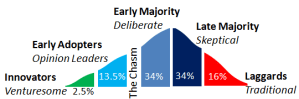
People adopt innovations at different rates, with laggards the last to adopt the innovation.


The nearby graphic shows the distribution of a population of people into five categories of people, based on when they adopt.

  • Innovators are the smallest group. They are venturesome individuals who bring new ideas into the system. Henry Ford would be considered an innovator because he was successful at combining existing technologies found in other industries.
  • Early adopters are opinion leaders that have an important function of decreasing uncertainty for others by sharing their positive experiences with the innovation.
  • Early majority comprises people who consider the value of the innovation carefully – they deliberate – before committing.  They rely on information provided by the early adopters.
  • Late majority are people who are skeptical and need to have most of the uncertainty removed before they adopt the innovation.
  • Laggards may never adopt the innovation because,

 The innovation is inconsistent with their closely-held values.

FIVE: Leaders Help People Cross the Chasm

Notice “the chasm” on the graphic, where the innovation has penetrated 16% of population of potential users.  That’s less than 1 in 5! The chasm turns out to be particularly difficult to cross, and this is a place where championing behaviors are needed:

  • Influencing tactics such as presentations, use of status and celebrities, bargaining, and appeals to higher authority.
  • Relationship building tactics such as befriending others and building professional networks
  • Business case development, to show the economic benefits of making the change
  • Visioning to help people understand the anticipated future.

When the innovation “crosses the chasm” it gains the critical mass where the majorities adopt it.
Do you agree with these principles of innovation? How have you used them on your strategic initiatives?

This posting originally appeared in the Linked2Leadership blogazine.

Posted in Competencies of Strategic Initiative Leaders, Success Principles for Strategic Initiatives, Transforming the Organization | Tagged , , , , , , , , , , , | 8 Comments

“Make it Happen” — More Tips for Developing Buy In for your Strategic Initiative

“I know that I should be a person that makes it happen for this strategic initiative,” confided Steve, “but, when I consider the risks and obstacles, the best I can do it help the strategic initiative along.” Steve was a member of the core team that had been charged with building a project management capability for a large Northeastern US bank. It was a boundary-spanning endeavor, with sponsorship by the Bank’s Chief Operating Officer.

Actually, I was glad to hear Steve’s honest appraisal of his level of commitment. I knew that we could count on his energy and support, but he might loose heart. We would have to manage the ambiguities and risks present in this strategic initiative.

A Useful Tool for Assessing Commitment

For years, I have sketched this simple five-level framework of commitment with definitions:

  • Profound Commitment is characterized by the phrase “Make it happen.” People that possess profound commitment will find ways to overcoming barriers and obstacles. They have passion.
  • Enrollment is characterized by the phrase “Help it happen.” This is engaged support where people have enthusiasm and volunteer their talents to achieving the vision.
  • Compliance is characterized by the phrase “Let it happen.” Here, people do what is in their job description, or what they are told to do by an authority figure. They follow the rules – often cheerfully – but seldom show initiative.
  • Grudging Compliance is the same as compliance with some sort of vocalization of anger or resentment. I tell people, “Think of a surly, rebellious teenager.”
  • Silence & Sabotage characterizes people who are passive or insurgents. They have and alterative vision, and can’t be counted on to do the hard work needed to accomplish the strategic intent.

I tell people to use this five-level framework to first diagnose their own level of commitment: that’s what prompted Steve’s realization. Then, consider other people who are instrumental to the initiative’s success.

What do they say? What do they do? Which level best describes them?

An Example of True Commitment

To be honest, “make it happen” true commitment is rather rare because it means that the person will not let obstacles deny them of their vision. Many people know of George Bernard Shaw‘s quote,

“The reasonable man adapts himself to the world; the unreasonable man persists in trying to adapt the world to himself.
Therefore all progress depends upon the unreasonable man.”

One of the best stories of true commitment concerns the invention and innovation of 3M’s Post It brand notes. 3M research scientist Dr. Spence Silver first developed the technology in 1968, while looking for ways to improve the acrylate adhesives that 3M uses in many of its tapes. In a classic case of innovative serendipity, Silver found something quite remarkably different from what he was originally looking for. Silver knew that he had invented a highly unusual new adhesive. Now the challenge was: What to do with it? For the next five years, Silver gave seminars and buttonholed individual 3Mers, extolling the potential of this new adhesive and showing samples of it in spray-can form and as a bulletin board. Despite its interesting properties, there were no commercial applications.

Dr. Silver was told to stop working on the adhesive, but he didn’t.
That’s true commitment!

Eventually, the team found that people would pay for an office product that combined the adhesive with note paper. The result is, as they say, history. In 1981, one year after its introduction, Post-it® Notes were named the company’s Outstanding New Product. Fry was named a 3M corporate scientist in 1986.

The Heroic Journey

In any story, the hero functions to serve and sacrifice. 3Ms Spence Silver was willing to risk it all, and it worked out well. It’s a great story!

By contrast, Steve (in the opening vignette) was willing to serve (enroll in the strategic intiative) but he was not sure about his willingness to sacrifice. People can sense when their leader is afraid to make reasonable sacrifices, and that is one reason that many strategic initiatives fail. I will be taking up the role of mentors and sponsors in future postings, as an important contributor to getting people to step up and lead.

More Leadership Tips for Buy In

One of the six traits of strategic initiatives leaders is that they have a strong results orientation. Here are some insights and tips:

  • Recognize the importance of emotive benefits as described in my previous posting.
  • Recognize that different people are motivated by different things. Some people are motivated by money. Some people are motivated by adventure. Some people are motivated by security.
  • Ask people to make promises. For example, “If you give me “help it happen” energies, I will see that you can learn new skills.” Think in terms of offers, counter-offers, and refusals. Actually this is something of a negotiation
  • Foster alignment AND commitment. Program management tools provide the benefits of aligning efforts with strategic intent, and get people to invest in the face of uncertainty.

Leaders are skilled motivators. How do you “make it happen?”

Please share this post with your network. It is noticed and appreciated!

Posted in Competencies of Strategic Initiative Leaders, Useful Practices & Management Tools | Tagged , , , , , , , , , , , , , , , , | 2 Comments

How to Secure Buy In for Your Strategic Initiative

The phrase “buy in” means people accept and support a specific concept or course of action. Because strategic initiatives involve uncertain outcomes, asking for buy in is asking people to make a decision under conditions of risk.

Let’s start with this question:

What is being bought and what is being offered?

Viewed as a transaction, “buy in” implies the exchange of promises. Here is what is being bought and offered:

Buy in involves the exchange of commitment for benefits.

Commitment is the willingness to invest resources – and stay invested – in the face of uncertain outcomes. Commitment is the second-ranked success factor for strategic initiatives (“correct strategy” is #1 in importance). A short list of what is committed in a strategic initiative would include:

  • Money
  • Hope and trust that the strategy is viable.
  • People’s time and talent.
  • Championing behaviors.

“In Exchange for your Commitment, I Offer…….Benefits!”

A successful sales person knows that customers buy benefits, not features.  Features cause benefits to happen. A classic example is drills and holes. A salesperson of power drills understands that the drill is a feature which solves a customer’s problem, they need the hole (the benefit).The sales pitch is something like this, “I offer you the benefit of holes, if you will commit to buying this feature from me.” The salesperson counters any objectives, and asks for agreement.

Strategic initiatives also involve features and benefits. Features are often called solutions and benefits are often called outcomes.  Examine the following three “pitches,” each of why offers benefits in exchange for commitment:

  •  “This initiative will add significant revenue growth to the company and increase market share.  This outcome is achievable for an investment of $20 million from your StratEx budget.”
  • “This strategic partnership will open up new distribution channels for our services and products, and will improve our competitive position.  We need your executive sponsorship.”
  • “Your department will be recognized for participating in this initiative.  We need you to convey its importance to your staff.”

Professional sales people tailor their pitch to each audience, and practice it so that it is natural.  A leader should do the same.

Strategic Stakeholders Have Complex Needs for Benefits

Strategic initiatives involve considerable complexity. People often can not agree on the nature of the problem or opportunity, thus they struggle with solution design. Often the initiative flounders as people begin to feel overwhelmed by the issues and the strategy.

In my previous post, I described how to energize strategic initiatives with a focus on outcomes. Here is an important insight:

Benefits are delivered incrementally, and
build the framework for realizing outcomes.

As you gain this more sophisticated understanding, it is helpful to recognize that there are two types of benefits:

  • Economic benefits
    are those benefits that are typically measured in units of money or production with standard accounting practices. Examples include revenue trends, attendance, profits, and utilization.
  • Emotive benefits
    are those benefits that create an emotional response in a stakeholder.  Examples include trust, confidence, and affiliation.  These benefits are seldom captured in traditional accounting measures. Some people call emotive benefits “soft benefits,” but I do not like the phrase because the word “soft” is often interpreted as “of lesser importance” – which, certainly is NOT the case.

People Mentally Evaluate Benefits Before They “Buy In”

Of course, our job as a leader of a strategic initiative is to gain the support of people who have different values and objectives. Our pitch will work with some, but not with others. One reason is that people rely to differing degrees on the different hemispheres (left and right brain) when making decisions. The left brain lights up when we consider economic benefits and the right brain is activated with emotive benefits. Since people use both brain hemispheres to make decisions, you should identify and communicate both economic and emotive benefits.

The Secret Sauce for Creating Buy In

I discovered that emotive benefits are an essential ingredient of the secret sauce. People learn with their heart as well as with their head, and many leaders lead from the heart.

Interestingly, there is a sequence for advocating for benefits: emotive first, building up to economic benefits.  Try this recipe:

  • First, identify how the initiative aligns with a stakeholder’s personal values. For example, if the person is interested in the topic of innovation, talk about the innovative elements of your initiative. Strategic initiatives center around business growth or cost efficiency, and you can look at the job or interests of the stakeholder through those two lenses.  Your communications strategy should be to reinforce the contributions of the strategic initiative to the stakeholder’s personal values, interests, and job duties.
  • Second, identify organizations that the executive would respect, and connect these with what is presently going on in the organization. Executives do pay attention to their peers. A great example of this was how Jack Welch and top managers at GE championed Six Sigma as reason for their operational success. Other CEOs found themselves saying, “If Jack Welch thinks Six Sigma is important, we should pay attention to Six Sigma, too.”
  • Third, you identify business outcomes, and now you can begin emphasizing conventional economic benefits.

 “Buy-in” Does Not Happen Instantaneously: It Builds Incrementally

As reported in How Google Will Save the News, the investigator reported a difference in people’s support for the strategic initiative over a year, moving from “dutiful” answer about the importance of the strategic initiative, to his impression that “people sounded as if they meant it.”

Because of perceived risk and ambiguity, people adopt new ideas in subjective – often slow – ways. A program leader’s job is to create incremental benefits. As stakeholders realize these incremental benefits, they edge closer to the conviction: “I’ll do everything I can to make it happen.” That’s true commitment!

In all cases, people want personal benefits AND they want to do what is good for the company.  The hardest part of securing buy in? Asking people to sacrifice for the good of the larger organization.

How have you created stakeholder commitment?

Posted in Program & Portfolio Management, Success Principles for Strategic Initiatives, Useful Practices & Management Tools | Tagged , , , , , , , , , , , , , , , , | Comments Off on How to Secure Buy In for Your Strategic Initiative

How to Energize Strategic Initiatives with Outcomes

It’s critical to understand – and forecast – the direction of performance

Organizations use strategic initiatives to deliver benefits to strategic stakeholders, who want measurable performance outcomes. A clear understanding of what causes performance outcomes is a force for energizing the program’s design. This article defines performance outcomes as forecasted trends of a critical results area.

Performance outcomes crystallize the vision
and help to identify the high-priority projects.

You can energize your strategic initiative by understanding performance outcomes. I will explain the key points in the following paragraphs.

Examples of Performance Outcomes

Here are two examples of performance outcomes:

  • Executives at Domino’s regarded its Pizza Turnaround as a success – in part – because it increased the performance outcome of same store sales . Its program vision – to launch a new pizza that could win (prevail over its direct competitors) a national taste test – was a driver for this key business metric.
  • The travel and hospitality industry uses revenue per available room (revpar) as its key indicator. This is computed as the occupancy × average room rate. A strategic initiative – such as a promotional program – should pay off in an improvement in the trend.

The Program Leader’s Job is to Drive the Strategic Initiative

Many strategic initiatives flounder in transitioning from strategy formulation to strategy implementation. The culprit? Ambiguity.

The program manager needs to step up and drive the initiative. An important early task for the leader of a strategic initiative is to

Identify the performance outcome
that is most valued by your “investors.”

I put the word investors in quotes to encourage you to think about your stakeholders in a broad way. People invest more than money; they invest with their time, attention, and emotions.

Performance Outcomes are Trend Lines

Outcomes measure business performance. As an example of a strategic initiative, consider a retailer with a goal of increasing revenues generated by coupons, presently $5 million of sales per year. Let’s assume this strategic initiative has the vision to double coupon sales, in each of the next two years: to $10 million during Year 1 and $20 million during Year 2. It will use Twitter couponing as the technology.

Our model building starts with these two assumptions: 1) the baseline performance is $5 million (which would render as a flat line, given the previous assumptions), 2) the goal of the strategic initiative is to create business growth of $10 million in each of the next two years.

Determine the Shape of the Outcome Curve

Modeling a performance outcome is a blend of art and science. You make some educated guesses and draw a trend line, such as the example displayed on the nearby graphic.

Here are a few tips:

  • I find it best to show the date of the launch of strategic initiative (the diamond on the graphic) and the “the point of inflection,” (the triangle on the graphic) where the benefits being yielded by the strategic initiative will begin to show their effect. Complex systems have more points of delay, thus you should anticipate a delay of time between the start of the strategic initiative and the point where the effects are noticed. As an example, the illustration shows that there is approximately six months of continued performance at baseline levels.
  • Then turn your attention to the question, of “What is a realistic slope and shape for this trend?” You will have to use your best judgment to figure out if it will slope upward quickly or slowly, or will it oscillate? Too, most businesses have seasonality where buying behaviors will peak. Will you model that seasonality or statistically smooth it?

Develop a preliminary forecast of outcomes

Build a Cause-Effect Model

Cause-effect models – and the related tool of causal loop diagrams – enable the team to challenge the organization with this question, “What does this organization need to do to create the outcome?”

Returning to the example of creating revenues through online couponing, the team would assess the factors have the most influence in achieving the result. For simplicity, let’s say that the experts on the team tell us that the two most important factors are the face value of coupon and the timing of the coupon. I would charter projects to optimize these two factors.

Conceptual models help people can better manage concepts that are visible and explicit rather than abstract or invisible and assumed. If you are personally skilled in the technique, that is great. If you lack that skill, find and bring experts onto the team.

Strategy Validation

Often strategy documents are filled with numerous activities; it is hard to discern the priorities. You can use cause and effect models to support strategy validation. The focus question is straightforward:

Given this set of activities,
what is the most likely
outcome
?

How to Energize the Strategic Initiative

Model building helps the strategic initiative team gain a better understanding of:

  • The actual workings of a strategy, particularly how its outcomes are produced by cause and effect relationships.
  • The interrelationships between the parts of the strategy.

What do you do with this understanding? I would use this enhanced understanding in concert with the Five Ways to Socialize a Vision and the Four Driving Questions. People need to understand something before they offer their commitment. Too, I would note this essential benefit in the context of the role of the Program Manager as the Chief Decision Architect:

Understanding the relationship between activity and outcomes
leads to better decisions
about how to achieve the desired outcomes.

Getting clarity over outcomes is one of the most important activities in developing a strategic initiative. What are your experiences with developing cause and effect understandings of outcomes?

Posted in Interpreting Strategy Documents, Strategy Coaching and Facilitation, Success Principles for Strategic Initiatives, Useful Practices & Management Tools | Tagged , , , , , , , , , , , , , , , , , , , | 12 Comments