Strategic Initiative Case Study: Delivering Large Cost Savings in Healthcare IT Infrastructure

Elevator ?

Many organizations have a performance gap in their cost structure. They launch strategic initiatives and business transformation initiatives to close that gap (drive down cost).

There are many good learnings from a major IT transformation initiative at a $42 billion (operating revenues) integrated healthcare system located in California. It was a significant endeavor, affected 1,000 locations across 8 regions and involved resources from 10 departments. The program was composed of numerous projects, overseen by 27 project managers. The result was saving millions of dollars and providing new service capabilities. Further, the program completed early and exceeded the cost saving target by 155%!

Phil Patrick championed this effort. You can read his first-hand account in Page 24-25 the August 2011 issue of PMNetwork. Phil described 5 key actions:

Phil Patrick
  1. Align with the executive visions.
  2. Assemble a skilled exploratory team.
  3. Present a compelling action plan.
  4. Obtain organizational buy in.
  5. Build high-performance project teams.

Phil agreed to an interview with me. Here are some more leadership learnings for strategic initiatives.

An Example of the Power of an Elevator Speech

Phil’s PMNetwork article starts with the line, “It all began with a chance elevator speech.” Elevator speeches are superb tools for the strategic initiative leader. The simple idea: have a concise, confident message for top managers that grabs their attention and curiosity.

Rather than this being a chance meeting, I think this was where “opportunity meets the prepared mind.” Phil had been thinking about the opportunity to save millions of dollars with his idea, and the executives had been supplying a vision for cost savings.

Using Stories to Reinforce the Strategy

The chief story teller leadership role resonated with Phil,

“It’s important to pay careful attention to the vision and key strategies presented at C-level meetings. I repeated my story of my elevator-speech encounter with the senior VP to motivate the project team with a reminder of the higher good we were achieving by completing our day-to-day tasks and activities.”

You Can’t Assume Your Boss is Strategically Aligned

Most people tend to assume that their boss knows the organizational priorities and will share them. Ideally, there is a cascade of consistent messages and metrics. However, that assumption does not always hold true. This is one such example. Phil told me,

“The team developed a document that quantified valuable cost savings, which I was in the habit of attaching to a brief summary of the meeting discussion that I distributed to my boss, my boss’ boss, and other senior managers in the organization. I never received an email, any inquiry or even a passing comment from my boss prior to his phone call informing me that his boss was interested in meeting with me to learn more.”

The boss is not always plugged into strategic priorities. I think Phil’s courage and strategic thinking are exceptional! Leaders must not assume that their direct boss understands or supports the strategies coming out of the executive suite.

In the past, Phil said he had not paid close attention to visions and strategies coming from the top executives; his operational focus was a comfort zone. One of his important personal learnings was this:

“Everyone should pay attention to key strategies/vision.”

Persistence and Determination

Phil had to develop the business case for this initiative on his own time! As I described in my article on Six Leadership Traits, strategic initiatives are

driven by inspired and determined individuals who will not take no for an answer and who often have to swim against a current of corporate indifference, if not outright resistance.

I asked Phil, “What is it about you that made you so determined?” He said,

“I had a meeting with my new manager. He told me some things that suggested the department would be taking a different direction, and my role was uncertain. The uncertainty of my future created an urgency to find ways to contribute and add value to the organization. As the reality settled in, one of the engineers on my weekly status call shared with me the heightened executive level interests in network cost savings.”

Early Benefits Delivery

Phil kept a strong focus on benefits. He explains, “In the first year, our customers began expressing approval as they began to see cost benefits.” The team was able to deliver more than simply economic benefits, for example, they provided bandwidth-on-demand technology that gave benefits to medical teams. This technology allowed a neuropathologist to remotely view brain tissue in high-resolution and provide expert advice to a surgeon in the operating room.

What other strategic initiative leadership lessons are present? How do you stay alert to strategic opportunities?

Posted in Competencies of Strategic Initiative Leaders, Examples of Strategic Initiatives, Transforming the Organization | Tagged , , , , , , , , , , , , , | 4 Comments

Strategy as the Backstory: Another Leadership Tip

Marlon Brando as Jor-El, with Kal-El played by...

Superman's backstory helps us understand the narrative arc. Strategic initiatives are one episode, and the strategy is the backstory.

Fiction writers and journalists use backstory to explain the circumstances that occurred in time before the main story. Backstory provides information that is relevant to understanding the main story.

The strategic initiative is but one episode in a long narrative arc for an organization. In the role of chief storyteller, the leader skillfully uses the backstory to help the audience make sense of the initiative; sensemaking being key to stakeholder alignment and commitment.

What is Strategic Initiative Backstory?

The strategic backstory includes the specific events and decisions are essential to understanding a given strategic initiative.  This can include inputs such as organizational mission, vision, values; SWOT; customer analytics, technology roadmaps, budgets, and balanced score card metrics.

The strategy-as-backstory also includes the organization’s history and culture. It also includes key individuals, as you can often discern strategy simply by observing which executives presently have more power and influence.

Do Not Let the Backstory Overwhelm

The narrative arc of Superman orginates with Jor-El sending the infant boy away from the planet Krypton. Occasionally the writers reference this backstory, but they don’t belabor it.  The writers know the audience is more interested in the current action (episode at hand).

In contemporary novels and movies, there is very little backstory presentation. Why? Modern audiences are impatient.

People want action and progress in executing strategy. Effective storytellers selectively  weave in backstory details in a way that is useful and relevant for telling of the main story (the strategic initiative). It might be as simple as introducing pertinent facts with a short phrase such as, “our customer analytics reveal,” or “as you recall, ___” or “did you know, ____” or “it’s important to note ___.”

The key point for the strategic initiative leader is this:

Know your backstory, but share it selectively. People care more about where the initiative is going, rather than how the strategy was developed.

EXCEPTION: When the Strategic Initiative Involves the Heritage Story, Emphasize Backstory Values

Many strategic initiatives involve changes that remind the organization of its founding values. This is called a Heritage Story. A heritage story calls upon a recognition of early successes and personal values. In evoking a heritage story, the leader emphasizes the return to – or continuity of – values.

Here are two examples:

  • Starbuck’s CEO Howard Shultz, in announcing a 2008 strategic initiative, explained, “By embracing our heritage, returning to our core – all things coffee – and our relentless commitment to innovation, we will reignite the emotional connection we have with our customers and transform the Starbucks Experience.”  Schultz is suggesting that Starbuck’s strayed from its values, and is making a return to them.
  • Domino’s Pizza Turnaround showed its original delivery vehicle (a Volkswagen Beetle sitting in the lobby of its corporate office), 41 seconds into its Pizza Turnaround video.  CEO Doyle emphasizes that Domino’s has always stood for quality pizza, and that pizza turnaround is a logical extension of that value.

Given change in the external environment, all organizations have to establish strategies to address new competitive realities.  The principle, when applying a heritage story to a strategic initiative, is this:

If anything, we are reaffirming our identity, our purpose, and our beliefs. Our turning point is one of strategy, not of values.

Strategic initiatives are elements of a larger narrative about the organization’s journey and mission: a smaller story inside of a bigger story; a bridge from the past to the future.

The chief story-teller role is one of the four leadership roles for strategic initiatives.  How have you used strategy as backstory?

Posted in How to Improve Your Story Telling Chops | Tagged , , , , , , , , | 2 Comments

What’s Scary, Weird, Stupid, or Hard? A Tip for Improving your Story Telling

dilbert

This is scary, weird, and a little stupid!

One (of four) important leadership roles is the Chief Story Teller role. In applying this role, the leader conceptualizes the strategic initiative as a story with a beginning, conclusion, and turning points that resolve the tensions.

This article is about humor in storytelling. This article kicks off a series, “How to Improve Your Story Telling Chops.”

The Benefit: Removing Barriers to Commitment

Humor is a tool for gaining the audience’s attention, revealing truths, removes tensions, and sparks creativity. The deft application of humor in your stories will help you remove the barriers to strategic initiative success.

Four Places to Find Humor

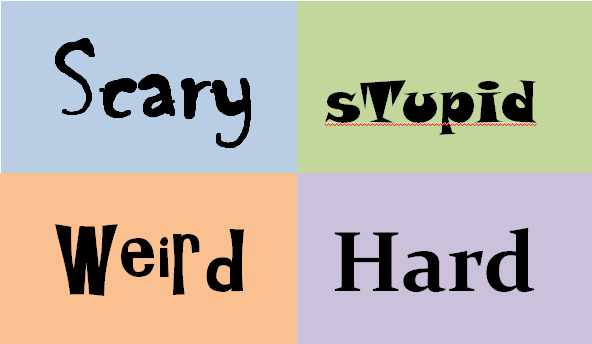
Judy Carter* suggests that you can find humor in one or more of these elements of your situation: What is scary, weird, stupid, or hard?

Let’s examine the relevance of the four factors in Domino’s Pizza Turnaround: a successful strategic initiative. Briefly, Domino’s listened to the complaints of their customers and reformulated its core pizza product, exposing the complaints and the changes in a very entertaining video.

  • It is scary to publicly repeat people’s complaints: “Your pizza crust tastes like cardboard.” It is embarrassing. Patrick Doyle (Domino’s CEO) told me that he was worried that consumers would remember the complaints, rather than Domino’s assertion that its pizza is improved. Doyle and his team had to trust in the data. They had to believe that things would get better and have the courage to peruse the vision.
  • It is weird (strikingly out of the ordinary) for a company to publish videos of people ranting about poor quality of its product.
  • It is stupid to maintain the status quo in the face of evidence that the status quo is no longer sustainable. Dominos took a smart and courageous route to make the changes.
  • It is hard to change the status quo. There were people who were not convinced that there was a problem that needed attention. The strategic initiative team needed to bring things to their attention, and they did that by showing the videos of the focus group.

Another Example

I was participating in a visioning exercise. Each member had prepared a set of items of what would be different about the organization three years. When it got to my turn, I presented a disaster scenario as well as a delight scenario. It created a lot of nervous laughter, and this laughter released a nervous tension that allowed people to be more honest with each other. I this case,

I was introducing the idea of failure, which was both weird & scary!

Being Weird is a Nuanced Thing

True weirdness is more than being “out of the ordinary.” True weirdness is often involves ghosts, spirits, and the like. Once I saw a project team at closeout stage. Everyone was dressed in black and they were holding a funeral for their project. That’s weird. But it’s funny and it’s remarkable and it offers lessons learned.

For another example, it is frequently said that markets are moved by animal spirits. Many strategic initiatives depend up on market responses that can’t be predicted.

If being weird makes you too uncomfortable, substitute the word unorthodox or the word unconventional.

Stupidity is Not the Same Thing as Ignorance

Stupidity is defined as taking a course of action (or inaction) with the knowledge that the action will cause you pain. The comic strip, Dilbert, does a nice job of pointing out stupidity in the workplace.

Stupidity is closely intertwined with the quality of decision making, and you should see some relationship to the leadership role of Chief Decision Architect. You might find stupidity revealed in the answer to a question like this:

What decision could we make that would assure our failure?

Ignorance is the lack of information, and the question to gain information is the domain of the Chief Learning Officer role that asks, “What do we need to learn?” Domino’s answer was asking the questions: what is the right combination of ingredients? What data is needed? How do we get people’s attention?

Humor Sparks Creative Thinking

Playfulness, curiosity, and zeal are hallmarks of the innovative team.

Playfully push the buttons of scary, weird, stupid, and hard. Get really weird, really scary, and really stupid. Push the extreme, and then you can pull back.

The element of hard stands apart from scary, weird, and stupid. Leaders overcome hardships by developing and applying courage and determination.

Humor Suggests the Turning Points in the Story

Stories get their energy from tension and release, and the release is a turning point when there is a resolution. When you sense that you are near a turning point – or you want to push for resolution of an issue – you should dig into your toolbox and see how humor can help you.

Humor, like strategy, is context specific. If you can find something humorous in the context, you are thinking strategically.

* You can read an excerpt from Judy Carter’s book, The Comedy Bible: From Stand Up to Sitcom: The Comedy Writer’s Ultimate How-to Guide at this link.

Posted in How to Improve Your Story Telling Chops | Tagged , , , , , , , , , , , | 5 Comments

Contrast the Pain and the Gain: How to Use Benefits to Sell and Motivate

| Read Part 1 | Read Part 2 | Read Part 3 | Read Part 4 |

Motivation involves gain and pain

Psychologists have shown that people go to great lengths to avoid loss, even passing up the opportunity for rewards. This article will explain how improve benefits propositions by recognizing the motivational power of avoiding loss.

Improving Your Benefits Propositions by Contrasting Gain and Pain

This suggestion will increase the receptivity of the stakeholder to your benefits proposition:

Contrast the Gain and the Pain

The Pain is something that is associated with loss. Ask yourself, “What does the stakeholder fear losing?” The answers might be pain is loss of face, image, status, organizational status, or reputation. When writing a benefit proposition, you use a verb like avoid, mitigate, or minimize (see prior posting).

Examples

For a business development executive…

This strategic initiative will allow you to build business relationships in this strategically important market, AND will dissuade competitors from making reckless claims about your company.

For a Chief Information Officer….

This portfolio management initiative will allow you to assure you are prioritizing projects correctly, AND help you mitigate criticism from requestors who have unrealistic expectations for delivery time.

For a critical supplier executive…

Our strategic sourcing initiative will allow you to better forecast demand for your product, AND help you manage your supply chain’s component pricing.

Notice that I capitalized the word ‘and’ in each of the propositions to heighten the contrast between pain and gain. This helps people to recognize the unacceptability of the status quo, and the vision.

Two Useful Questions

Few business people would admit to fear (it makes them look weak), so you probably won’t directly ask a stakeholder the question, “What do you fear losing?” However, if you listen for clues and develop some empathy you can find some useful ideas.

Here are two questions that I regularly ask during discovery and requirements capture:

  • What is your pain?
  • Who else has the pain?

When I ask those questions,  I commonly hear, “That’s a good question, and I’ll need to think about it.” A few days later, or in a follow-up email, I will ask again.  Here is one success story,

“Greg, I thought about your ‘What is your pain?’ question, and my answer is that my staff needs to have better tools and insights for managing stakeholder expectations.”

It was rather easy – from that point on – to design a solution that met her expectations.

The second question has also proven to be quite valuable.  It encourages the stakeholder to think of others (for example, their boss), that might have a different perception of problems (the pain), opportunities, and priorities.

Both the Carrot and the Stick

The idea of contrasting pain and gain in the benefits proposition is really a variation of the carrot and stick analogy. We should always try to find positive motivators, but sometimes the threat of pain or loss is what really secures the commitment to a new way of doing things.

How have you used this idea of contrasting pain and gain?

Posted in Incremental Benefits Delivery, Useful Practices & Management Tools | Tagged , , , , , | 5 Comments

How to Build Consensus in the Strategic Initiatives Team

Flowchart of consensus based decision-making

Consensus is to buy in and strategic execution

In my article on the Five Types of Decisions, I explained that  consensus is used only for Type 3 decisions (“We talk,  We decide). The reason is that some decisions need everyone’s support in implementation. Some examples where consensus is strategically important include:

Agreeing on  fundamentals like mission, vision, technical architectures, and decision rights.

Many people have a poor understanding of the word consensus.

Consensus means that each person agrees to support the IMPLEMENTATION of the decision, regardless of  whether or not he/she agrees with the decision.

There two critical factors necessary for obtaining consensus.

Factor #1 – Membership in the Decision Team

The above definition has a key corollary: membership is defined and known so that each member of the group knows who is in and who is out of the implementation group.

For large groups, you need to define and develop the core team, extended team, and the network of relationships in the organization.

Factor #2 – A Clear Signal that the Individual Will Support the Decision

There needs to be a way to recognize the 100% agreement of project participants. Each member of the group must visibly signal their agreement to support the implementation. The signals can range from verbalized statements to physical signals. (I like to use the “thumbs up or thumbs down” technique.)

An Example of Consensus Reaching

My firmness over the definition of consensus helped to create a turnaround for a strategic IT initiative in an international bank. By the time of my involvement, team members were feeling like they were on a deathmarch project. They were most interested in surviving the situation, rather than the strategic success.

Since I had a fresh perspective on the project’s status, it was easy for me to see the lack of good requirements. (Poor requirements are the number 1 reason for project failure, thus any strategic thinker should pay attention to requirements.)

To test understanding, I wrote this question on a whiteboard, “We all fully understand the system requirements.” I then defined consensus and asked them to signal with a “thumbs up” gesture if they agreed.

Every group member – except for one individual – signaled they agreed (they understood the requirements). The one member who did not agree received considerable verbal abuse from her peers. After the group explored (and debated) her concerns, I wrote a new question and tested for consensus, “We will spend 15 minutes testing for understanding of requirements.”

Although some participants initially thought the return to requirements exploration was a waste of time, the benefits of doing so were quickly identifiable to the open-minded individuals in the group.

The team revisited the requirements and found they were incorrect and incomplete. Two days later the group was still evaluating and testing for requirements. In their hurry for avoiding the distasteful requirements task, they had sidestepped an important part of the project. The truthfulness and courage of the lone dissenter helped the organization move the project forward into the necessary area of gaining a firm
understanding of requirements (albeit painful and unpleasant). The organization was able to avoid considerable waste in its project by recognizing the absence of critical information on project requirements.

Benefits of Consensus

Consensus is an important tool because

  • It assures that people will align their actions with their decisions.  It is a basic discipline that surfaces and  removes obstacles to full implementation.
  • It supports commitment, defined as the willingness to invest resources in the face of uncertain outcomes.

What are your experiences with reaching consensus?

Follow this blog (see top of page) for free updates of useful articles for turning vision into results through strategic initiatives.

Posted in Useful Practices & Management Tools | Tagged , , , , , , , , , , , , , | 7 Comments

A Template for Strategic Objectives (Benefits Propositions, Part 3): A.D.V.I.C.E. & Business Drivers

Two Girls on a Cliff| Read Part 1 | Read Part 2 | Read Part 3 |Read Part 4 |

Like benefits propositions, strategic objectives are powerful for tools for program execution; and they are essential for accomplishing strategic initiatives. Here is a template for writing a strategic objective:

The strategic objective is to ____ [insert an ADVICE verb] _____ [insert a business driver].

A.D.V.I.C.E.

ADVICE is another of my clever and memorable acronyms, in this case gives you six possible ways to characterize business drivers for quality (present or not) or directional improvement (increase or decrease).  The exhibit below lists the six ADVICE verbs.

A

Avoid….Align, Amplify

D

Decrease….Deliver, Demonstrate

V

Verify….Validate

I

Increase…..Improve, Initiate

C

Create…….Comply

E

Establish…….Enhance, Energize, Experience

Of course there are a number of other verbs that are common: bigger, quicker, faster, & recognize. They just don’t fit the acronym and that is a limitation of the acronym.

Business Drivers

Business drivers are those elements of the business model that play an important role in fulfilling the organization’s value proposition. As I wrote in an earlier article, A Guide to the Three Types of Strategy and Business Model Scope, there 8 elements that drive the organization’s value proposition are:

Revenue streams, cost structure, key partnerships, key activities, key resources, customer relationships, customer segments, channels

More specifically, consider this list of possible business drivers in combination with the ADVICE verbs:

Productivity, cost, quality, customer satisfaction, regulatory compliance, lender relationships, speed to market, brand value, idea management, project delivery,resource utilization, service

If you have a good understanding of your business model, you should have no problem identifying and prioritizing business drivers.

Examples

Here are two examples of strategic objectives connected to business drivers,

Google’s  “Save the News” Initiative – To establish a Google-based platform that allows partners to deliver news content in a way that is consistent with the partner’s business model.

Disney’s “Destination Disney” Initiative – To improve Disney visitors’ experiences and create more opportunities for incremental revenue enhancement and customer loyalty.

Benefits Connect the Stakeholders Duty and Strategic Objectives

In Part 1 and 2 of this series, I explained that each internal stakeholder is concerned about accomplishing their role within the organization.   Stated simply, their job is a duty (an obligation) and each person takes pride in do their job well. You can modify the above template as follows,

The stakeholder’s duty is to ____ [insert an ADVICE verb] _____ [insert a business driver].

Here are some examples of the template for the CFO, CIO, Treasury Manager positions described in Part 1.

The CFO has a duty to enhance organizational controls to satisfy each bank’s lending requirements.

The CIO has a duty to deliver IT and MIS services.

The Treasury Manager has a duty enhance global management of cash.

In future articles on the role of benefits development, I will reveal more about using benefits propositions to motivate stakeholders, how to create benefits maps, and the overall structuring of the strategic initiative as a program.

How might you use this strategic objectives template?

Posted in Incremental Benefits Delivery, Program & Portfolio Management, Useful Practices & Management Tools | Tagged , , , , , , , , , , , , | 5 Comments

Director Business Transformation: Position Description & Relationship to Strategic Initiatives

The Transformation Project logo
Business Transformation

Large companies are increasingly developing and staffing Business Transformation groups. This article highlights three position descriptions for the Director level. Many of these Directors will handle strategic initiatives as well as strategic projects and programs.

It is worth noting that the word transform appears in the standard definition of a strategic initiative:

A strategic initiative is a boundary-spanning endeavor that intends to achieve three interrelated goals: 1) achieve a strategic intent or vision, 2) provide benefits to significant stakeholders, and 3) transform the organization.

This information is useful reference information for anyone seeking to create a new job, refine an existing position, or make a greater strategic impact. It will also be useful the candidates for those positions to understand if the position fits their skills and ambitions.

For comparison, see my article titled Vice President, Director, Manager of Strategic Initiatives: Position Description Best Practices.

Business Transformation: An IT Buzzword

The term business transformation is most closely used by Information Technology (IT) organizations as a perspective for viewing IT as enabler of strategic change. The term is starting to supplement or replace project management offices (PMOs).  In most cases, the reporting is to the CFO or CIO level.

Example Position Descriptions: Director of Business Transformation

The following three examples capture the flavor of what should be expected transformation initiatives.

Hertz – Director, Transformation Management Office – Finance Projects

This business transformation initiatives role is part of Hertz’s global finance shared services organization. It supports the leadership team in gaining organizational visibility and Business Unit customer alignment.

Notable:

  • Ensures the right initiatives are undertaken and the benefits are being fully realized throughout the enterprise
  • Champions project management disciplines and provides the processes, structures, and tools for individual project management and program management across the transformation
  • Provides a governance structure. The role ensures accountability and enables the predictability of the outcomes of each transformation initiative.
  • The key result areas are business service strategy/planning, project strategy/planning, communication and change management, and continuous improvement performance management.
  • The director role leads acquisition and integration for short and long-term strategy development. It provides strategic leadership through facilitating or advising strategy development while demonstrating foresight, conceptual capability and environmental market awareness.

SuperValu – Director Business Transformation Initiatives

This position ensures that each initiative is well designed and implemented. The role provides expert advice and coaching to initiative leads and initiative teams to ensure best-practice execution of the Supervalu approach for initiatives. Facilitates the identification of timelines, dashboards and financial scorecards for each initiative to keep executive leaders current on progress and potential red flags.

Notable:

  • Supports large-scale enterprise-wide projects that incorporate a proactive and innovative solution to addressing business challenges and achieving organizational goals and objectives. Integrates how the big picture of the initiatives comes together from definition through implementation on implications across the business.
  • Supports development of clear case for change, desired outcomes, accurate scope, clear roles and decision-making
  • Gives advice and counsels leaders without owning the projects themselves in order ensure the steps, tracking and expectations are consistent.
  • Supports initiative teams with skills in process excellence, project management, facilitation, problem solving, accelerating transformation and value creation to drive toward required outcomes. Surfaces capacity, pacing, resourcing issues and any other red flag issues needing leadership attention. Ensure effective stakeholder engagement and communications. Ensures timelines are adhered to for initiatives by keeping executives aware of any red flags concerning the timing or integration process
  • Ensure organizational alignment in the design and execution of
    initiative efforts

Sears – Director of Organizational Change Management

This role is responsible for developing a clear understanding and support for organizational change management with senior leadership and throughout the organization. The Director partners with internal and external resources as they establish an organizational change model/methodology and execute change management strategies and plans in support of business transformation initiatives.

Notable:

  • Creates a measurement system and/or tool to assess awareness, understanding, buy-in and support of change management activities
  • Develops a feedback mechanism at strategic touch points to facilitate open discussions of organizational improvement opportunities

Business Transformation Compared to Strategic Initiative Leadership

As I noted in this article, the term business transformation is one that is closely associated with IT/MIS and other shared-service organizations. Regrettably, the transformation is about how IT can change the organization, rather than how IT is an enabler of change.

Here are some good things to note:

  • Increasingly, I’m meeting people in Transformation Initiatives that both have business acumen and a real curiosity about strategic thinking.
  • Increasingly, organizations are saying “There is no such thing as an IT project, only business projects with an IT component.”

It seems that the trend in transformation initiatives is that – with the right leadership – they can merge with strategic initiatives and the leadership competencies will be similar.

I encourage you to read more about the topic in the related articles below.

What is your experience with business transformation?  Are there important distinctions between business transformation and strategic initiatives?


Posted in Examples of Strategic Initiatives, Transforming the Organization | Tagged , , , , , , , , , , , , , , , , , , , , , , | 6 Comments

Three Templates: Strategic Initiative Benefit Propositions (Part 2)

patterns
Templates and patterns make the job easier

 | Read Part 1 | Read Part 2 | Read Part 3 |Read Part 4 |

An effective strategic initiative leader skillfully articulates clear, unique benefits to stakeholders. You will find the three templates in this article will help you build that skill.

Template 1: Direct Mail Benefits Template

I call this the direct mail template because you can identify this cause-outcome format in direct-mail letters. The direct mail template for benefits is, “Because of _____, you will _____.”

You write the feature in the first blank and the benefit in the second blank. This format helps us to see the distinctions between features and benefits.  The template exploits these fundamentals taught in all basic salesmanship courses:

  • People buy benefits, not features
  • Features cause benefits to happen

Here are two examples of this template:

“Because of the 24/7 ability of the system, you will gain flexibility in your personal schedule.”

“Because of the strategic initiative’s governance structure, you and other top executives are assured of appropriate involvement in decision making.”

Template 2: The Brag Benefits Template

This template adds the phrase “able to claim that,” and is in this form: “Because of ___ you will be able to claim that ____ .”

Successful internal stakeholders are always making claims about their performance to justify their presence, demonstrate value add, and create opportunity for themselves. Ambitious people let others know of their accomplishments. Here are examples,

“Because of the transformative vision of this strategic initiative, you will be able to claim the addition of many new customer prospects to your business.”

“Because of the “collaboration plank” of this strategic initiative, you will be able have a more efficient cost structure.”

“Because of the portfolio management feature of this strategic initiative, you will be able to have a better view of project priorities and resource needs.”

Not everyone enjoys or practices bragging. I call it the brag template simply because that name is memorable.

Template 3: The Experience Benefits Template  

This template adds the phrase “able to claim that,” and is in this form: “Because of ___ you will be able to experience ____ .”

Consider this: Benefits are not just realized, but they are experienced by stakeholders. The book, Making Meaning explains that there are five kinds of experiences.  While the book focuses on marketing and branding, there is excellent correspondence to the stakeholder benefits propositions:

  • The economic experience – When an individual has an experience of economic benefits, they are typically gaining revenues or avoiding cost. This is the classic stuff that can be modeled through financial analysis and reported.

“Because the strategic initiative delivers an enhanced business model, you will experience the gain of 2,000 new customers for your division.”

  • The functional experience – The functional experience is the individual stakeholder’s ability to solve problems or exploit opportunities. As an example, the CFO (see the previous article) will feel satisfaction in the knowledge that that the internal controls capability has been enhanced.

“Because the project disciplines are repeatable, you will be able to identify variations and deviations from standards.”

  • The emotional experience – The functional experience is the stakeholder’s feelings of rewards such as love, pride, respect, self-satisfaction.  It might be as simple as the self-satisfaction of accomplishment.

“Because of the strategic initiative, you will feel an increased sense of pride in your organization.”

  • The experience of identity – This experience is similar to the emotional experience, but is realized by reinforcing the individual’s identity or membership. One great example is how status motivates managers.

“Because of this strategy, you will be seen as one of the elite leaders in this industry.”

  • The meaningful experience – Meaningful experience is one that is provides great personal meaning to an individual, such as the birth of a child.  A meaningful experience is powerful and profound for the individual.

“Because of this solution, you will have a life-changing experience.” (This was part of a COO’s vision, as I described in a prior post on As and To Be.)

~~~

Like most things in life, we face tradeoffs.  This is certainly the case with articulating benefits for stakeholders. The following graphic illustrates this tradeoff.  The more valuable benefits for claims (Brag Benefits) tend to be more economic, outward, and objective.  The view of benefits-as-a-personal-experience is different in that it is meaningful, inward, and subjective.  A leader knows that he/she needs to win both hearts and minds, and there is not one best way to accomplish that objective.

Notice where the lines cross. Might functional experiences might be a suitable gateway to more powerful benefits propositions? Do you agree that the leader has to skillfully express the right benefits in the right way for the situation ?

Follow this blog to stay current on practical information for turning vision into results through strategic initiatives!

Posted in Incremental Benefits Delivery, Useful Practices & Management Tools | Tagged , , , , , , , , , , , , | 7 Comments

Strategic Initiative Benefit Propositions (Part 1): Identifying the Duties of Internal Stakeholders

Value for Attention
Image by Dave Duarte via Flickr

Read Part 1 | Read Part 2 | Read Part 3 |

Strategic initiatives involve the delivery of important benefits to strategic stakeholders, by definition. This article provides you with a method for identifying these important benefits.  You use benefits to gain their attention and commitment.

This article’s scope is internal stakeholders. Internal stakeholders are those managers and employees inside the organization that need to “buy into” the strategy. The leader offers benefits in exchange for commitment. Consider this insight:

People contribute to the organization’s success by performing their job duties.

Applying that insight, your task is to connect benefits propositions to the answer to this question:

How does the stakeholder think about their “duty” with respect to making the organization successful?

Pride and professionalism are at the core of identity for internal stakeholders. In the face of chaotic work environments, pride and professionalism in performing their duties gives them calming reassurance. Find a person’s duties, and you can find what they think is important.

Benefits Identification and Analysis

Here are four questions that can help you discover and identify relevant benefits for any given stakeholder:

  • Which of your many duties is most essential to your organization’s performance?
  • How do you know you are doing a good job?
  • Compared to today, what do you need to be able to do better tomorrow?
  • What do you want to be different 1 year from now?

For practice, ask yourself these questions before you start interviewing other stakeholders. You will find yourself saying, “I do many things that contribute to my organization’s success, but the most important thing that I do is contribute to [the revenue stream by performing ___] or the [cost structure by performing ____].” For more on revenue streams and cost structures, see my article on business models and value propositions.

People Want to Do Their Job Better

Your goal is  to use a benefits statement to get people’s attention and to motivate them to offer commitment. You want to craft specific benefits messages that will make sense to the stakeholder by reinforcing their own evaluation of what is important.Keep in mind the top benefit you offer is that you help them do their job better.

An Example

In large organizations, there might be thousands of important stakeholders, so you will have to pick out those that you believe are most important. Not surprisingly, Executives and C-Level people are natural choices for important stakeholders.

I was recently involved in a strategic initiative to increase the application of project management tools and disciplines for a global organization. I developed the following table for selected C-Level stakeholders.

Stakeholder

Duty

Impact on Business Model

Chief Financial Officer To enhance organizational controls to meet bank’s expectations Affects cost structure
Chief Information Officer To deliver IT and MIS services to internal customers (users of information) Affects cost structure
Manager of Treasury To assure global management of cash Affects cost structure

I attempted – to the best of my ability – to understand the context of the stakeholder and to understand how each contributed to their organization’s business model. In developing this table,

I consciously avoided describing the solution and features. Why? People don’t care how much you know until they know how much you care!

These three stakeholders were each concerned with different aspects of the organization’s cost structure. I decided to create benefits propositions that connected cost efficiency benefits with the design of the solution (in this case, the project planning and execution system).

Each time I interacted with the three stakeholders (CFO, CIO, and Treasury Manager), I gave my elevator speech about how project management tools and principles would benefit them:

  • I reinforced the CFO’s belief that project disciplines would socialize the value of consistency in planning and execution.  Not only would this support his duty to provide controls, it would provide an economic benefit of eliminating the waste of poorly defined, planned, and executed projects.
  • I helped the CIO understand that MIS services were delivered to his customers through projects, and that more capability would increase satisfaction as well as improve cost efficiency. I helped the Treasury Manager understand that needed improvements to the cash management system would not “just happen” by force of will, but would need a disciplined understanding of requirements matched with a project execution strategy.

How have you identified benefits desired by your internal stakeholders?

Please become a follower of this blog.  Click on the “Follow” button and enter your email.

Please bookmark this post with your social media. It is noticed and appreciated!

Posted in Incremental Benefits Delivery, Program & Portfolio Management, Strategy Coaching and Facilitation, Useful Practices & Management Tools | Tagged , , , , , , , , , , | 11 Comments

Use the As-Is-&-To-Be Table to Clarify Strategic Initiative Vision

One effective technique for turning vision into results is to develop and populate a two-column As-Is-&-To-Be Table.  Put the phrase “As Is” at the top of the left-hand column and “To Be” at the top of the right-hand column.  The As Is column describes the present state of the organization’s process, culture, and capabilities.  The To Be column describes the future state; in other words, how the organization’s process, culture, and capabilities will appear in the future.

Encouraging Analysis of Vision and Needs

I used the As-Is-&-To-Be table with a company that had a floundering strategic initiative. The initiative’s purpose was re-engineering and automating process to strengthen the business model. It had lost sight of the strategic and customer focus.

Fortunately, several months prior to my involvement, the Chief Operating Officer had written a white paper that described his vision for the strategic initiative. Realizing that the initiative was floundering, he remembered and shared it. I saw an opportunity to use that white paper to help the team create the structure and scope that could re-energize the strategic initiative.

The nearby table shows two selected “As Is” elements from the COO’s white paper.  Since I could not find a complementary “To Be” vision, I placed question marks in the To Be column. Next I brought my analysis to the team and to the COO with the question,

What is the future state?  Is it to maintain a function, add a function, or increase performance of a function?

As Is

To Be

Our business model provides is a fantastic (life-changing) opportunity for a key stakeholder. A stakeholder might not understand this immediately and she might have other fantastic opportunities

? ?

Our onboarding process is perceived as difficult

? ?

Here is are condensed answers that the COO and the team generated for the “? ?:”

In the future, our offering continues to be a fantastic opportunity for stakeholders.
In this future state, the company will have a new state of operations that promotes faster understanding by the stakeholder of the benefits and onboarding process, and gives the stakeholder the ability to better assess the quality of this opportunity with respect to other opportunities.
Our practices and processes are defined and measurable. The desired performance goal is improvement over the “as is.” The ideal outcome would be qualitatively described as “as “simple, elegant, & delightful.”

Confirming the Gap and Identifying Hidden Best Practices

I also found numerous statements of vision in the COO’s white paper, many of which did not map to an “As Is” statement. For an example, see the two selected statements in the nearby graphic.  Both of the “To Be” statements show that the future state was more developed and sophisticated.

I asked, “Would you define the current “As Is” state at an ad hoc state of maturity?” The answer was, “Yes, and we need to provide a solution that establishes the needed structure.”

I also asked if there were any hidden best practices that the COO or other might not know about. My question stimulated several “ah ha moments,” because there were many
good practices but these were practices performed by a few exceptional individuals.  These were identified and documented as best practices inserted into the future state design.

As Is

To Be

? ?

We will actively encourage teachers to renew, not just send them a renewal “survey.”

? ?

We will have a more-refined definition of markets to include available market, potential market, etc.

Don’t Shy Away from the Future State

Business analysts often refer to As-Is-&-To-Be with the term gap analysis and others use it as part of developing a program blueprint.

In my experience, these analysts focus too much on the documentation of the present state and not enough on the future state.  Don’t misinterpret me: it is important to understand the “As Is.” My concern is that, in practice, analysts shy away from the ambiguity of the future and stay in the comfort zone of documenting the present. Consequently, analysis paralysis delays many strategic initiatives.

One of the most significant challenges for many leaders is dealing with the people who are uncomfortable with ambiguity.  The future is ambiguous, and that is why many people are reluctant to participate in vision-development exercises.

The leader’s job to bridge the gap between the concrete present and the ambiguous future.
The leader has to help people move out of their comfort zone and into the
learning zone.

Posted in Examples of Strategic Initiatives, Interpreting Strategy Documents, Transforming the Organization, Useful Practices & Management Tools | Tagged , , , , , , , , , , , , , , , , , , , , , , | 12 Comments