How to Develop Completion Criteria and Success Metrics

This article describes two tools that assure that projects are defined with crisp boundaries and good metrics.

The Case of the Growth Playbook Strategic Initiative

A global company launched a strategic initiative for organic business growth, that it called the Growth Playbook.

Strategic initiatives involve abstract concepts such as visions, outcomes, and benefits. The overall initiative involved is a portfolio of coordinated projects intended to find and exploit opportunities.  Some projects were already underway, and some projects needed to be chartered.

Strategic initiatives are programs composed of separate projects integrated to create synergy. The principal difference between programs and projects is one of mindset: program managers need to develop strategic thinking.

As an example, I’ll describe Alpha project, which was already underway at the launch of the Growth Playbook Strategic Initiative. The Alpha project was a new product platform which was key to realizing the product strategy roadmap.

How the Alpha Project Defined its Completion Criteria

My first question when I met with the Alpha team was, “What does done look like for your project?” Many individual opinions were present, but there was not a unified and integrated approach for that project.

The project team had limited exposure to project management techniques, and needed some coaching help for turning the strategic vision into results. People didn’t have a lot of time or patience for “process,” yet they needed a credible execution plan for the steering committee.

The simple technique outlined in Exhibit titled Eight Steps to Defining Completion Criteria took less than an hour of time, and resulted in an improved collective understanding of the project’s expectations.

The exhibit below presents the Alpha project completion statement.

How to define project success metrics

Next, I helped the team establish its metrics with the addition of one word to the setup completion criteria:

“This project is successfully completed when…”

The steps for generating the success metrics are the same as above.  However, because we are now addressing measurements and evaluations, there will be more discussion because of definitions, perspective, and nuance.  While it may feel tedious at times,

Most people welcome the early clarifications of expectations, and the definition of success serves as a powerful team motivator.

The exhibit below provides the success criteria. Notice the explicit measurements.

The team wrote the completion statement and success criteria onto a presentation slide where it served as a touchstone or vision statement.The use of the criteria helped the Alpha project team to finish strong.

Incremental Benefits & Strategic Initiative Program Management

A natural extension of the completion criteria and success criteria exercise is to start the analysis of benefits because the topics of metrics, stakeholders, and success are fresh in people’s minds.

Next,

Map project deliverables to benefits statements.

How?  I recommend starting a two-column table with one column labeled project deliverables and the second column label benefits.  You will find that the completion criteria and success are useful inputs that will spark discussion, especially on the topic of incremental benefits.  You want to find ways to provide a steady stream of benefits to your stakeholders. The ideal is to deliver early and incremental benefits.

The entire Growth Playbook strategic initiative benefited because other projects could better understand Alpha’s metrics and contributions to the Growth Playbook vision.

Do you agree that a crystallized vision of the final successful outcome –and with a determined focus – you’ll assure that the steps you take are in the right direction?

Posted in Strategy Coaching and Facilitation, Useful Practices & Management Tools | Tagged , , , , , | 3 Comments

Ask Informed Questions

This request makes a big difference in understanding strategic intent

This request makes a big difference in understanding strategic intent

An important leadership skill is that of asking good questions. An informed question is a question that is grounded in existing relevant knowledge.

As a consultant to organizations, I have learned to identify quickly organizational patterns and executive imperatives. You can do the same.

I advise strategic initiative leaders to pay attention to the messages in town hall meetings, press releases, speeches, media interviews, and other corporate communications. Use that information to demonstrate understanding of the context. Here are three useful introductory statements:

  • “I see that you ___”
  • “You wrote that ____”
  • “You said that ____”

From that you can pose a tentative conclusion, or you can ask permission for additional discovery. The next section provides an example.

An Example: The Case of the “One Company” Initiative

I call a common type of strategic initiatives the “one company” program. They usually arise after a period of growth that results in organizational complexity. As the organization realizes that it is confusing customers with its different systems, and has redundant activities, it starts to centralize and unify its structure. Here is a script using an informed-question approach:

I saw the recent announcement on the launch of the “1 Company” vision that intends to present the company as a single integrated system, rather than conglomerate of diverse business systems. I thought that you will need help in establishing this as a strategic initiative, including a focal point for structuring, leading, and delivering benefits.

Have I drawn the right conclusions from what I’ve read?

Preparing Yourself

As I search for patterns, I test the quality of the information and my inferences. I mentally review:

  • What is the problem to be solved or the opportunity to be captured?
  • How good is the data?
  • What inferences have you made from the data, and are these inferences legitimate?
  • What are the biases behind the inferences, selection or collection of data?
  • How would someone from a related, but different discipline look at the problem, and could an interdisciplinary approach improve the analysis?

The Discovery Phase Expands and Tests Informed Questions

Most strategic initiatives should have a discovery phase, intended to gain a more objective perspective of “what we know” and “what we don’t know.”

Another Example: Overcoming Growth Pains

In one recent discussion of innovation productivity at a successful joint venture, I first reviewed a document outlining current organizational issues. I noted several of the client’s “list of things to improve” that included senior involvement at the right time, project portfolio prioritization, accurate and thorough business cases, and documentation.

I concluded that

The “As Is” for your organization is one of a growing company that is now feeling (or soon will feel) “growth pains.” I can’t assume that everyone in the company would have a shared diagnosis. I can see some patterns that I’ve seen before: A very successful company that has rode up the “S” growth curve in its industry, but is facing increased competition, more sophisticated customers (who might also be competitors).

The informed question is, “To what extent do you agree with my tentative diagnosis about growth pain?”

I continued,

The “To Be” vision is to come, though we can see from the experiences of other companies that there is a “best practice” or state of the art. To be honest, I doubt that the company can double in size without the newer disciplines.

I understand the culture has values and concerns. They include: avoid bureaucracy, preserve agility, preserve entrepreneurialism, keep it simple and practical.

Again, I ask for the evaluation of my opinion. With their agreement, I proposed,

The discovery phase would involve me meeting with stakeholders and interviewing them for patterns, perceptions, needs, opportunities, and ideas. There are probably multiple ideas of the “truth” out there. Through this dialogue, we will find people coalescing around a roadmap for improvement. The roadmap must address strategy and platforms, decision-making, and metrics.

Conclusion

An informed question is a question that is one that is purposeful; it intends to move the needle towards better performance. A subtle point is that the question is not a mindless request for more data. It is intended to show familiarity with the subject, but is done in a way to organize and expand the knowledge structure and to test a hypothesis.

What examples do you have of informed questions?

Posted in Examples of Strategic Initiatives, Strategic Planning Issues for Strategic Initiatives, Useful Practices & Management Tools | Tagged , , | 1 Comment

How to Identify Strategic Assumptions

Strategy execution depends upon the ability to identify specific actions, resource them, and tie action and results to milestones. In other words, the strategic initiative team needs to create and follow an execution plan. All plans depend upon assumptions, so it is essential to recognize their presence and manage them.

Basics

Assumptions are tools for planning, and the basic definition of an assumption (in the context of planning) is:

Assumptions are those factors that are considered true, real, or certain for the purpose of creating a shared understanding of the plan.

People MUST make assumptions when they plan, using their best judgment and available data.  Otherwise, the thing called “the plan” is simply a document that few people believe.

Implementation teams must then move from planning to action: they have to accept the risks that assumptions might be wrong.  Fortunately, following two commonsense rules helps avoid major mistakes: always document the assumptions and always validate them during execution.

Examples of Strategic Assumptions

Strategic assumptions are those critical factors that, if invalid, would cause termination or significant changes to the initiative. For contrast, compare them to estimating assumptions are those factors that are the basis of assumptions for cost, time duration, or resource commitments.

Here are four examples of strategic assumptions:

  • We assume that the market will respond favorably to our new product, and we will steal 10% market share from our competitors.
  • We assume that the organization will not be acquired by another organization during the next 12 months.
  • We assume that the development engineers can solve the compatibility and integration issues.
  • We assume that there will be no new significant legislation or regulation of our industry in the next 12 months.

What makes them strategic?  It is that if they are invalid, there would be good reason to cancel the initiative or redirect it in a major way in order to achieve the pre-determined definition of success.

Use M.O.Te.R. to Find Strategic Assumptions

It turns out that you can find strategic assumptions in four areas

  • Marketing – Describe the response of customers and the marketplace
  • Organizational – Describe the configuration and stability of the organization.  It is hard to sustain strategic change in the face of corporate reorganizations.
  • Technical – Technical problems and challenges that affect solution design.
  • Resources – Availability of capital, knowledge, skill, and human resources.

How an Executive Tested for Bias in the Implementation Team

I once advised an executive with privately-held doubts about the implementation team’s ability think strategically. He suspected that the implementers had a “technical big-system bias” that would lead to designing a solution that was inappropriate for the need.

As part of a “strategy implementation readiness meeting” that involved him and the team, we asked the team to prepare questions for the executive. He was right: they had many erroneous assumptions:

  • The team never asked about the political climate, they asked about due dates! Traditionally the goal of projects was date-driven deliverables, not strategic benefits realization.
  • The team never asked about the desire to penetrate an unexploited market niche, they assumed that they were going to address a problem in the mature part of their business. (Important-but-often-missed-principle: you have to recognize the different types of strategies and the role of business model definition.)

This particular executive had a generous and nurturing spirit. He coached the team to think more strategically.

A Core Leadership Challenge this….

Technical people have been trained to find and apply the “right formulas.” That training and mindset works well in areas that are well bounded. It does not work well in strategic areas.

They are making the mistake of making assumptions
rather than asking questions.
Often these assumptions are invalid, and lead to
wrong solutions and wasted resources.

The strategic initiative leader has to assume the Chief Learning officer role.  This means be curious, watch for mistakes, expect change, and ask more and better questions.

 How do you identify and manage strategic assumptions?

Copyright Greg Githens – Please properly attribute this article if you use any part of it.

Posted in Strategic Planning Issues for Strategic Initiatives, Strategy Coaching and Facilitation, Useful Practices & Management Tools | Tagged , , , , , , | 5 Comments

Strategic Initiative Case Study: Intel’s Product Development Turnaround

Image representing Intel as depicted in CrunchBase

This is a “story of two strategic initiatives” at Intel. Each initiative involved improving the productivity of the product development process. Insiders regard the first initiative as a failure but the second one as a success.

Intel’s First Initiative Failed to Get Traction

Intel’s first strategic initiative for product development was not judged as a success, despite the many good practices applied to the effort. These practices include chartering a team of good people who took the time to identify healthy practices used by leading companies (see the below section titled, Sidebar: Excellence in New Product Development). The team documented the previously undocumented and produced a helpful 3-inch binder that described the model process, decision criteria, and supporting check lists.

The team faltered with this important task: working within or around the culture to adopt the proposed toolset. The team pushed this new product development process onto their partner organizations with the idea that the partner organizations would conform to the new unified process. Unfortunately, the partners perceived the new process as “arduous” and “onerous.” The problem?

“The vision was not communicated in a way that middle management could understand it. The value proposition was a mystery to them. But the most significant issue was the lack of clearly-defined next states that were palatable for the maturity of the organization.”

Become Skilled at Working With Culture, Strategy, and Change

The quote above mentioned vision, communication, middle management understanding, value proposition, next steps, and maturity as key concepts.  The word culture conveniently captures those concepts.

A consistent theme across all strategic initiatives is the need to recognize the role of culture in organizational performance and skillfully design strategies and programs to navigate the culture.

Success with the Second Strategic Initiative 

Often it takes a crisis to cause an organization to make changes.

In Intel’s case, Michael Dell of Dell Computers informed Intel’s CEO Andy Grove that Intel was Dell’s worst supplier of a key component. Andy Grove acted quickly, first calling 1500 people into a cafeteria where he calmly and eloquently spoke about the importance of quality.  The second meeting was with a select group of middle managers.  One of the managers reported,

“Andy was eloquent in a different way. He was angry and he let the heat show.  There was no ambiguity. He wanted it fixed.  Money was not an object, but money wasn’t the answer. We didn’t know what was broken.”

Obviously, the attention of the CEO was helpful for establishing the case for change and gaining some initial traction. But it took the efforts of the entire Intel organization to realize the benefits. Similar to other strategic initiative case studies that I have described, Intel experience was a journey that required skill, sacrifice, and perserverance.

The result of this second strategic initiative: Intel achieved new levels of quality, speed, and new product development productivity.

Sidebar: Excellence in New Product Development

In comparison to organizations with ad hoc product development practices, there are numerous leading companies with a consistent, structured development process that are both speedy and efficient. (Professional associations like the Product Development and Management Association or the Project Management Institute regularly report on these leading companies.) Companies with this solid and structured development process are able to compete better.

They select the right projects for their portfolio. They do not overload the development pipeline. They give their project teams the tools to get the job done.

It is important to note that the development of these “good” processes involves discipline, and discipline usually involves pain.  One of the needed competencies of the strategic initiative leader is to recognize the pain and work to balance perceived benefits and perceived cost.

More Learnings on Cultural Change

Here are some more key learnings noted by Intel:

  • Organizational pain comes in many forms; the key is how to use it to your advantage
  • As things become more complex, focus more on conveying the next steps
  • Set clear expectations
  • Develop and use feedback for what is working and what is not
  • Take small steps towards the ideal model
  • Work to harmonize the initiative with all other initiatives
  • The product life cycle is strategic and needs to align with investment decisions and strategic goals
  • Remember the imperative for delivering business results (benefits); it is easy for people to get lost in process minutiae and documentation
  • There is value in “user focused solutions”
  • Recognize that some organizational units will adopt and execute faster. Use their learnings and examples with slower innovating organizational units

Copyright – Greg Githens. Please properly attribute this article.

Posted in Examples of Strategic Initiatives, Transforming the Organization | Tagged , , , , , , , , , | 3 Comments

Strategic Initiatives | Are You Ready to Implement?

I define readiness as a quality possessed by a group of people showing that they are physically able and mentally willing to take action. Implied in this definition is a sense of enthusiasm,

We have what we need and we are eager to get on with it!

On more than one occasion, I have seen teams impulsively plunge into implementation.

My basic message is one of commonsense: prepare and plan.

Readiness Assessment

It is common for airline pilots and surgeons to use checklists before starting their procedures. Financial transactions require stacks of audited documents.

Each of these endeavors is strategic in the sense of making large, irreversible resource commitments and putting other’s well-being at risk.

Two Approaches for Assessing Readiness

One approach is to ask an independent person to conduct a “strategy implementation readiness” assessment (or audit, if you prefer that term) to assure that the key success factors are present. The scope of work normally includes a review strategy documents and interviews with stakeholders. The deliverable is an opinion about the program’s readiness (some call it a probability of success) and recommendations for the launch the strategic initiative.

The second approach is to ask the strategy team, to pause and reflect on its readiness. This is often done as part of the kickoff meeting. Of course, the two approaches can be combined and with the independent expert serving as the team facilitator for the activity.

Complexity and Starting Conditions

We see the results of failure at the end. However, the seeds of failure are sown at the beginning. I have often said,

Projects don’t fail at the end, they fail at the beginning.

Thus, it is only commonsense to emphasize the “starting conditions” when a project is being conceived, resourced, and planned.

Strategic initiatives are not the same as strategic projects, as strategic initiatives often involve high levels of complexity. Read my article on Five Rules for Complex Strategic Initiatives and my article on Path Finding and Way Finding to get a better understanding of the different requirements for leadership. Both of those articles identify the role for establishing the starting conditions for a strategic initiative. My experience says that these four items are critical factors:

  • Understanding the rational for the initiative. What is the performance gap? What is the problem or opportunity? This is huge, and I explain more in the next section.
  • Having the right people in place. Assure that they have the time available. Be open minded to forming partnerships and alliances with other organizations.
  • Recognize the conceptual gap between the need (issues, problems and opportunities) and the solution design. Too commonly, people jump into designing solutions based on their individual perceptions and experiences. The consequence is that they don’t address the true causes, and they cause conflict or hesitation by other stakeholders who do not share their perceptions and experience. The obvious first step is to diagnose the situation and understand the performance gap.
  • Identifying linkages and interfaces with other strategic initiatives.

List: Do’s and Don’ts for Strategic Initiative Readiness

Although this is not a complete list, the following will improve your strategic initiative readiness:

  • Do conduct – early – a strategic initiative readiness assessment that involves a structured review and evaluation of key milestones, intended actions, relationships and dependencies. This is similar to the common project management practice of a project walkthrough.
  • Do be prepared to invest more time than you might initially guess
  • Do review strategy planning documents
  • Do leverage outside expertise (don’t be afraid to ask for help or think that you can do it all yourself)
  • Do understand the definition of strategic initiative and the distinctions of program management from project management
  • Do discuss program governance, including decision-making expectations and defining a working definition of consensus
  • Do expect that there will be mixed support for the initiative from the executive suite. Strategic initiatives – by definition – are boundary spanning.They fall into every executive’s silo, and yet seldom exclusively in their silo.Don’t make a big announcement of the strategic initiative to the press or to employees. Wait until the team is in place and functioning.
  • Do pay attention to requirements.
  • Don’t rely sole on standard project checklists. Strategic initiatives are not simply strategic projects, and standard project checklists are insufficient.One reason is that strategy is often complex, whereas projects are merely complicated.
  • Don’t avoid ambiguity and don’t oversimplify

Do you formally charter and kick off your strategic initiative teams?

Posted in Success Principles for Strategic Initiatives, Useful Practices & Management Tools | Tagged , , , , , , , , | 7 Comments

Incremental Benefits Delivery: The Key to Sustaining Commitment to Strategy

Organizations frequently get distracted from strategic initiatives, and consequently gain little traction against important performance gaps. The skilled leader sustains attention by continuously delivering small, incremental benefits.

Benefits Distinguished from Features

Early in my professional career, my boss insisted I take a class in effective selling techniques. There, I learned two important principles about benefits. I think they are key to effective leadership of strategic initiatives:

  • Customers buy benefits, not features. Simply defined, a benefit is a “good thing;” whereas, a feature is an inanimate deliverable. Features are emotionally neutral; benefits provoke a response. I learned that good sales people focus on the benefits that are experienced by the user. Poor sales people spend their time presenting features.
  • A feature causes a benefit to happen. Notice the cause (feature) and effect (benefit).  While features are obviously important to spec writers and experts, there is a need to tell a story so that the visible features are not regarded as mind numbing technical detail but rather as the source of the benefit.

The classic example of the difference between features and benefits is drills and holes. A drill (feature) gives the customer the ability to create holes (benefit).

If you watch for the distinctions, you will see ways to improve the design of the strategic initiative. For example, a well-designed consumer product offers many clues to the benefit proposition. In the next paragraphs, I will explain their application.

Four Guiding Ideas for Defining Benefits in Strategic Initiatives

Here are four guiding ideas are helpful for defining benefits. Notice the leadership implications.

  • Different stakeholders have different definitions and desires for benefits
  • Recognize two types of benefits: economic and emotive
  • Recognize that people prefer their benefits earlier, rather than later
  • Partition benefits into compact, incremental releases

1.) Different stakeholders have different definitions and desire for benefits

Obviously, getting “buy in” from the various stakeholders is one of the primary challenges of strategic initiatives. Good leaders develop empathy for the stakeholders, and having some skill at stakeholder analysis is important.

In an earlier article on stakeholder and benefits statements, I explained how stakeholders perceive that their job responsibilities involve duties. They are constantly saying to themselves, “My duty is to ____.”  You will improve commitment if you can link the benefits provided to their sense of duty. [Follow the links in that article read additional installments in the series.]

My advice: develop multiple value propositions for each stakeholder.

2.) Recognize Two Types of Benefits: Economic and Emotive

It is important to recognize that strategic initiatives involve both economic and emotive benefits.

  • Economic benefits – Defined as those quantitative benefits that you can show in monetary units. They would include performance outcomes such as return on investment, revenues, efficiency. Economic benefits are typically lagging indicators and can be modeled with outcomes. They are more attractive to the mental processing of the left hemisphere of the brain.
  • Emotive benefits – Are benefit that are processed in the right side of the brain that involve feelings and emotions. Examples are pride, reputation, credibility, and “coolness.” Emotive benefits are leading indicators.

Technocrats often restrict their definition of benefits to units of economic value. For example, the Project Management Institute provides the examples of “increased profits, improved operations, growth, or improved employee morale.” Those benefits are certainly desirable but don’t instantly accrue. We have to offer our stakeholders more than a business case. We have to excite them (or at least address their perceptions of risk).

Notice that I mentioned the left and right sides of the brain. We are more likely to sustain our messages with a holistic communications and management approach.

An ongoing task for the strategic initiative leader is convincing people to commit to a strategic initiative.  Benefits are a tool for gaining that commitment.

3.) Recognize that People Prefer their Benefits Earlier, Rather than Later

This principle is straightforward and commonsense. These questions can help you:

  • What is the smallest increment of work, deliverable, or benefit that is sensible?
  • What do we want the stakeholder to feel?
  • How could we immediately deliver this small increment?
  • How could we create a series of releases of small increments of benefits?

My advice:

Develop an operating rhythm within the program for early and incremental benefits delivery.

4.) Partition Benefits into Compact, Incremental Releases

I recommend you develop work packages (either within the project framework or the program framework) that are granular and linked to benefits. For example,

  • A short feasibility study can provide assurances that you are on the right track (or need to rethink the vision or the design).
  • A meeting with customers or a prototype can provide early feedback on the design.

Small quick wins will help sustain momentum. A plea to “trust us”or a directive to “watch the schedule” is risky.

What examples do you have of early and incremental benefits delivery?

Copyright 2012 Greg Githens. You are welcome to link to this site, but please correctly attribute the words and ideas of the author.

Posted in Competencies of Strategic Initiative Leaders, How to Improve Your Story Telling Chops, Incremental Benefits Delivery, Success Principles for Strategic Initiatives | Tagged , , , , , , , | 7 Comments

The Strategic Initiative Leader: The #1 Success Factor!

A CEO, determined to succeed with a strategic initiative, asked me to identify the #1 success factor. I thought for a moment and told him,

The #1 most-important action is recruiting a capable person to own and direct the strategic initiative.

This capable person is a source of leverage. S/he can:

  • Shape and influence the vision and strategy, including capturing emergent opportunities that were not originally identified
  • Identify and manage interfaces with other strategic initiatives and with ongoing operations (including non-strategic initiatives)
  • Attract and negotiate for other resources, including information, people, capital, facilities, etc.
  • Build and lead the implementation team
  • Inspire people to step outside of their comfort zone and accomplish stretch goals
  • Establish governance to assure that benefits are delivered early and incrementally to stakeholders
  • Establish metrics and reinforce a culture of accountability

The Capable Program Manager: Competencies & Characteristics

I have drawn upon research from academics (Owen Gaddekin, Richard Leifer and his associates) as well as my personal observations to develop this description of a capable program manager for a strategic initiative.  Stated simply,

Program Managers have strengths in strategic thinking (in addition to critical thinking) matched by use of leadership skills, determination and commitment to a vision.

Programs are not simply big projects, and program managers have competencies different from project managers. They,

  1. Have a long-term and big-picture perspective
  2. Are systematic and innovative thinkers. They tolerate ambiguity in the problem discovery and concept development phases.
  3. They have a mindset of abundance (rather than a mindset of scarcity). They scrounge for, find, and empower the best people. They build teams that are characterized by open and fluid cultures.
  4. Focus heavily on external stakeholders.  They continually promote the potential benefits of the program.
  5. Thrive on relationships and influence
  6. Are strongly committed to the mission and delivering results. They develop robust strategies with alternative solutions.
  7. Are selectively involved in project issues.  They exercise judgment to recognize profound problems versus the mundane.
  8. Proactively gather information and insist on results. They ask many questions and listen.
  9. Are opportunistic, looking for quick wins rather than dogmatic compliance with protocols.

  Do you agree with my list of characteristics and competencies?

Posted in Competencies of Strategic Initiative Leaders, Strategy Coaching and Facilitation, Success Principles for Strategic Initiatives | Tagged , , , , , , | 7 Comments

Strategic Initiatives | Executive Sponsor Roles, Power, & Politics


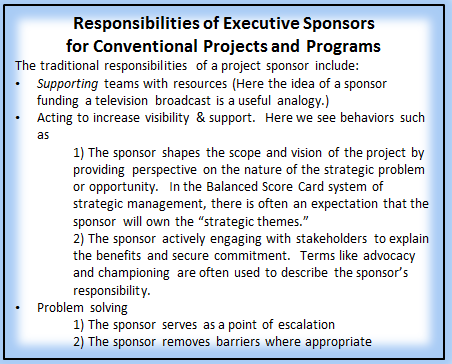
My purpose in this article is to explain how executive sponsorship of a strategic initiative is nuanced and different from sponsorship of the typical run-the-business project or program.

Your take-aways are:

  • The traditional responsibilities for an executive sponsor apply (see the graphic). However,
  • The program manager and the executive sponsor share responsibilities for four unique principles.  They partner and collaborate.
  • It is essential to acquire and exercise power.

An Example of a Successful Partnership Between an Executive Sponsor and a Program Manager

Several years ago, I had a program manager role leading a strategic initiative. It was hugely successful; it changed the business model and added record revenues.  I could master the internal relationships and tasks, but I lacked a network of contacts in the industry (this network was essential to putting together a venture than had all of the needed elements of the delivery system).  Here the program’s executive sponsor was critical: he had a network of personal relationships with potential partners.  Too, the title Vice President conveyed gravitas. Thus, he was in a better position to manage those stakeholders than me.

The Program Manager (me) and the Executive Sponsor developed an effective partnership.

Four Shared Responsibilities

In reflecting upon my experience, I found four important functions that take place by either/both the program manager and the sponsor (they are drawn from the research of Harvard’s Wheelwright and Clark). I list them in the left column of the following table and provide examples in the center and right columns.

My experience with strategic initiatives shows that the functions are not unique to the executive sponsor.  Instead, they are shared in a way specific to the personalities of the people and the situation.  Thus, the point is

This table provides a framework for discussing specifics: How can the Executive Sponsor and Program Manager best partner to increase the probability of success?

Picture the Executive Sponsor and the Program Manager in a conversation: How will each person activate one of the four functions? How can each role help the other acquire power?

Responsibilities Executive Sponsor Program Manager
Energize and guide organizational decision making Participate in portfolio management discussions to determine the  appropriate prioritization for this strategic initiative versus other programs, projects, and operational imperatives. Apply the philosophy of fast and effective decisions lead to fast development.
Clarify direction to help people understand Remind/reinforce key messages to executive steering team members.  Capture feedback and manage dialogue to   tweak direction or cancel initiative if necessary. Use program and project management tools to enhance alignment and  commitment. Work on making vision concrete. Turn into verifiable project   requirements. Socialize the vision.
Provide a sense of balance,   confidence and maturity to the   organization Particular attention to steering team and other executives. Advocate for launching the initiative. Support the learning process. Particular attention to functional executives, project managers, and   technical resources.  Support the learning process.
Facilitate Network Building Boundary spanning with partners and external stakeholders.  Tap into industry experience and knowledge. Support external boundary spanning, but somewhat more emphasis on internal stakeholders and project managers.

Of course, this framework rests upon the assumption that the organization has identified an executive sponsor, steering team, and program manager for the strategic initiative.  Regrettably, that is not always the case and the lack of roles is a leading indicator of upcoming problems with the strategic initiative.

Power and Politics

Power is the ability to influence or control scarce resources.  The obvious resources are money and other capital resources (remember the “Follow the Money” story) as well as expertise.

Less obvious – but equally important – is knowledge about the strategic context and strategic intent of the organization. In my above-described example, I lacked the VP’s power, but I recognized that my effectiveness depended upon the ability to capture and exploit organizational power for the good of the strategic initiative.  I helped him get power, and he helped me as well.

For many project managers, politics is a dirty word.  But it’s not: politics is the willingness and ability to gain power for the benefit of the organization. I will share more about politics and power in future articles.

Complexity is the Reason Why Strategic Intiative Leadership is Different

Strategic initiatives are different from “strategic” projects and programs. For one, strategic initiatives often involve complexity (unpredictable, emergent conditions), whereas programs and projects are “complicated” (with suitable expertise, a predictable result is achieved). I believe that if you understand the challenges and competencies that are unique to strategic initiatives, you enhance your tool kit for conventional projects and programs.

What else would you like to learn about the role of the strategic initiative’s executive sponsor?

Posted in Competencies of Strategic Initiative Leaders, Success Principles for Strategic Initiatives | Tagged , , , , | 9 Comments

Know The “Follow-The-Money” Story. How was Your Strategic Initiative Funded?

This article is the fourth installment in “how to improve your story telling chops.” The  leader’s goal is communicating the strategic initiative as a story, not as a sterile collection of projects.

Lessons from All the President’s Men

The now-famous phrase “follow the money” entered the vernacular in a scene in the 1976 movie, “All The President’s Men,” which chronicled the connection of a burglary – and its coverup – to the resignation US President Richard Nixon.  The protagonists of this story are two Washington Post Newspaper reporters, Bob Woodward and Carl Bernstein. Starting with a burglary at Democratic Headquarters at the Watergate hotel, the reporters find evidence of possible involvement by White House staff in either the crime itself or a conspiracy to cover up the crime.

Woodward and Bernstein would need clear proof before they could publish their story. In one pivotal scene, Woodward is meeting with a mysterious source, code-named Deep Throat, who helps them separate the important from the trivial. Here is dialogue and a scene from the movie…

“Follow the money” was a sense-making rule that helped to identify a strategic pattern. With it, Woodward and Bernstein could better understand the movement of money and link the White House’s to the covering up of the Watergate break-in. (This practice now has a fancy name: “forensic accounting.”) As we know, President Nixon resigned in the face of likely impeachment.

In strategy, we often encounter substantial detail (a.k.a, noise). It was a signal that helped reporters cut through the noise of less-important details.

Money Talks: Why the Follow-the-Money Story is Relevant to Strategic Initiatives

The always-important accounting concept of “cash flow” is another way to say, “follow the money.” For-profit organizations raise money from external sources such as debt and equity offerings and internal sources such as sales and investments. Not-for-profit organizations gain funds from debt, gifts, grants, and endowments. Government organizations secure funds from debt, taxes and pass throughs. In each of these types, there are frequently extensive contractual term and conditions that apply to the funding.

Some program managers think that finance and accounting is irrelevant and boring, but it is all part of the strategic initiative back story. They can improve their odds of success if they are…..

Prepared with Answers to these Questions

The follow-the-money principle suggests these questions:

  • Where did the funding for your strategic initiative come from?
    Stated more specifically, do you know which executive(s) provided funding, and in what proportion? Do you know the reasons and promises?
  • How will your investors measure the strategic initiative’s performance?
    Imagine a future conversation with an investor who is asking you, “Did I get my money’s worth?” You are thinking strategically when you think about the definition and measurement of success.
  • Are there strings attached?
    There are often legal and contractual expectations.

An Example: Funding Strategy for the Common Good

In a recent experience, the CIO was providing all of the funding for a major software deployment. The program manager recognized that the software would alter basic processes and policy, and launched a low-key campaign to educate executives. Here, the Program Manager was functioning as an internal entrepreneur.

Because the entire business would benefit from this investment, other executives had to step up with funding to support costs of the program.

The resulting fund is termed “Stratex” (for strategic expenditures, and distinguished from capital expenditures and operating expenditures). The term helps executives distinguish operational expenses (“run the business”) from strategic expenses (“change the business”) to assure that the organization is investing for the future. Stratex becomes the funding for strategic initiatives.

As the story continued, the company decided to designated the program as a strategic initiative and expanded the scope so that there was full consideration of the changes to process, policy and people.

Importantly, each of the business units that fund StratEx are now considered as investors. They want a return on their investment.  It is the program manager’s job to deliver the benefits to those “investors.”

Do you agree that it is useful to know the “follow the money” story?

Posted in How to Improve Your Story Telling Chops | Tagged , , , , | 5 Comments

Path Finding and Way Finding

Strategic initiatives have to
find a path through
 the organizational terrain.

It is common to hear people say in the early definition stage, “Wow, this strategic initiative is complex. Where do we start? I’m overwhelmed!” My advice is to use the path finding technique.

This article builds upon my article, Five Rules for Managing Complex Strategic Initiatives. (Refresher: the five rules are manage starting conditions, enlarge the strategic discussions, dissent strengthens the strategy, increase learning with rapid experimentation, and monitor for emergence.)

Path finding is a simple – yet powerful – approach that involves three distinct skills: pattern searching, sense-making, and nudging:

  • Pattern Searching – (also known as pattern recognition) is the competency of discovering important regularities. (A pattern is an arrangement of facts implying some sort of relationship between them).  For strategic initiative leaders, patterns are found in the strategic context and in the conversations that stakeholders have about the goals and methods of the strategic initiative.
  • Sense-making is the ability to interpret the patterns so that the interpretation forms a story that is relevant to the stakeholder. The result is the ability to gain alignment and commitment in areas that have complexity, ambiguity, or high uncertainty.
  • Nudging is a deliberate incremental action that advances the strategic initiative towards its goal.  It involves decisions and incremental actions.

Path finding and way finding are both concepts that have to do with navigating through natural and built environments. I’m not inventing anything new here; just re-conceptualizing some common-sense ideas into useful leadership practices.

Path Finding Explained with a Simple Analogy

Picture yourself in a field facing a dense forest. You have a simple goal: to find a path that allows you to pass through the forest. (You’ll get additional richness in this analogy if you visualize your team standing with you.) Your initial reaction is that the tree line and scrub has formed an impenetrable wall, behind which are many unknowns. Using the skills of path finding, you find a strategic spot to enter. Once inside the forest, you move towards your goal occasionally making detours.

The Skill of Managing Starting Conditions

First, there is a meta-pattern to consider: are you just starting your journey (your strategic initiative) or is it underway?

The knack of managing starting conditions is to be able to judge the enormity of the endeavor and have the right quality and quantity of resources.  In the cross-the-forest analogy, you would want to make sure that you have sufficient provisions and gear for the trip.  You would consider hiring a guide to help with the orientation and the work.

Obviously, there are a lot of risks to consider. One practical tool for managing starting conditions is to apply the Compact Approach, asking, “What are the mistakes I must not make?” One mistake might be to rely on a map given to you by someone who does not really know the terrain. (Fact: the famous Donner Party disaster in 1846 was partly due to their reliance on an invalid map and rumored shortcut, the “Hastings Cutoff.”)

Comment – For many, a “project methodology” might be considered a map or a blazed trail to get to the end point.  However, the “terrain” of a simple project differs considerably a strategic initiative.  A strategic initiative is often terra incognita.  A rigid project management approach intended for a deployment project might not work well. (See my charter article).

 The Skill of Pattern Searching

Continuing the forest-crossing analogy, assume you are standing outside the forest with your guide. You look for any evidence of a break in the tree line.  You look at the height of the trees. You assess their relationship to landforms like mountains, canyon walls, or water. What are the patterns you observe?

You hope to get off to a good start, and need to recover quickly if you make a poor initial decision about the place to enter the forest (Rule 1 from my complexity article). If you have a team, you should ask for their input to help recognize patterns (Rule 2) and encourage dissent (Rule 3). Here you are monitoring for emergence (Rule 5) .

The Skill of Sense Making

Next, taking everything into consideration, you ask yourself, “What do all of these patterns tell me?”  Perhaps, the collective pattern shows that it is more sensible to wade up a stream rather than hack through the underbrush.

Perhaps the patterns provide evidence of someone else’s passage. If someone has gone this way before, is there something useful to learn?

Here you continue to integrate experimenting and monitoring for emergence. You can use the team’s input to enlarge the perspective and improve decision-making quality. This is a good time to encourage dissent (Rule 3) to see if your story is the best fit for what is facing you.

One of my favorite techniques for working with teams is to make short observations and provocations, and then ask this question,

 “Does that make sense?”

The Skill of Nudging

Finally, you make more deliberate attempt to penetrate the forest.  You select a suitable place to enter and take a few steps inside, breaking through the tree-line scrub. You stop and feel the ground under your feet. This is nudging.

Are there any apparent risks?  What does your intuition tell you?

Just stomping a little on the ground is an experiment that tells you the potential firmness of the footing.  Are you ready to commit to the next step?  How about the team?

You continue nudging forward, learning as you go (Rule 4). You find it is now less tangled, but darker. You iterate through process of learning, sense making and nudging.  You might face tangles of small and large trees, fallen trees, rocks, and so forth. You move forward and back track occasionally.

You continue to notice new patterns and adapt to them.

With persistence, you find your way through the forest to meet your goal.

Path Finding for a Strategic Initiative

This path finding approach fits well to the case examples described in my earlier articles.  For example,

  • Pattern Searching – Domino’s found the repeated consumer complaint of “your crust tastes like cardboard” formed a pattern. Google used many analytics trends in news gathering and news papers to help it understand the strategic terrain for its “save the news” strategic initiative. Wal-Mart saw a pattern in the public’s perception of it that caused it to take on the challenge of “making money by doing the right thing.” Note that usually it is a collection of patterns that become a stimulus for a strategic initiative.
  • Sense Making – The heritage story is a story that people use to help reconcile strategic goals with the company’s history.  You can find evidence in Google, Domino’s and Wal-Mart examples that showed how the strategic initiative – involving new business models – was actually a continuation of the principles that made for the company’s initial success.
  • Nudging – Domino’s and Google’s nudges included hiring new employees, and the role of a consultant was essential to making progress for Wal-Mart. CEOs at both Google and Wal-Mart went public with a “proximate objective” announcing their intentions, resulting in incentives to for stakeholders to change behaviors. (Richard Rumelt defines a proximate objective as a target that is feasible for the organization to meet.  Having a proximate objective helps to focus attention and resources.)

Patience! The Path is Revealed, not the Trail is Blazed

In complex environments, we often can not understand or predict the results and actions of others.  In these environments, the traditional project-management mindset of “plan your work and work your plan” is inadequate.

Don’t make the mistake of plunging and forcing others to bend to your will. On the other hand, you can’t stay in study mode too long.  Work incrementally to build confidence and credibility.

In prior articles, I have discussed ambiguity and strategic thinking.  Path finding is a helpful tool in that pattern searching and sense making allows you to recognize ambiguity and nudging can allow you to make low risk & reversible commitments. Path finding is a practical, memorable, and effective tool for strategic initiative leaders.

Readers! This article is my path-finding attempt for a book on Strategic Initiative Leadership. Is my nudge effective? Should I dig in deeper with more explanation, methods, and examples? Your comments (and your dissent) are appreciated.


Posted in Competencies of Strategic Initiative Leaders, Strategy Coaching and Facilitation, Success Principles for Strategic Initiatives, Useful Practices & Management Tools | Tagged , , , , , , , , | 6 Comments