Strategic Initiatives Case Study – Domino’s Pizza Turnaround

Inside the Pizza Turnaround Strategic Initiative

Leaders need to recognize that their pride in their product is “their story,” but may not be the same as the “customer’s story.” When this happens, it is time for rethinking strategy. A remarkable strategic initiative – Domino Pizza’s “Pizza Turnaround” – shows how a company faced up to the reality that many consumers did not like its product. It’s worth your time to watch this 4-minute video at http://www.pizzaturnaround.com/.

I decided to learn more, and secured an interview with three key Domino’s executives, which was just published in Visions Magazine. In addition to the article, I want to point out some learnings that are more specific to the topic of strategic initiatives.

Leadership Lessons for Strategic Initiatives

  • Outside-in perspective. Domino’s listened to the voice of the market and the voice of the customer. It is often easy for managers to assume they know what is important to customers. Domino’s had the courage to listen, even if they didn’t like what they heard. Brandon Solano told me,
    “We did a lost buyer study, and the reason they [customers] were leaving was product.
  • A compelling vision for the initiative – The criterion for success was a statistical win in taste tests versus national competitors. This data-driven vision was understood throughout the organization. Referring to the need for a good-tasting pizza, CEO Patrick Doyle told me,
    “Our first priority was to get it right.
  • Be bold, and meet your promises – People are information overloaded. If you have a good story to tell, you need to do something bold and memorable. As Brandon Solano told me,
    “I believe our bold advertising made people interested and think differently about our brand, the product delivered on the promise, and we have an on-going, not one time increase in our business.
  • Replace old stories with new stories – Fifty years ago, Domino’s achieved an initial strategic advantage from its business model of pizza delivery. However, delivery of pizza is an old and non-distinctive story, and “good enough” tasting pizza created no enthusiasm with consumers. Domino’s new story was one of a diligent company that took its customer’s needs and wants seriously, and would show the courage to make the change. Chief Marketing Officer Russell Wiener told me,
    “We purposely filled our stories with facts, not just opinions.
  • Senior manager’s direction in balance with empowerment – A common reason for failure of strategic initiatives is that senior managers set a goal, but fail to sponsor the initiative with resources and attention. Domino’s on-boarded several key leaders who brought both the big-company experience with launching new products and follow-through execution abilities. As Brandon Solano explained to me, top management,
    “Focuses on the big risks and trusts that the product development teams have handled the details.
  • Build credibility incrementally – Prior to the pizza turnaround, the team scored quick & small wins by launching a lunch and desserts menu expansion. The success with lunch and desserts gave credibility to the pizza turnaround strategic initiative team. Brandon Solano told me,
    “My team had a lot of credibility because we launched sandwiches in three months.
  • Learn systematically – Domino’s didn’t do things haphazardly. This included the careful formulation of the new recipe, the socialization of the vision with the franchisees, or the testing of the advertising. The company used experimental design and data to support the need for business change. Brandon Solano told me,
    “We tested all of the components (crusts, sauces, cheeses) together in a design of experiments to find the winning product.

Not everyone will love your product, and some will actually hate it. While leaders should “accentuate the positive” they also need to recognize the need to change.

Is it time for a turnaround in your organization? How can you replace old stories with new ones?

Posted in Examples of Strategic Initiatives | Tagged , , , , , , , , , , , , , | 11 Comments

Google’s Strategic Initiatives Team

Image representing Google as depicted in Crunc...

Google and its Strategic Initiatives Team

Google – certainly one of the most progressive companies in the world – has identified a role for a Strategic Initiatives Team.  This posting briefly describes the Team, project structuring, and competencies that Google expects of its leaders.

What is the Strategic Initiatives Team and where does it fit in Google?

The Strategic Initiatives Team is part of the Americas Sales Operations Group. The group spearheads tackles key challenges facing online sales, such as identifying and addressing opportunities and threats to Google’s business, ensuring the effective long-term growth revenue and profits.  Much of the day-to-day work involves structuring problems, analyzing data, making recommendations and driving implementation.  Operationally, the strategic initiative team works cross-functionally with partner organizations and relevant operating groups such as Google’s sales, product, engineering, finance, and HR teams.

What is the nature of the strategic initiative projects?

Google says that its leaders work on one to two projects at a time spanning a few weeks to a few months with end-to-end responsibility.

What are the key leader competencies?

The strategic initiative leaders drive complex, ambiguous, and potentially charged business issues. The stand-out competencies for the leaders include:

  • Personable yet persistent ­- ­This is the ability to build relationships, yet insist on results.
  • Impeccable business judgment – This is interesting. It goes beyond “good problem-solving and analytical skills.”
  • Consensus builders – The leader needs to manage many moving parts across cross-functional and cross-regional teams, again with an insistence on results.
  • Influencers of senior level audiences ­– The leaders spends time with key stakeholders probing for needs. They develop compelling recommendations for solutions.
  • Good with data and ambiguity – The leader needs the ability to pull data from multiple sources and to work the various stakeholders to interpret that data.

I derived much of this article’s content from analyzing recent Google job postings.

Does your organization have a focal point for strategic initiatives?  Do your strategic initiative leaders possess these characteristics?

Posted in Competencies of Strategic Initiative Leaders, Examples of Strategic Initiatives | Tagged , , , , , , , , , , , | 4 Comments

How to Use the “What About” Technique

Focus

Focus is key to effective leadership

I use focus questions to bring attention to core elements of the strategic initiative. In this article, I describe one of my preferred focus questions. The question is,

“What are you concerned about?”

An example

I was invited to help a business turnaround for US-based company that was losing $20 million each year in its European manufacturing operations. The executives had set the strategic vision: close down select facilities but move the capability to other facilities. The VP of manufacturing reiterated the project’s strategic intent and then said, “Here is Greg Githens and he is going to help turn this initiative into an actionable plan.”

How to Create a “What About” List

I first ask the group to think about the focus questions, “What are you concerned about?” While I am asking that question, I am writing the words “What about….” at the top of a flip chart page.

Sometimes it is useful to allow a few minutes of quiet time for individuals to write down their responses.

I then give each participant the opportunity to state one concern (or say, “pass” if they want to skip their turn, for it will come again). As facilitator, I write their concern on the flip chart. If the participant is verbose or is struggling to get their thoughts, I tell them, “give me a few words that captures your concern and I will write it down.” This is important: I use their own words and not my interpretation.

It is important to allow each individual to speak and be heard. Also, I do not allow for discussion or rebuttal at this point. (This technique is actually a variant of nominal group technique.)

Then I move to the next person and repeat this question, “What are you concerned about?” and write the answers on the page. I keep things moving; people are not permitted to hijack the discussion with analysis, discussion, proposed solutions or rebuttals. This continues: giving each person an opportunity to state one concern at a time, until the people have exhausted their concerns. I also take a turn, stepping out of the facilitator role and into the participant’s role to add a comment.

It takes somewhere between 30 and 60 minutes to finish the what-about list. At this point, we will have several flip chart pages of concerns. I tape to the wall so everyone can see the scope of the collective concerns of the group. [Especially for long running-projects, people tend to loose sight of all of the key questions and drivers of success.]

Energizing the team

My goal is to get people to step up to the challenge of the strategic project. I point to the pages and tell them that their challenge is to collaborate and resolve these concerns. We will use our program and project disciplines for structure and energize the problem solving.

Sometimes (particularly when the project is in a crisis or turnaround mode), I adopt a “Dutch Uncle” persona for a moment, and give a frank and direct challenge: You own this initiative and need to do the tough work to make it successful.

Give them a R.A.D.I.O

I next help the team classify the long list of concerns. The following categories are helpful:

  • Risks – Uncertain events that can affect the initiative for good or bad. It should be stated as a description of the event and estimates of the probability and consequence.
  • Assumptions – A factor that is true, real, or certain for planning purposes
  • Decisions – An important decision that must be made by someone who needs information (often provided by someone else)
  • Issues – A problem is resolved with a decision and action
  • Opportunities – An event that – if realized – adds value. One distinctive feature of strategic initiatives and program management is the focus capturing opportunities as opposed to mitigating threats.

This is straightforward: Next to each item, with the team’s assistance – I simply write the letter R, A, D, I, or O as appropriate.

These many items are now in five separate buckets and ready for further action. The issues bucket is typically the largest of the five. As I describe in another article on issues management, the team develops an issues log and specifies the issue for effective resolution. (The other four buckets are each managed differently, as well.)

Why this works

Strategic initiatives are different from strategic projects in that they involve people with different perspectives. For example, many managers find themselves in a debate over which solution is the best solution, without realizing that there is no common understanding of the problem or root cause. This condition of ambiguity is important for the leader of the strategic initiative.

The “what about” technique allows people to come to the initiative with their own subjective framework, and helps the group come to a common mental model. Group dynamics are vital to success with strategic initiatives. This technique allows us to address the concerns of individuals who:

  • Think better in silence
  • Are less vocal, or are overwhelmed by other individuals who are more vocal
  • Are not inclined to participate or are easily distracted
  • Believe that there is controversy but would prefer to avoid direct confrontation
  • Have not spent much time thinking about the strategic initiative

It is easy to apply if you have some basic facilitation skills. It draws people out – even the quiet ones – and helps them to get a sense of their own interests, needs, and priorities. It establishes a better mindset for more sophisticated program and project management techniques.

How do you involve people who have anxieties and concerns? What do you see as advantages and disadvantages?

Posted in Strategy Coaching and Facilitation, Useful Practices & Management Tools | Tagged , , , , , , , | 11 Comments

How to Manage Issues

Problems are Opportunities

Problems = Issues

People often feel overwhelmed early in a strategic initiative.  The good news is that there are any number of ways to get things to make sense. One way is to identify issues, and start a process of systematically managing them.

Issues management is an important responsibility for the leader of a strategic initiative. See the nearby text box that emphasizes strong issue management as an important hiring criterion.

Issues are easily defined: Issues are problems to solve. If you keep in mind the cliché – a problem well defined is a problem half solved – you are well on the way to making progress at creating the opportunity-creating mindset that is essential for succeeding with strategic initiatives.

Issues exist in one of two states: open or closed.  The goal is to transform open issues into closed issues. We resolve issues through analysis, decisions, and actions.

  1. Clarify the issue, including its impact on project performance and impacts on stakeholders. 
  2. Generate options. You want to be resourceful and remove barriers recognize the limitations of the established ways
  3. Establish a preferred option

You will get the best results using a team-based approach. Anyone can raise issues. Issues can be raised in team meetings or during one-on-one conversations with the Strategic Initiative’s leader.

Rather than having the program/project manager own all issues, it is better to assign two kinds of responsibility: investigation responsibility and decision responsibility. Investigation responsibility simply means that the individual will collect information, perform analysis, and communicate findings and potential recommendations to the decision maker. For decision responsibility, we want to be able to identify a single individual who will be making the decision.

The issues log is an essential tool for the strategic initiative. 

Issues Logs are Common Program Management Tools for Strategic Initiatives

Here are a few more tips:

  • Keep track of closed issues. When enthusiasm starts to flag, you can use your closed issues lists as a tangible reminder of the progress made.
  • Prioritize with forced choice, which involves setting up a series of 1:1 comparisons of the issues. It results in a prioritized list.  This is also a good team building practice.
  • Make it a part of every team meeting and part of the roll up reporting to the executive council.

Finally, where do risks fit in?  My experience is that once the team feels comfortable with the issues process, they can be cajoled into a risk identification, quantification, and response planning. Because of the ambiguity that is present in strategic initiatives, you get more alignment and commitment when you have issues management in place early.

What are some of the fine points for mastering issues management?

Posted in Useful Practices & Management Tools | Tagged , , | 6 Comments

Six Leadership Traits

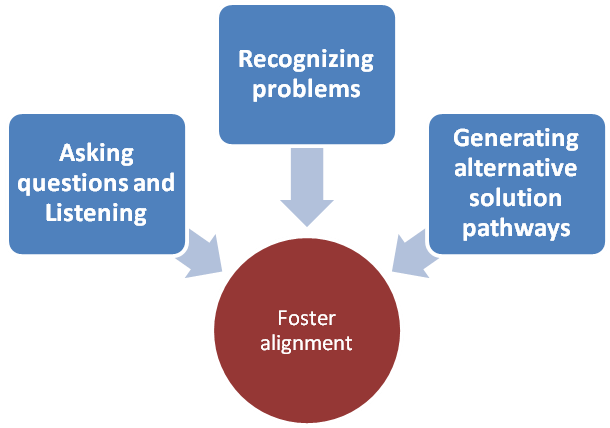
Traits that Foster Strategic Initiative Alignment

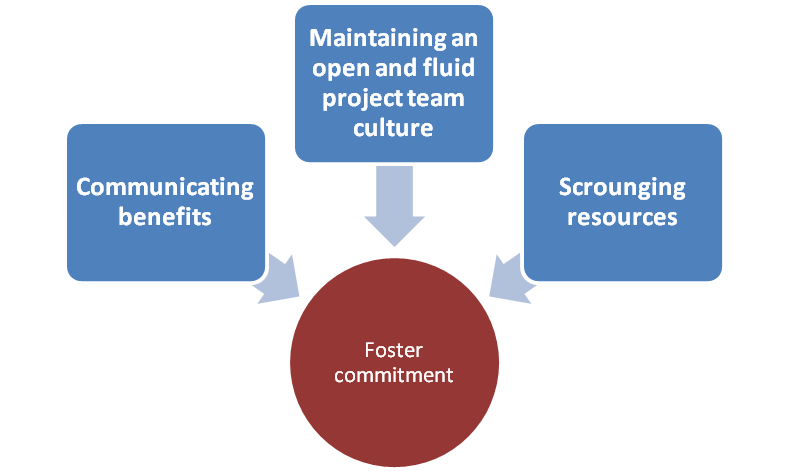
One of the few sources high-quality academic research about strategic initiatives is Richard Leifer and his colleagues at the Rensselaer Polytechnic Institute. They looked in depth at success and failure in radical innovation as practiced by companies such as GE, duPont, TI, and IBM. Among their many findings, they observed that initiative leaders were good at the tasks shown in these two graphics:

Traits that Foster Strategic Initiative Commitment

A coach can help you enhance the above capabilities. Here is one example for the first item of asking questions.  Your coach can:

  • Provide a list of good questions that help to uncover and understand expressed and implied strategies
  • Provide training in conducting interviews and other knowledge gathering techniques
  • Reinforce the importance of courage

The graphics also show the recurring theme of alignment and commitment as foundational to success of a strategic initiative.

Process or Individual?

I continually hear people talking about methodology, consistency, and standardization.  I think they are valuable organizational competencies and worth pursuing.  However, as a cautionary note, the Rensselaer researchers found, “The firms participating in our study earnestly wanted to follow a systematic, organization-driven process.  However, we found just the opposite, radical innovation was primarily driven by individual initiative.” In other words, they leadership comes from

“inspired and determined individuals who will not take no for an answer and who often have to swim against a current of corporate indifference, if not outright resistance.

What do you think?  Do these traits match your experience? Can process take the place of inspired and determined individuals?

Posted in Competencies of Strategic Initiative Leaders, Program & Portfolio Management, Strategy Coaching and Facilitation, Success Principles for Strategic Initiatives, Transforming the Organization | Tagged , , , , , | 5 Comments

A Concise Guide to the Differences between Programs and Projects

Programs are collections of projects, but… there’s more to it!

Strategic initiatives are an important tool of organizational strategy execution.  From my experience, a good way to understand how to execute a strategic initiative is to understand the differences between the principles and norms of program management versus project management. Strategic initiatives are most commonly programs composed of smaller projects rather than large strategic projects.

In a future post, I will examine the differences between programs and portfolios and the different competencies of a program manager (of a strategic initiative) versus a project manager. For now, let’s take a look at the structural differences of programs and projects independent of the leadership behaviors needed for success.

The following two tables provide some compare and contrast. While it may seem like simple semantical nitpicking, language frames much of what is important to know about working with strategy. The first table involves generalizations that I can use with a high degree of confidence, whereas the second table involves numerous qualifications involving the word “typically.”

Projects Programs
Are assembled from tasks. Rollup reporting is involves aggregating task performance. Are assembled from projects. Rollup reporting is involves aggregating project performance.
Are focused on “outputs” and “deliverables.” It is the result of a process. If you can touch it or see it, it is probably an output. Are focused on “outcomes,” “benefits,” and achievements. Outcomes are things that can be graphed and analyzed for trends.

In recent years, I’ve spoken to hundreds of people about program management in general and strategic initiatives in specific.  Those individuals who come out of classic techno-process background have experienced project management as a science, and are somewhat frustrated to find out that program management is more of an art.  The following table shows some generalizations.

Projects, typically Programs, typically
Have solutions that are known and describable Know that a solution exists, but is often is initially unknowable
Are amenable to a structured process (“methodology”) Less amenable to a structured management process
Have specific details in their charter documents (and are often indistinguishable from a project plan) Are chartered to reflect the strategic nature of an investment
Have an internal focus on tasks and project issues Have an external focus on stakeholders politics and alliances
Regard “risk” as a threat that will undermine performance. Project mangers focus on reducing uncertainty. Regard “risk” as an opportunity that brings with it threats and obstacles that will be managed. Program managers focus first on managing ambiguity and then on managing uncertainty.
Are typically led by people who have good knowledge of the technology and system Are typically led by people who appreciate the politics and culture as well as the technology. Stated differently, they tend to function more as executives than as technocrats.
Are smaller in size and intended impact Are larger in size and intended impact, thus are more strategic and aligned with enterprise strategy
Are funded from a single funder Are often funded by multiple stakeholders, and often self-generate their own funds
Have clearly distinguishable end points Often end when the underlying technology platform becomes obsolete and funding is withdrawn (for an example, the NASA in the USA recently terminated the Space Shuttle Program)
React to changes from specific customers React to changes from stakeholders of all type, from changes in strategic intent, and from changes in strategy

Many practitioners regard programs are larger and more complex projects.  I think that this perspective is changing and that the profession is seeing that program management is not “project management on steroids,” especially for the special topic of strategic initiatives.

As a final point, the Project Management Institute’s Standard for Program Management adds three new knowledge areas to those identified in its Guide to the Project Management Body of Knowledge.  Because the standard-setting process casts a wide net across practitioners, we can be assured that we are less likely to be looking at the subjective opinions of individuals, and more likely to have some sort of consensus. PMI takes the existing 9 project management knowledge areas (saying that all 9 apply to programs) and add the following three knowledge areas to its Program Management Standard:

    • Program Stakeholder Management
    • Program Financial Management
    • Governance

These differences imply significance to how the leader of an initiative will practice leadership. For example, the leader has to use more questions and tolerate more ambiguity (and do it with confidence). How have you seen this work?

Posted in Program & Portfolio Management, Success Principles for Strategic Initiatives | Tagged , , , , , , , , , , | 14 Comments

Five Types of Decisions: A Practical Tool for the SI Leader

Five Types of Decisions Strategic InitiativesOne important role for the leader of a strategic initiative is the Chief Decision Architect. A good decision is one that enhances the strategic initiative’s alignment and commitment.  Here is the guiding principle:  

Fast and effective decisions lead to fast and effective program execution.  

This simple principle implies:  

  1. Decisions are a driver of performance. They involve decision makers and individuals who possess critical information.
  2. After decisions are made, people need to support the implementation of the decision. They often do not support implementation because they neither understand the decision or participated in it.
  3. There are consequences to implementing or failing to implement the decision. You are “standing at the crossroads” to use a blues-music metaphor.
  4. Leaders should be concerned about the quality and timing of decisions
  5. There are different types of decisions (because of the elements just listed) that require different decision making styles and tools
  6. Categorizing the decisions into types provides a way to make decision making more efficient and effective.

Still with me? There are five types of decisions involving, as listed in the table. The practical rule for the leader is this: Understand the type of decision being made, and then select the appropriate blending of discussion and participatory style

Type Action Suited for when
1 I decide and tell you Simple decisions where authority and accountability are needed. The authority (“I”) has the necessary information needed to make a quality decision and merely needs to tell (“you”).
2 We talk, I decide and tell you Simple decisions that affect others. Hence, the “we talk” allows the authority (“I”) to understand the possible impacts on others before making the decision.
3 We talk, We decide Complex decisions that require the understanding and support of others.  These are the strategic decisions that benefit from a full vetting by all stakeholders because their participation in the decision increases alignment and commitment for the decision. This is the only one of the five types of decisions that requires consensus*, as explained below.
4 We talk, you decide and tell the boss Decisions that are better made by experts or those closest to the situation.  In a type 4 decision, the authority figure has some information (“we talk”) that should be considered in the decision (“you decide”).
5 You decide and tell the boss Decisions where the expert or local person has all the information and authority needed to make the decision (“you decide”).

 * Effective Consensus   

Definition of consensus:  All individuals agree to support the implementation of the decision, even if they do not agree with the decision.  

Implications of this definition: 1) You need to define the decision making team exactly, and have complete participation of each decision maker and 2) You need an un-ambiguous way to recognize that consensus has been achieved.  I prefer to use the “thumbs up” criterion. I want to see each person to show their fist with the thumb pointed up as an agreement that they will support the implementation.  

~~~  

Reasons why people like this tool:  

  • It is compact. There is not a lot to remember.
  • It reminds people of a commonsense idea: Some Decisions Require More Talk, Others Less
  • It improves speed by eliminating unnecessary information sharing and unrealistic expectations about involvement
  • It implies the situations where that teams can be productive and accountable
  • It supports the principles and rules in the introductory paragraphs of this post

~~~  

Real-World Application  

Here is one example of how I have used this tool. I was coaching an IT advisory group composed of experts and stakeholders. The issues of advice versus policy arose. When could this group go ahead and implement their ideas, and when did it need to involve the organizations Managing Directors?  Neither group had the time (or the inclination) to be in constant contact with each other.  

I introduced this tool and explained that the Managing Directors would be the authority (“I” in the framework) and the advisory group would be the experts (the “we” in the framework).  Everyone agreed that this tool facilitated better performance by both groups.  

How do you think this tool can help you with your strategic initiatives?

Please bookmark with your social media. It is noticed and appreicated!

Posted in Strategy Coaching and Facilitation, Useful Practices & Management Tools | Tagged , , , , , , , , , , , | 6 Comments

The Four Driving Questions for Success

You can increase your ability to build alignment and commitment for strategic initiatives by asking and answering what I call The Four Driving Questions, shown in this graphic. The order is important: first why, then who, then what and when.

Four Driving Questions

 Why

The first question is, “Why are we doing this?” Answering this question provides an understanding and builds commitment for the program. Most important of all, the why question encourages people to think about the justification for the program. This is necessary both for funding the program and for creating alignment and commitment.

Asking “why?” encourages people to reflect and learn. Here are several questions that stimulate personal reflection:

  • Within your organization: Why is this initiative important to me personally? Answer these same questions for your boss and for your business unit.
  • For your alliance partners or other interested stakeholders: Why is it important for the individuals, their boss, and their employer? Why are my peers interested?

Who

The second question is, “Who needs to be involved?” An experienced product developer told me one time that one of his most important insights was the rule, “Get the right people and get the people right.”  The right people have the knowledge, skills, attitude for the specific needs of the project.

To “get the people right” points to the importance of team building.  Jim Collins’ bestselling book Good to Great stresses “First Who…Then What” in Chapter 2. His research led him to conclude, “The key point is that ‘who’ questions come before what decisions.” If you get the people right, the vision will take care of itself. Collins observed that the best leaders “first got the right people “on the bus” (and the wrong people off the bus) and then figured out where to drive it.”

Since strategic initiatives often involve growth, Collins says, “Put your best people on your biggest opportunities, not your biggest problems.”

What

The third question is, “What exactly are we going to do?” Asking and answering this question helps to define and refine the outcomes and the means to get to the outcomes.

Strategic initiatives are typically characterized by ambiguity, and the reason for addressing “what” is that the answer to the first two questions will naturally lead to the answer to the what question.  Here is the logic:

When we answer the why question, we are creating the motivation for the program (or at least validating the importance of the program).  As we recruit talented people, they use their ingenuity to create outcomes and opportunities that top management might not have been originally considered during its strategy formulation efforts.

I have found that some traditional project managers are uncomfortable with ordering this question in the number three position.  They are used to clear scopes of work, which are typical of incremental improvement efforts. As leaders, we have to help them get out of their comfort zone and into their learning zone.

When

The fourth question is, “When are we going to do this?” Ideally, we want to sequence the delivery of benefits to provide them incrementally and early. Practically speaking, the program manager will work to clarify deliverables and the benefits associated with those deliverables.

 ◊ ◊ ◊

These “four driving questions” are asked and answered in this order. (By contrast incremental innovations often order the question this way: when, what, and who. They seldom even asking why.) You will find that they provide a useful approach for structuring a strategic initiatives program.

How have you seen these applied?  Do you disagree with the ordering?

Posted in Strategic Planning Issues for Strategic Initiatives, Success Principles for Strategic Initiatives, Useful Practices & Management Tools | Tagged , , , | 8 Comments

Strategic Initiatives Case Study: Hospital and Health Care – Part 2

This 28 year old woman presented with congesti...

Image via Wikipedia

This is the second of several postings on Strategic Initiatives in Hospital and Health Care. There are good lessons here from the enterprise perspective as well as for the leadership of a strategic initiative.

Organizational Turnaround through Strategy

St. Mary’s Duluth Clinic Heart Center (SMDC) is an integrated health system with 4 hospitals, 17 clinics, and 7,000 physicians and employees managing more than 400,000 patient visits each year. SMDC – like many organizations has grown organically and through merger. Following one large merger, it found it had a “strategic plan” which listed more than 350 initiatives! In its attempt to comprehensively-approach strategy formulation & execution, SMDC struggled because its initiatives were not strategic. As a result, people were not clear on their roles to execute the strategy. SMDC reported that:

  • Executive Leadership Team mired in operational fire-fighting and day-to-day details
  • Board of Directors unfocused and confused about their role
  • Management and employees did not understand the strategic direction of the organization
  • Gradual decline of margin

The turnaround included much hard work, including the refinement of metrics through the balanced scope card, and the use of strategy maps to guide the prioritization of strategic initiatives. This aligned the entire organization through a common set of well-understood objectives and created a platform for developing a single organizational culture of accountability. The result was a $20 million dollar financial turnaround and return to profitability.

Analysis of One Strategic Initiative

Congestive heart failure is a highly prevalent, costly condition that imposes a significant burden on those it affects. In this strategic initiative*, SMDC focused on long-term costs and quality of care and achieved excellent results. It delivered benefits that include the following: increased use of appropriate medications, improved outcomes and functional status, and reduced readmission rates, length of stay, and overall costs of care for the health system.

Leadership Lessons for Strategic Initiatives

  • Understand the financial implications – SMDC was losing money on hospitalized congestive heart failure patients largely because they were admitted in a highly decompensated state that required lengthy, costly stays. The program management approach involved first building a data-driven case for costing and performance over a six-month period, and evolved into a learning process for developing methods and training, incrementally gaining support for the benefits of the initiative. SMDC funded the initiative and provided medical doctors, nurses, support staff and at least 100 hours of time from IT for database development.
  • Sequence benefits delivery – In this case, there was a goal to improve the provision of guideline-directed care. As the organization achieved its early goals, other benefits follow, such as decreased admission rates. SMDC found that it took time to get to the desired financial performance. It looked for both direct and indirect opportunities for revenue generation, as it may take time for the program to generate revenues on its own. From this base, the leaders can add additional goals.
  • Engage stakeholders early – Two key stakeholders – nurses and primary care physicians – received considerable attention in the strategic initiative. For example, primary care physicians have concerns about control over the care of their patients. The program communication plan addressed this concern.
  • Scale up the program – Start the program on a small scale so that the staff is not overwhelmed, and then increase as the as people learn the new system and as qualified staff are added.
  • Consider organizational structure and ownership of the solution – In this case, SMDC found that the creation of a separate entity (to operate and maintain the new capability) might cause confusion about referral patterns and program ownership. The learning: look for a logical “home” for the resulting solution.
  • Understand each strategic initiative in the larger enterprise context – It is tempting for organizations to affix the adjective “strategic”to every endeavor. Further, it is a stretch to expect people to give full effort to the initiative while doing their normal workload. Management is about making choices on where to invest scarce resources, and you can identify a strategic initiative by looking at where resources are invested.

* For more on this strategic initiative, see http://www.innovations.ahrq.gov/content.aspx?id=275

Do you understand the financial case for your strategic initiative? Do you understand how your initiatives fit into the strategic context?

Posted in Examples of Strategic Initiatives, Transforming the Organization | Tagged , , , , , , , , , , , | Leave a comment

Strategic Initiatives Case Study: Hospital and Health Care – Part 1

Emergency and Trauma Center at Duke University...

Image via Wikipedia

This is the first of several postings on Strategic Initiatives in Hospital and Health Care, a topic that touches everyone.  If you follow the logic of the excellent book, The Innovator’s Dilemma in Healthcare, in a few short years the entire hospital and health care industry will look completely different.  That includes the exit of many hospitals (large and small) from the market. There are numerous implications for the formulation and execution of strategy in that industry.

In this first example, I examine a success story of an organization uses strategic initiatives to improve performance and support achievement of the strategic goals.

Strategic Initiatives at Duke Children’s Hospital

Duke Children’s Hospital is part of the Duke University Hospital (www.dukehealth.org). It has been recognized as one of the world’s great health care providers by such publications as Time and U.S. News & World Report. In a recent paper, Duke reported on 10 years of performance improvement initiatives. Here are some of the following positive results:

  • Increase in the variable contribution margin by 240 percent
  • An improvement in net margin
  • Reduction in morbidity, a decrease in re-admits from 7 percent to 4 percent, a decrease in infection rates from 3 percent to 1 percent, and a decrease in length of stay by 0.6 days
  • Patient satisfaction scores have exceeded the set targets
  • Team Training and the associated process improvements have resulted in significantly improved communication and an increased awareness of safety process

How did Duke University Hospital accomplish these benefits? They recommend, “A systematic approach that identifies a specific goal and links projects to a specific initiative.” Some specific practices for strategic initiatives include:

  • Duke adopted the Balance Score Card, and modifying its strategic perspectives to address and prioritize on healthcare-related metrics. It started with the Quality and Patient Safety perspective and added supporting measures of Quality and Patient Safety, Customer, Finance and Work Culture
  • Using the strategic plan as an input, Duke determined specific goals that linked to each of the strategic perspectives. Duke recommends limiting the goals and metrics to three or four per perspective, because it maintains focus on initiatives and the strategic plan. They found it best to pick a modest improvement from baseline, such as 10 to 20 percent in the initial scorecard.

Leadership Lessons for Strategic Initiatives

  • Tailor metrics to culture and expectations – The balanced score card perspectives were modified from for-profit business criteria to recognize the peculiar challenges of the health care environment
  • Link metrics from board priorities to the unit and individual contributors – Duke used its metrics to align initiatives with strategic goals. This avoided two common problems: 1) reactionary behaviors and 2) initiatives focused solely on local concerns that may have little impact on organizational outcomes. This practice assures that the entire organization benefits from collaborative efforts.
  • Communicate the linkages of strategic initiatives to strategic intent – Leaders need to help important stakeholders understand the reasons for various initiatives.  “Training” was one part of the program management solution.
  • Create effective teams – Team building could be seen as a strategic initiative in its own right. Team building requires specific learnable, observable skills that are sometimes difficult for technically trained people.
  • Keep a long-term perspective – Duke has given its strategic initiative portfolio over ten years of sustained attention.  Obviously, this long-term perspective requires both vision and patience.

* For more, see10-Year Experience Integrating Strategic Performance Improvement Initiatives: Can the Balanced Scorecard, Six Sigma, and Team Training All Thrive in a Single Hospital?” http://www.ahrq.gov/downloads/pub/advances2/vol3/Advances-Meliones_40.pdf

Do you tailor your performance metrics?  Do you link your initiatives to strategic intent?

Posted in Examples of Strategic Initiatives, Success Principles for Strategic Initiatives, Transforming the Organization | Tagged , , , , , , , | 1 Comment