Strategic Initiatives Drive Growth and Innovation in the Travel Industry

A strategic initiative gives competitive advantage to the Vancouver's Cruise Port

A strategic initiative gives competitive advantage to the Vancouvers Cruise Port

The travel industry is very competitive, and is in a near-continuous state of launching strategic initiatives that are intended to change the market or competitive position:
the #1 reason for chartering a strategic initiative.

Many of these are bold endeavors to better serve a target market by making the experience more memorable, easy, or luxurious.
Here are three examples of strategic initiatives that drive growth and innovation:

1. Vancouver’s “US Direct” Strategic Initiative

To enhance the attractiveness of departing from Vancouver to cruise to Alaska, the Fraser Port Authority launched the “US Direct” strategic initiative. The program pre-identifies US citizens in arriving cruise ship passengers, whisks them through immigration and onto a bus, direct to their same-day departing Alaska cruise ship. Their luggage is delivered automatically from airplane to stateroom.

The initiative involved a number of stakeholders, including 6 major cruse ship lines, 8 major airlines, and US and Canadian customs. Leaders of strategic initiatives have to be skilled at spanning these boundaries.

2. Executive Lounges at Hilton Hotels

Executive Lounges are important to many hotel guests.

“For frequent fliers, the business lounge is much more than a posh breakfast diner—it is a travel destination in its own right. It combines a place to meet and mingle with like-minded guests, get connected and work, or simply dine, drink and relax. You are greeted by smiling concierges who can help arrange airport transfers, book flight and rail tickets, reserve dinner tables, and facilitate a stress-free check-in and checkout. The worldview outside, wherever you are, may change, but inside the lounge resides a globe-trotting camaraderie, a sense of belonging—topped off with exquisite service.

Hilton Hotels is currently undergoing a multi-year strategic initiative to develop its next generation of Hilton Executive Lounges. It involves extensive global research and feedback from HHonors members and frequent business travelers. Reports Hilton’s Dave Horton,

“We are exploring a range of exciting options to deliver a relevant, high-value Executive Lounge product.” These options include “the customizing of menus, services and other elements that respect the cultures of both the communities and individual guests we serve.”

In the travel industry, service designers and brand managers must strike the right balance between a consistent standard of service and the need to address the characteristics of the city where it is located.

3. Marriott Hotels Improves Brand Loyalty with Initiative to Change Bedding on 628,000 Beds in 10 Brands and 65 Countries

Fresh bedding and comfortable mattresses are a very high priority for business travellers, and Marriott launched a 2004-2006 initiative to spend $190 million on new bedding. The Marriott program involved 21 teams addressing the logistics of 2400 properties. The program team needed to provide a benefits proposition to stakeholders (e.g., franchisees) showing that this initiative would both improve consumer loyalty and reduce costs. Some of the interesting tools were:

  • A monthly executive fact sheet that provided key stakeholders with specific information on the project status (number of hotels, obstacles, risks, upcoming milestones)
  • Kicking off the initiative with a pajama party
  • Developing a single source data base with all pertinent information on the project (for example, each Marriott property is different in details such as mattress height, thickness, and sheet size).

This initiative earned a nomination for PMI’s 2007 project of the year. Said Bob McCarthy, president of North American lodging operations,

“The program proved to be a masterful example of the best way to start, manage and implement a large-scale initiative.”

Leadership Lessons for Strategic Initiatives

Like strategic initiatives in other industries, strategic initiatives in the travel industry require program management disciplines with strong leadership. Here are five important tasks:

    • Understand the “brand promise” – Travel companies have invested considerably in their brand, and it is a vital corporate asset. The brand is a promise to the customer about the kind of experience that they can expect, and it is important to leverage the brand as well as maintain the brand. At the same time, the program team needs to ….
    • Understand the voice of the customer – Travelers have diverse needs, which can include luxury, convenience, and socializing. Of course, cost/price is a factor in designing the correct travel experience. Thus, the leader of strategic initiative in this industry has to carefully define the target market, and probe effectively for spoken and unspoken requirements. To do this, they need to…
    • Effectively leverage business intelligence and analytics – In addition to market research, industry studies, and the like, companies are increasingly using social media to connect directly to their customers. The leader needs to be able to pick out the signals from the noise. This allows them to …..
    • Establishing appropriate success metrics – A strategic initiative with a compelling vision is more likely to be successful. Metrics create insight and accountability. (And don’t forget about the importance of creating leading and lagging indicators.) Leaders use this vision and the metrics to….
    • Drive effective and fast decisions – Fast and effective decisions lead to fast execution. Because of the competitiveness of the industry and because of the complexity of service delivery in a large organization, the leader and program team needs an effective set of decision-making tools to facilitate sound judgments about benefit-cost tradeoffs.

What other competencies are necessary for success?

Posted in Examples of Strategic Initiatives, Success Principles for Strategic Initiatives, Transforming the Organization | Tagged , , , , , , , , , , , , , , , , , , , , , , , , , , , , | 2 Comments

Strategic Initiative Case Study: Destination Disney

Walt Disney World Resort logo

Destination Disney was a company-wide strategic project to transform the company’s marketing and sales processes, implement Customer Relationship Management, and replace mission-critical sales and service systems at Walt Disney World. Strategic initiatives are transformative, and in this case, Disney

transformed its business from a product-centric to a guest-centric organization.

The frontier of competitiveness for many organizations is this: customers buy experiences, not products or services. Too, Disney customers willing pay premium prices because the experience is valued. Disney attends to this business driver by designing an engaging, quality experience.

According to Roger Berry (retired CIO of Disney)  the key elements for Destination Disney included:

    • Customer-first vision – Disney wanted to reduce the hassle for visitors to the park by creating a more personalized environment. The driver of this strategic initiative was to establish “real time” personal relationships with its guests. Guests can book and experience the “magic of Disney” the way that the guest wants to experience it.
    • Development, Deployment and Integration of Technology– Technology innovation was critical to the success of the initiative. This called for integrating a host of existing systems and technologies across all major business areas.  Most of these systems had not been previously connected or integrated. Walt Disney World became a pilot for an ambitious piloting of IT convergence—the combination of global positioning satellites, smart sensors, wireless technology and mobile devices, including one that looks like Mickey Mouse himself—to reinvent the customer experience, influence visitor behavior and ease crowding throughout the parks.
    • Socializing the program in the organization.  The biggest challenge wasn’t selecting and deploying new technology and process.  It was convincing cast in other areas to get IT involved before they planned and implemented technology. 

 This strategic initiative helped Disney restore the luster of its aging brand, increase efficiencies and boost attendance—as well as the bottom line. Destination Disney is part of the platform for future growth of Disney Parks & Resorts worldwide.

Customer Experience as a Strategic Initiative Business Driver

The leader of a strategic initiative can get a lot of traction by shifting the organization’s thinking away from “the solution” and toward the customer experience.  Few people want to wait in long lines at an amusement parks, yet if it could be turned into something fun and memorable, it could enhance the total offering.

Identify the stakeholders of your strategic initiative, especially the users and those who are spending the money.  Ask yourself,

  • What is a bad experience?  What do we do that annoys important stakeholders?
  • What is a good experience? What do we do – or could we do – to delight people?

Compare this case with other cases on this site. Do you see how vision, integration, alignment, and commitment are critical success factors?

Posted in Examples of Strategic Initiatives, Success Principles for Strategic Initiatives | Tagged , , , , , , , , , , , , , | 6 Comments

Validation: How to Get Strategy Right

Getting Strategy Right
This article explains strategy validation

CEOs regard the “correct strategy” as the #1 success factor for strategic initiatives. This article will help you identify and assure achievement of the desired strategic initiative outcomes.

Many stakeholders are involved in strategy formulation, many of whom are involved in the process of creating, editing, presenting, revising, and approving documents. These documents become inputs to the strategic initiative program team. There is much ambiguity, which can be handled by discourse. However, “talking it through” does not mitigate the risk is that someone will misinterpret something.

Misinterpretation Mistake #1 – Simplifying Transformative Change into Incremental Change

Transformative strategies are those that involve a major change in the direction of the company.  An example is the recent combination of Hasbro (toy company) with the Discovery Channel (media) to retool the “Discovery Kids” channel into “The Hub.” This new cable TV channel creates programming in part based on Hasbro products like The Transformers (Hasbro paid $300 million for a 50 percent stake in the channel). 

Now, what would happen if people just treated this investment like another project?  You’d get the status quo. Creating and socializing a case for change – a vision – is an important leadership issue. Transformative change is risky, abstract, and difficult.  This need for transformative change might appear as grandiose statements in the strategy documents.

It is easy for those in the down the organizational pyramid to under-respond to an ambitious vision, and interpreting it as an incremental change.  Thus, some leadership is needed.

Board of Directors fire CEOs because of their failure with strategic initiatives. In one recent study, half of board members said that poor performance in their change initiative was a factor:

“Most pointed to a failure on the CEO’s part to properly motivate employees and managers, and more specifically, to adequately sell the need to change course.

Misinterpretation Mistake #2 – Building a too-large change initiative

A second mistake is when a leader over commits the organization to a big transformation effort when the underlying need is making incremental performance improvements. 

A Director of Purchasing at a global energy company made such a mistake, and it ended his career. Steadily promoted through a 25-year career, he found himself managing a hundred-person organization responsible for nearly a billion of dollars of annual spend.  He decided to create an e-procurement initiative, supported by expensive new software requiring the support of a large team of external consultants.  The scope of this change was more than the organization wanted, and the Director was demoted.

Validation: Getting it Right

Consider the related challenge of translating text from English to another language. It is a common practice for one translator to translate the document and having a second person translate back into English and comparing the twice-translated text to the original.  A yes answer to the question, “Was the meaning preserved?” means that we have a valid translation. 

Strategy documents are more complicated than language translation. We have a valid – or correct — strategy if we have:

  1. Matched a distinct problem or an opportunity with an effective solution.
  2. Assured that the selected solution is adequately resourced and structured for implementation.


 A strong, logical coupling of a distinct problem/opportunity with a distinct solution improves your confidence. Here are two examples that should give you an idea of how it works.  The first describes the relationship between a solution and a problem, and the second describes a solution and its relationship to an opportunity.

Example of a solution coupled with a problem. In a product description, “IBM InfoSphere FastTrack helps speed time to value for strategic initiatives by enabling the translation of business requirements into completed data integration projects that may solve complex business problems.” Notice the solution, benefits, and problem solved.

Example of a solution coupled with an opportunity.  In a press release, “United Bank Limited announces strategic initiatives in the Middle East and network expansion in new territories” because there “exists immense business opportunities in Kazakhstan including the banking sector.”

You now have a logical-but-simple validation tool: Evaluating the relationship of the solution to either a problem or an opportunity.  The validation question is this:

Are the concepts in the strategy document coupled to either a problem or opportunity statement?

You can not assume that each and every stakeholder will agree with the coupling of proposed solution to problem or opportunity.  Thus, an important leadership role is to meet and work with important stakeholders. If they understand and agree (with each other), you have a solid framework for developing and strengthening alignment.  You have achieved validation

If there is disagreement, you have some useful insights about the issues that the implementation team will have to manage.

Why is it important to validate strategy? What else should be considered?

 Related Articles
Posted in Interpreting Strategy Documents, Strategic Planning Issues for Strategic Initiatives, Useful Practices & Management Tools | Tagged , , , , , , , , , , , , , , , , , , | 10 Comments

Strategy is a Boundary-Spanning Activity

Imagine that another person has started a crossword puzzle and handed it to you to finish. You take over with the hope that the existing answers are correct, but you can’t sure of the accuracy of the words.

It is an opportunity for you to show what you can do.

Horizontal Connections: Don’t Focus on the Solution, Focus on the Stakeholder

Horizontal connections are those that occur between common elements of other functions or with suppliers and alliance partners. As you review for horizontal connections, be aware of a typical flaw in found in many strategic plans:

The flaw is that the typical strategy document describes solutions and activities, not stakeholders and needs.

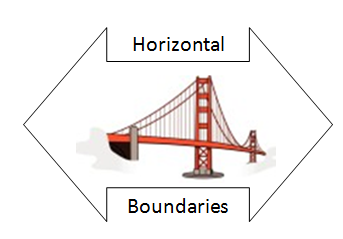
Success at a strategic initiative involves bridging horizontal boundaries

Some might argue that this is not a flaw; that the purpose of a “plan” is to list solutions and activities. The problem with describing solutions and activities is the ambiguity avoidance. People implement things “to the letter;” they then miss – or lose sight of – the underlying rationale for the strategy.

Leaders recognize ambiguity and probe for the contextual factors
behind decisions and strategic intent.

I’ve seen it happen repeatedly: Ambitious goals are lowered to the point that it is no longer a strategic initiative, just a technology-deployment project. Don’t de-scope or ignore boundaries.

Try this instead:

Focus on audiences and outcomes.  Clarify the “need” as either a problem solved, or an opportunity seized. Build bridges and search for synergy.

For example, the VP of HR for a large company in the Travel/Hospitality industry presented his strategic plan, which contained several activities that would support the company’s growth strategies. The plan was approved and handed off to a project manager in the HR department. As time went by, little progress was made on strategic objectives. The turnaround came when this project was rolled into a strategic initiative program, and program management concepts were applied:

  • The program manager led the reexamination of stakeholders and outcomes (in this case, the board of directors was holding executives accountable for generating new revenues for invested dollars).
  • There was more emphasis placed on finding the best ideas from anywhere, not simply within the company. The project manager of the HR portion was forced to look at cross-functional concerns from the marketing and operations groups.  Creative ideas were found by looking outside of the company’s existing product line.

The result of program management and improved leadership: The strategic initiative was able to establish a credible program for generating the business revenue growth.

Leaders Make Connections

By definition, a strategic initiative is boundary spanning. Here are some additional ways that you can make connections that might suggest opportunities to find strategic synergy:

  • Person-person – Who are the people who have information, resources, and personal connections?
  • Cause-effect – Given that you want a certain outcome, what are the drivers of that outcome?
  • Supplier-customer – What interesting is going on with your suppliers and with your customers?

Synergy involves the accumulation and fusion of knowledge. Where can you find boundary spanning opportunities in your current endeavor?

Posted in Interpreting Strategy Documents, Strategic Planning Issues for Strategic Initiatives, Strategy Coaching and Facilitation, Useful Practices & Management Tools | Tagged , , , , , , , , , , , , , , | 6 Comments

What are the Strategic Pillars that Support the Vision?

Pillar Puzzle

Pillars provide strength and support for something. In the case of strategy formulation, strategic pillars hold up the vision. Remove a pillar, and the vision is in risk of collapse. (Strategic pillars are also called strategic planks.)

In an earlier post, I explained that a vision is something that can be verified: you can “see” its achievement. Pillars help people to confirm that the vision is not a flight of fancy.

When evaluating a document, look for the vision and strategic pillars. Use them to develop a logical case to guide implementation. If you can’t find them: Red Flag!

Here are some examples.

Example of strategic pillars: The Save-the-News Initiative at Google

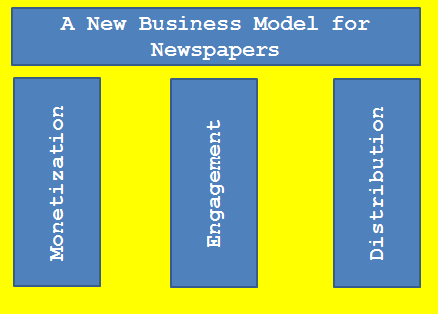
I described a real world example of a strategic initiative in an earlier posting on How Google Will Save the News. The nearby graphic represents Google’s vision with its three strategic pillars of monetization (get people to pay for the news, or advertising, or some combination), engagement (better involve the reader example: display ads), and distribution (collect and disseminate information in the best way for the business model example: YouTube Direct).

Example of Strategic Pillars: Schibsted

Here is an example from Schibsted, a Scandinavian media company. Its vision is to

build platforms for further growth within different media channels to create the most attractive media group in Europe

Shibsted then connects its vision to its Two Strategic Pillars:

Our strategy to deliver on our vision is twofold: One is to build leading positions in print and online news in Norway, Sweden and international. The second is to become the leader in rapidly growing online marketplaces.

Example of Strategic Pillars: Boy Scouts of America

Another fairly good example is from the 2011-2015 strategic plan for the Boy Scouts of America (see page 2 their strategic plan for vision and page 3 for the strategic pillars). In my analysis, BSA recognizes that it needs to be relevant and adaptive. Its pillars include programming, technology, and branding.

A Tutorial on Strategic Pillars for Content Marketing

I would like to give a shout out to Chris Morris for his tutorial, How to Develop the Strategic Pillars to Hold Up Your Content Strategy. Increasingly organizations are creating strategic initiatives around content marketing to engage customers, with the idea that high-quality, relevant and valuable information creates attention and loyalty.

Step 4 of his approach that he terms “plotting and diagramming fun.” (The earlier steps involve understanding the organization’s vision and understanding customer needs). In his example, vision rests on the five pillars shown in the nearby graphic.

Put it in Pictures

Chris Morris points out that graphics of strategic pillars offer three benefits:

  • They have more impact than prose or bullet points
  • They’re easy to drop into presentations to stakeholders, decision-makers and team members
  • They’re perfect “cube decoration” – objects that get looked at often and get internalized better

People Need to Believe that the Strategy is Real and Not a Passing Fancy

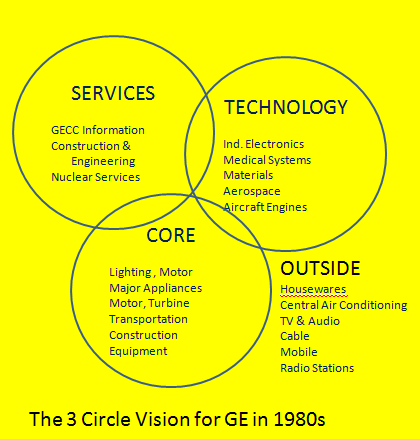
When Jack Welch became CEO of GE in the 1980s, he needed a concept that would have strategic meaning on what it was and was not. He devised what has come to be known as the three circle concept of GE strategy, illustrated in the nearby graphic. He backed up his ideas with action, for example divesting GE’s venerable-but-lagging Housewares Division.

A final example is a large pet supplies retailer. Its vision is to grow the business and the pillars are delight the customer and operational excellence. It came up with a clever acronym of DOG (delight, operate, grow); making their mission as a pet supply retailer relevant to the decisions that employees make in support of the vision.

What are some other examples of Strategic Pillars? How can we know if we have the right pillars?

Gregs new book available now
Posted in Examples of Strategic Initiatives, Interpreting Strategy Documents, Strategic Planning Issues for Strategic Initiatives, Success Principles for Strategic Initiatives, Useful Practices & Management Tools | Tagged , , , , , , , , , , , | 7 Comments

Can You See Your Vision Statement?

vision

VISION - See It!

An important task for the leader of a strategic initiative is to bring clarity to the statement of (call it any of the following) strategic intent, vision, outcomes, goals, and business requirements. I introduced Step 1 of a four-part approach for interpreting a strategy (see the side box for a recap of the issue) in a prior post. In this posting, I provide some insights on finding, evaluating, and improving the vision statement.

Finding the Vision Statement

One important purpose of strategy documents is to justify budgets and the continued support of a functional organization; the result is that the documents contain descriptions of activities.

The Issue: Vision and Strategy Documents

A strategic initiative is different from the ongoing business of a given function because – as an initiative – it is intended as a launch of something important.

Your primary task in reviewing a strategy document for vision: find the language that describes the outcomes, goals, results etc. in the document.  I happen to like the word “vision” because vision is something you see; it is a more concrete word than the more common word “goal.”

Evaluating the Vision Statement

When discussing strategic initiatives, we want to make sure that the vision clear and compelling.  The Chrysler Viper had a vision that was “a production automobile that evokes the Shelby Cobra” and Domino’s pizza was to “win a taste test against national competitors.” The guiding principle is:

A good vision statement is verifiable.

You can verify the vision statement in one these four ways: demonstration, testing, analysis, or simulation.  Also consider the following principle:

Vision statements that are closer to the present should have more detail
than those that are farther out in time
.

The Phil Delta Theta fraternity provides an example of how to do this well. Their “Strategic Initiative #1 – Growth” explains that they will execute strategies to achieve 200 chapters and colonies by the year 2020.  They provide more detail that says that this growth is targeted to achieve an outcome of a total of 12,250 members.  How are they going to do this? By installing 7 chapters per year, starting in the year 2010.

Improving the Vision Statement

Vision statements for strategic initiatives can usually be improved, and this provides the opportunity to involve important stakeholders.  Here are some suggestions:

  • Involve others.  Consider the advantages of each of the five ways to socialize a vision.
  • Consider big stretch goals and dreams.  I am a big believer that people can accomplish great things.  I encourage your to think about considering a breakthrough result rather than an incremental result.
  • Dig into the data. Vision is not magical dreaming. It means you need to know your important (and interesting) stakeholders interpret the world around them: technology, social factors, economy, and so forth
  • Create milestones. Consider a series of vision statements, each at various points in the future; say 2 years out and 5 years out.
  • Create criteria for verification. Those vision statements that are closer in time have more detail than those that are farther out in time.
  • Consider them as a chopping mechanism. As Chris Peters of Microsoft says,
    “A good statement tells you what’s not in the product.  The hard part is figuring out what not to do. We cut two-thirds of the features we want to do in every release off the list. If we could actually write down everything we wanted to do, it would be a fifteen-hundred page document.  So the vision statement helps you in the chopping mechanism, not in the creation mechanism.

Vision, Alignment, and Commitment

I have previously explained that alignment and commitment are fundamental characteristics of a successful strategic initiative. I think that vision is perhaps the key tool for achieving it.  If a group of people can see the same destination, they can both align their energies and make better choices about whether the benefits that come from achieving the vision is worth their investment of time, energy, and emotions.

Your homework:  look at your documents. Is there a vision statement? Does it make sense? Is it verifiable?

Posted in Interpreting Strategy Documents, Strategy Coaching and Facilitation, Useful Practices & Management Tools | Tagged , , , , , , , , | 11 Comments

Interpreting Strategy Documents: More Insights and a Valuable Tip!

Make this request of the strategy formulators

A “strategy implementation readiness” meeting is useful for aligning top managers (strategy formulators) and the program implementation team. Typically, strategy documents are distributed to the team in advance, and the meeting typically involves asking questions and clarifying intent. These documents include slide decks, spreadsheets, position papers, and research reports.


How to get them to ease into the strategy’s backstory

When you are in the situation of talking to the author(s) or editor(s) of a strategy document, make this simple request:

“I’ve read through the strategic planning documents that you provided me.  Can you walk me through the background and your thought process?”

This approach works wonderfully in getting people to open up. It gives them permission to think out loud; which is important because people structure memory differently. Your job is to listen for interesting things. As management guru Peter Drucker writes,

“The most important thing in communication is to hear what isn’t being said.

Much important information is found in a strategy document. However, the process of developing those documents is one where the author/editor – in trying to create consensus and clarity – removes information that might trigger disagreements.  Here are examples of things that seldom make it into a strategy document:

  • Weak signals from the marketplace, technology, and industry. Often these are important leading indicators. I classify these as external strategic context. For example, Silicon Valley is full of companies that were started by entrepreneurs who saw and exploited a weak signal.
  • An assessment of power and influence.  Yet, most members that vital organizational information is knowing who is up, and who is down. I classify these as internal strategic context. Despite all the methodology of rational process, tribal emotions rule the organization. 

When you let people tell their story in their own words, you hear about their passion and their pain.  This is the energy that creates relevance and enthusiasm for the strategic initiative. 

Avoiding Three Common Mistakes

The walk-me-through-your-thought-process request helps to avoid these three common mistakes…

  • You assume that because an individual’s name is on a document, the individual is the author of the document. That may not be the case. The author could have been a consultant, staff specialist, or executive assistant.

Now, let’s assume that they did not write the document.  
Should we assume that
they read it?

  • You assume that the author remembers what they wrote.  We all know that memory is fragile. Can you recall the details of a document that you wrote 3 weeks ago?  Probably not, and it’s not fair to ask someone else to remember the details behind the abstractions typically found in a strategy document. 
  • You forget that that the document likely went through a number of iterations and edits.  Ironically, the process of aligning and committing decision makers edits out much important contextual information that would be valuable to the implementation team.  So you assume that the strategy is “correct” and take it at face value.

It is risky to take a strategy document at face value.  Why? It is impossible to include all relevant information.  Furthermore, the document is an output of a long series of conversations, deliberations, and decisions. 

What interpretation techniques do you use to understand people’s perspectives on the strategic context?

Posted in Useful Practices & Management Tools | Tagged , , , , , , , , , , , , , | 4 Comments

Interpreting Strategy Documents: A Key Skill for Implementation

Strategic Plan

Turning strategy into action

“Less than 10% of strategies effectively formulated are effectively executed,” reports Fortune Magazine.  Numerous authorities have opined that the reasons are lack of executive leadership and involvement, good metrics, and aligned compensation.  Interestingly, little has been written about the essential task of interpreting strategy documents.  It may be boring, but it is certainly not trivial.

Here is a short statement of the issue:

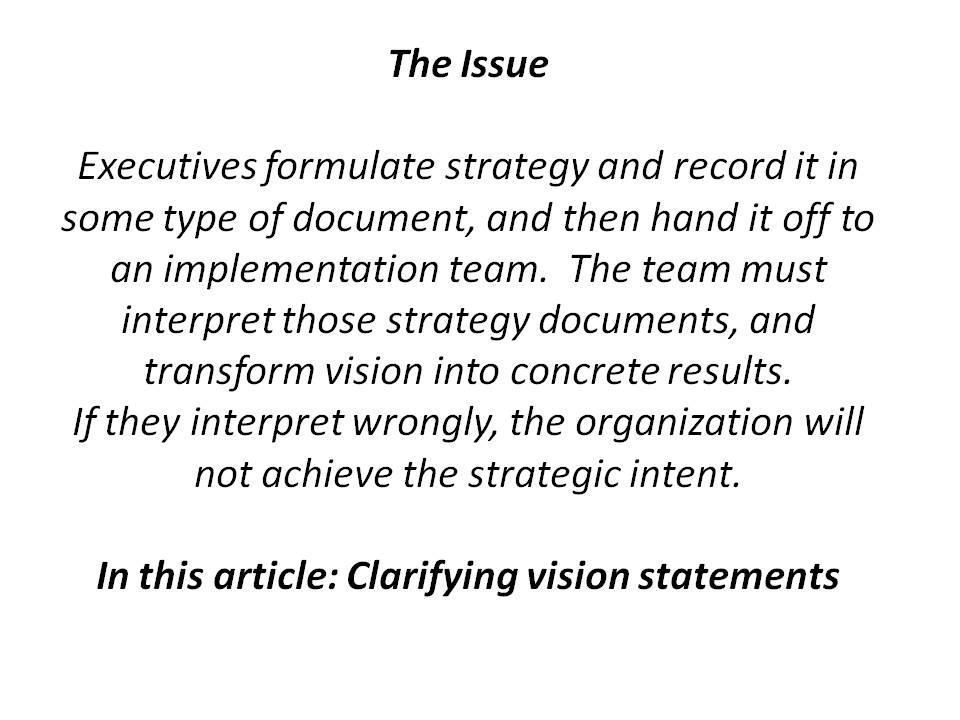
Executives formulate strategy and record it in some type of document, and then hand it off to an implementation team.  The team must interpret those strategy documents, and transform vision into concrete results. If they interpret wrongly, the organization will not achieve the strategic intent.

The reasons for poor interpretation of strategy include:

  • Strategy documents are typically crafted for presentations.  Often there is a master set of templates for each functional area in the organization chart, with the purpose being consistency.
  • Implementation is seen as a detail. The authors often assume that brilliant strategy is the heavy lifting.  There is no “strategic readiness assessment” nor a project kickoff for managing the transition.
  • The implementation team often has not participated in strategy formulation.
  • The individual reader brings bias to their interpretation of the documents.

You can use this four-step process to improve the understanding of strategy, and hence its adoption. In this article, I introduce some useful practices for Step 1 and illustrate with an example.

Case Study: Interpreting a Strategy Document

The merchandising function of a large North American specialty retail company (45,000 employees at 1300 locations, publicly traded) had developed a strategy covering the period from 2010 to 2013.  The “Plan” was a summary 13-page document of PowerPoint presentation slides showing proposed activities year by year. In reviewing the document, I could tell that the authors had put a lot of time and thought into identifying a set of activities that would improve company’s ability to execute merchandising activities.

As is often the case, it was sent to the implementation team without much supporting direction other than “write a strategic initiative.” In this case – and it is typical of strategy implementation –the implementation team included people who normally work with well-defined tasks with clear deliverables; e.g., technical backgrounds like IT.  One senior manager observed the challenge of interpretation in this way,

“It is hard for the team to mentally reframe from detail/precision to ambiguity. It shocks their comfort zone.”

Three Useful Practices for Interpreting Strategy Documents

As the strategic initiative leader, your first step is one of analysis to gain an understanding of the document’s author(s). Here are three practices that I used in this situation:

  • Key Words/Glossary – The team identified 9 key words in the document, and developed a glossary for any terms that might be misinterpreted.  This is a useful practice for assuring that the strategy implementation team understood the intentions of the strategy formulation team.
  • Metrics – Metrics give us insight to priorities, and new metrics suggest points of change. In this case, there were few metrics listed. Thus, we knew that we would need to ask more questions about how the executives would evaluate the success of this strategy.
  • Concept Map – I developed a concept map for the team, and encouraged their critical thinking about its validity.  This is a really interesting tool, so read on!

More How Concept Maps Can Help with Strategy Interpretation

Here is the concept map, developed with CMap Tools (freeware- check out the link). The concept map shows the hierarchical structuring of knowledge related to the Focus Question, which was: What are the main elements of merchandising strategy contained in the PowerPoint file?


You read a concept map from top to bottom. Each node-to-linking-phrase-to-node is called a “proposition,” and the higher-order propositions are the basic answer the focus questions.   The lower-order propositions (towards the bottom) help to explain the higher order: much easier to comprehend compared to thousands of words spread across a PowerPoint file!

Through this initial analysis, the implementation team could gain some perspective about high-level abstract concepts, and their relationship to the details:

If this is the strategy, what does it imply for implementation?

Notice that the concept map presents three individual merchandising elements: promotions, pricing, space and assortment. Stated differently, a retail manager needs to price and promote merchandise, and assure that there is an appropriate amount of shelf space and assortment.  These are core to the textbook duties of a merchandising functional group.

This concept map clarified the “structure” of the strategy, but it also raised an important question:

Where are the Opportunities for Synergy?

The interesting parts of this strategy might be found in the two non-merchandising elements on the top level of the concept map.  Notice the presence of processes (shown as process, standards, and tools on the concept map) and training (shown as training associates, grow talent, create happy associates, capable with strong expertise).  These improvement elements offer two points of synergy:

  • They probably overlap with other functional strategies for this company.  Combining resources may create more efficiency and strategic impact.
  • There may be the famous “white space” opportunities. White space is jargon for finding needs for that “fall between the cracks” in the company’s current business model.

Run the Business and Change the Business

I learned from HSBC Bank this simple rule that I apply when reviewing any strategy portfolio:  everything that a manager does supports either 1) running the business, or 2) changing the business.  Since strategic initiatives are transformative, we need to identify and understand the nature of the change: is it incremental change of a continuous improvement nature? Or is it radical change that requires strong leadership and committed resources?

How do you create insights and strategic perspective?

Please bookmark with social media, your votes are noticed and appreciated:

Posted in Examples of Strategic Initiatives, Interpreting Strategy Documents, Program & Portfolio Management, Strategic Planning Issues for Strategic Initiatives, Useful Practices & Management Tools | Tagged , , , , , , , , , , , , | 11 Comments

Action Items to Make You Sleep Better

What Keeps You Awake at Night?

Newsweek magazine called the opening guitar riff to the Rolling Stones’ (I Can’t Get No) Satisfaction, the “five notes that took the world.”

It has been widely reported that Keith Richards woke up in the middle of the night, recorded the riff and chorus on a portable tape recorder, and fell back asleep (he later described the tape as “2 minutes of music and 40 minutes of snoring”).

 He brought these two musical hooks to his band mates, and collectively the Rolling Stones launched a career breakthrough.

Your Inner Voice

An inner voice caused Richards to awake. Perhaps the Satisfaction riff came from an inner muse, but I suspect that Richards’ subconscious was processing tensions and anxieties from the Stone’s 1965 tour.

Similarly, an inner voice can help you with the tension and anxiety due to implementing strategy at work.

This analogy of Satisfaction with organizational strategy includes a dynamic context (e.g., a growing demand for bluesy British rock music), strategic intent (e.g., the Rolling Stones’ desire to be successful in the US market), and a group of talented collaborators.

The inner voice can resolve tension in ways that are good or bad. First the good….

Sparking Individual Creativity

As Keith Richards knew, the inner voice is an asset and a tool for problem solving.  Conrad Hilton explains,

“I know when I have a problem and have done all I can: thinking, figuring, planning, I keep listening in a sort of inside silence until something clicks and I feel a right answer.

Here are some good ideas for using the inner voice:

  • Work in very short, intensive bursts.  Strategy and its execution often involve considerable data, and this data requires analysis.  I find this helps me find clarity, and occasional breakthroughs: first, a deep dive into the data, and then a “time out” for a trip to the gym for some equally intense exercise.
  • Ask good questions.  For example, a company that was struggling with a vague strategic vision used this question: “How might we transform our organization from its current focus on operations to one where innovation is seen as an equally desirable activity?” As the team grappled with that question, they were often stuck by observations that everyone was busy, they had been successful to this point, and “that’s the way we do things.”  In other words, culture would get in the way of the transformation.  One breakthrough came when a member said he awoke with this question, “What are the core organizational values that give strength to this company?”  The resulting list became the pillars for making an effective transformation.
  • Listen well. People need to have a certain amount of venting to get their concerns off their chest.  A good leader will be patient listeners that are skilled in paraphrasing.

Your Unchecked Worrywart

The stresses of a strategic initiative can cause the inner voice to become overactive and anxious. Strategic initiatives have uncertain outcomes, and people are concerned that their personal association with a strategic initiative may lead to an unpleasant outcome.

As most know, people can get neurotic when they pay excessive attention to threats.

Action Items to Make You Sleep Better

We need to manage the concerns that cause the inner voice to speak up. Of course, we can’t ignore the organization’s desire for rationality and structure.

I have observed and participated in numerous risk brainstorming sessions, many of them bureaucratic exercises of identifying risk events; followed by analysis, prioritization and contingency planning.

If facilitated well, there is a sense of relief from anxiety.

Here is an interesting approach that provides a rational structure yet allows the inner voice to express its concerns:

I am working with a 12-person virtual group and we rely on conference calls supplemented by web tools. In my earlier meetings, I would simply say, “Let’s identify risks, assumptions, issues etc.” Most of the time there was very little participation.

This time I posed the question, “What keeps you awake at night?” It turned out to be an interesting modification of the “What about….” technique.

People could relate to the stress and anxiety of worry by this question, and it really engaged them emotionally and they were much more enthusiastic participants. We are now calling we are now calling them, Action Items to Make You Sleep Better. Our discussions were much more lively and productive.

Shakeel Ahktar
Denver, Colorado, USA

Turning Tension Into Action

Our job as leaders is turning tension into action

Strategic initiatives are characterized by ambiguity; most people tend to avoid ambiguity, or at tolerate it with discomfort.  This creates tension, which we overcome with action. The psychologist and humanist Viktor Frankl wrote,

“What man actually needs is not a tensionless state but rather the striving and struggling for a worthwhile goal, a freely chosen task.

One of the leader’s jobs is helping people resolve the tension between what individuals want to achieve (vision) and what is holding them back.

How do you turn tension into action?

Posted in Competencies of Strategic Initiative Leaders, Strategy Coaching and Facilitation, Useful Practices & Management Tools | 3 Comments

Leadership: A Tool for Strategic Initiatives

067/365

Leadership is an essential element for transforming vision into results. Leadership enables the two critical benefits of alignment and commitment. I assert that leadership is a tool, because

“Leadership causes results.”

As the following table shows, there is a linkage between leadership elements and organizational benefits. The left-hand column lists key elements of strategic initiatives, and the right column shows leadership attributes. Leaders have to consider a number of factors – and get them right – to be successful with a strategic initiative.

Strategic Initiatives involve: Leadership Functions
Stretch goals that require creativity and innovation Inspiring others to bring out the best of people’s energies
Confronting threats and harsh realities Showing courage: Bravery is needed to venture into the unknown. Truth telling is necessary revealing unpleasant information.
Working with vision, ill-defined problems and emerging opportunities Helping people to overcome ambiguity and develop common mental models of vision, metrics, and methods. Help define and make relevant the abstractions.
Gaining the support of important stakeholders that are external to the organization Reaching out, listening, and promoting compelling ideas. Cultivating personal relationships and making promises
Accountability for results Modeling and expecting integrity
Different points of view about the nature of the problem and the solution Sharing and building values and ideals

As I watch executives, I see that some “use” the leadership functions listed in the right column more skillfully than others. There is a direct correlation between the skill in the listed function and the quality of the result achieved.

Stated differently, leadership could be considered a means to an end.

What Tools Do

Consider: Tools help in the performance of a task; they are also a means to an end. Therefore, if leadership is a means to an end, and tools are a means to an end, a provocative question is:

Is Leadership a Tool?

My short answer: Of course leadership is a tool. It helps in achieving the expected result. A person is more likely to achieve the intended results of a strategic initiative with leadership than without it.

My Perspective

My Myers-Briggs is ENTJ type, and I value competencies, capabilities, capacities, skills, and ingenuity as they relate to performance. That’s just how I make sense of the world around me.

ENTJs are 5-12% of the population, and the other 8-95% of people would see leadership differently.

Other temperaments might see leadership in spiritual, nurturing, and sensible paradigms. For an example do the spiritual paradigm, check out the course description for an executive course called The Soul of Leadership (Northwestern University’s Kellogg School of Business). It declares that the learner will gain the “Understanding the soul as a confluence of contexts, meanings, relationships and archetypal themes.”

I can see that understanding relationships, context and meanings are important leadership ideals. But it doesn’t ignite my passions.

If I’m standing in front of the CEO, I’m sure that I want to talk about gaining results and not touchy-feely abstractions.

I want to get things done, and I want the tools that will help me.

So, do you think that calling leadership a tool soulless? Given a specific task or situation, can you choose to use or not use leadership?

Posted in Competencies of Strategic Initiative Leaders | Tagged , , | 2 Comments