That’s the Fact, Jack: Data Drive Strategic Initiatives

A strategic initiative is more likely to be successful if there is an accessible record of facts, data, and patterns. This gives the leader the inputs for creating a valid, useful narrative that will gain the attention of stakeholders. Two cases in point:

  • Domino’s Pizza Turnaround was driven by consumer verbatims about the lack of quality in the product. The data was cross referenced with social media, focus groups, and accounting data.  The complaints (such as “crust tastes like cardboard”) were even posted in the product development laboratory.  Further, the development team used a sophisticated experimental design to find the optimal new product configuration.  The key launch criterion was supported by data.
  • Google’s initiative to reinvent the news was supported by extensive data and analytics on trends in the news business, from circulation to advertising revenue.

One warning sign of trouble is when a narrative is created by the strategist, but that narrative is not supported with relevant data. An example: A manager at Cooper Tire related his perception of the challenges of repositioning the company into an unfamiliar market.  He said, “It was the CEO’s vision. It made no sense to the middle managers. There was no data. We didn’t have strengths in the market area, and it took away from our core focus.” He and others did what was instructed to support the initiative, but didn’t believe in the initiative. Over time, the initiative floundered, in part leading the Cooper Tire Board to issue a press release announcing that CEO Thomas Dattillo, was leaving to “pursue new opportunities.”

Diagnosis is a Key Part of Any Strategy

A key element of any strategy is a diagnosis of the situation. The question is simple, but the answer to it involves ambiguity and strategic thinking,

What is going on here?

A diagnosis serves to describe the situation. For Domino’s Pizza, the diagnosis was that a trend of food-quality complaints in social media and elsewhere was related to revenue trends.  For Google, the diagnosis was, “If newspapers stop producing good journalism, we will have nothing interesting to link to.”

All organizations face complexity and struggle to master it (see this article for rules for managing complex strategic initiatives). A diagnosis provides a simplification of reality that allows managers talk about the causes of the situation, and to evaluate the worthiness of various plans of action.

Strategic Initiative Leadership: Connecting Facts to Strategy

I find Christopher Agyris’s ladder of inference (illustrated in the nearby graphic) is a useful tool for connecting strategy to the facts.

In the previous article, I explained how strategy and conversation are intertwined. At a micro level, strategy is a set of actions based on a set of beliefs. Where do those beliefs come from, and how does this relate to data?

At the top level of the graphic we see the actions-belief relationship. The beliefs rest upon conclusions that in turn rest upon assumptions that are culturally influenced.

A skilled conversationalist uses this tool to walk people up and down the ladder. Sometimes the conversationalist uses inquiry (help me understand your mental model) and sometimes the conversationalist uses advocacy (let me explain my mental model).

An Example of Walking Up and Down the Ladder of Inference

In a recent strategy session, Deborah and Mike found themselves disagreeing on the proposed actions of their group, and were taking up valuable group time with their discussions. They were each frustrated. Deborah advocated for “Strategy X” while Mike advocated for “Strategy Y.”  I helped them get through this by sketching out the ladder, and inquiring about their mental models. Soon it became very clear that Deborah was looking at a different set of facts than Mike. Further, Deborah placed more meaning on some data that Mike found less important.

We didn’t resolve the frustration in that meeting, but at least we got agreement that we needed better data and analysis.  The situation was resolved and a strategy was set at the next meeting.

Include White Hat Thinking in Strategy

I suggest that people read Edward de Bono’s Six Thinking Hats.  Early in any strategic planning or execution planning exercise, we should use the White Hat, which is the emphasis on gathering and understanding the facts.  The White Hat is a useful counterbalance to Red Hat emotional reactions.

How has data and analysis driven your strategic initiative?

Posted in Competencies of Strategic Initiative Leaders, Strategic Planning Issues for Strategic Initiatives, Strategy Coaching and Facilitation, Success Principles for Strategic Initiatives, Useful Practices & Management Tools | Tagged , , , | 4 Comments

A Simple Idea that Every Good Strategist Knows

An IT program manager approached a Kaiser Permanente executive after a meeting and suggested a solution to an important business issue. That low-key, off-line conversation led to the chartering of a strategic initiative that provided millions of dollars of cost and other business benefits. (Read more here.)

It is common to hear that a strategic decision was made in a hallway conversation or on a golf course. Every strategist who has been “in the trenches” knows that the values and fears of the people in the culture are powerful moderating forces.

Thus, every good strategist understands this simple premise: strategy is a series of conversations about important business issues culminating in the commitment to act.

Why Conversations are Relevant: A Micro-Definition of Strategy 

Strategies often fail because people are not convinced of the need for change, and/or they don’t take action. Thus, one practical definition of strategy is,

Strategy is a set of actions based on a set of beliefs.

This definition fits nicely with more conventional textbook ideas of strategy. Examine this logic: strategy is discussed in conversations; conversations are sense making devices; stories help people make sense; collectively, individual stories become larger narratives; organizational narratives are (in part) explanations of the organization adds value and intends to gain competitive distinction.  Hint: start with the espoused high-level strategy and you have a conceptual tool for transforming vision into action!

Talking is a form of action; indeed, it is what managers do most. Effective managers use conversations as a tool for gaining agreement on problems and solutions and to making commitments to each other.

Personal Beliefs and Strategy

Strategy implementation depends upon its socialization by stakeholders.

When individuals meet to discuss strategy, they naturally bring their own mental models about the organizational situation, vision, and proposed actions. Joe may think the situation dire, and Jake may think Joe is over reacting. Susan may think there are tremendous organic growth opportunities, and Sunil may think that an acquisition is the only viable strategy. Gary wants to budget more money for new product development, but Anna wants to invest in improved workforce engagement. Each has facts and logic to support their point of view.

What is Good Strategy? A Conversational Perspective

If strategy is a set of actions based on a set of belief, next, consider this proposition: A good strategy is the right actions on the right things. The notion of something (more specifically, a belief) being right or wrong encourages us to recognize that each person carries a set of beliefs about right and wrong, and this ethical framework guides their actions.

Executives and other stakeholders have opinions as to whether the situational assessment (e.g., SWOT) is correct, whether the vision is right for the situation, and whether the proposed actions are appropriate or optimal. The conversation about strategy can now be extended to include questions like these:

  • Is our strategy focusing on the right things?
  • Will these proposed actions help us close our most-important performance gaps?

Making The Strategic Conversation Work

Not everyone cares about every issue; some people are passionate and some are apathetic. Not everyone has the same information about the issue. Finally, each person brings a difference set of experiences and training to the situation. Strategy implementation depends upon its socialization by stakeholders.

The good news is that executives can reach consensus. How do they do that?

They hold one-on-one conversations with each other,
where they can probe, test, and argue ideas.

Constructive Dissent Improves Strategy

Leaders can assure a more complete analysis of strategy – and reveal threats – by fostering dissenting points of view. Here are three example questions to consider:

  • This is what I believe. What do you believe?
  • I don’t believe this trend. What do you think?
  • What contrary beliefs would upset our business model?

Strategists should keep in mind the advice of the 5th Century BC historian Herodutus, “Unless a variety of opinions are laid before us, we have not opportunity of selection, but are bound of necessity to adopt the particular view which may have been brought forward.”

Do you agree that conversation is an essential element of strategy? Doesn’t it stand to reason that conversation is a skill, and that quality of conversation may determine the quality of strategy?

Posted in Competencies of Strategic Initiative Leaders, Strategic Planning Issues for Strategic Initiatives, Useful Practices & Management Tools | Tagged , | 12 Comments

Apple versus Samsung: Three Lessons for Strategic Initiative Leaders

Last week, after weeks of arguments in a highly-visible court case, a US jury found that Samsung violated Apple’s patents and awarded it $1.05 billion.

Here are three lessons for strategic initiative leaders:

Lesson 1: Tell the Better Story

Patent law is complex and specialized, not unlike the issues found in most strategic initiatives. These issues need to be distilled into a plausible narrative arc. This arc allows the audience to clearly identify the hero, the villain, and the tension between the two.

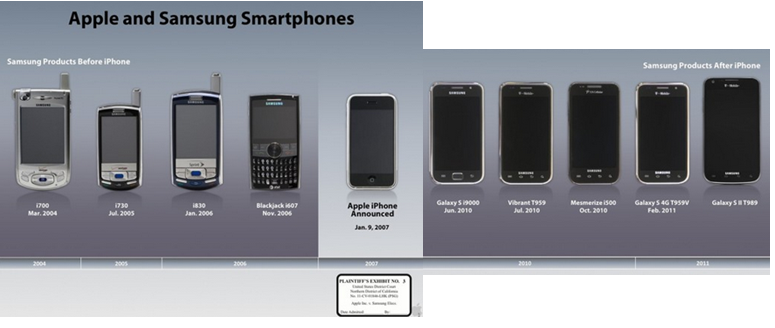
In this case, the jury found that Apple told a more plausible story: Samsung intentionally copied Apple’s patents. Expert witnesses for Apple stated that Samsung “ripped off” Apple.  Perhaps the most effective part of building the Apple case was a series of illustrations (see nearby graphic for a mash-up) that showed Samsung’s designs before and after the introduction of the iPhone. The jury was shown these slides repeatedly, reinforcing a central theme of Apple’s narrative.

Samsung’s lawyers had a more difficult story to tell, which was “Apple is not this creative genius that they claim to be. They are losing market share [to Samsung] and  want to compete in the courtroom,” (source, Brian Love as quoted in the Wall Street Journal, August 37, 2012). To make this story work, Samsung’s lawyers had to convince the jury that Apple’s had exaggerated the innovativeness of its patents. Second, Samsung’s lawyers had to convince the jury that Apple had infringed on Samsung’s patents (intellectual property law is a specialized and technical field). The result?  The jury was not convinced.

Apple showed Samsung designs before and after the introduction of the iPhone

Lesson 2: Make Better Strategic Bets

Trial testimony shows that Samsung had the opportunity to purchase licenses for smartphones and tablets from Apple.  Had Samsung chosen that strategy, they would have avoided the huge cost of this jury verdict and the weakened competitive position they are now in.

Lesson 3: Value Originality

We don’t know why Samsung chose the relatively lazy approach of copying Apple, rather than investing in its own design and engineering. Apple showed that other smartphone competitors could come up with original designs, as did Nokia and HTC.

One important element of leadership is the search for authenticity and originality, and the inspiring others to find a unique path.

What other strategic initiative leadership lessons are present?

Posted in How to Improve Your Story Telling Chops, Success Principles for Strategic Initiatives | Tagged , , , , , , , | 1 Comment

Four Things Strategic Initiative Leaders Need to Know About Requirements

Requirements are the #1 cause of project failure and frustration. Because strategic initiatives are programs composed of projects, a project-level failure could compromise the performance of the entire strategic initiative. The logic is straightforward: requirements quality influences project outcomes; a failed project will undermine strategic initiative performance.

The implication:

To turn vision into results, leaders need to be proactive with policy for capturing and managing requirements.

1. Requirements Flow From Strategic Vision and are Distinct from Solution Design

Perhaps one of the most important of all strategy tools is a strategic vision statement. A well-constructed vision statement describes the future-state target for the strategic initiative. Since the vision is the target, the strategic initiative is the means to achieve that target. Stated differently, the vision is the “what” and the strategic initiative is the “how.”

Usually, strategic vision statements are abstract. To turn “vision into results,” we leaders need to systematically decompose that vision. We do this by working to better understand the vision; that is, make it more specific by better understanding the problem or opportunity.

Here is the best definition of a requirement:

A requirement is a description of a verifiable future state in which a customer, user, or stakeholder expects to experience benefits that are sufficient to justify investing resources to develop a solution.

Parsing this definition into its essence yields five important insights:

  • Requirements describe a future state. Requirements perform essentially the same function as a vision statement.
  • Requirements (the what) are not the same thing as a solution (the how).
  • Stakeholders expect to receive benefits.
  • The benefits must justify the investment of resources.
  • Requirements are verifiable. The solution developer (or the project manager) must compare the solution to the requirements to see if the solution has the expected functions and performance. The definition implies that requirements are agreements or promises.


Commonly, strategic vision statements include things that people consider
wants or needs or wishes or desires. Often, you will hear the phrases, “must haves” and “nice to haves.” Here are two rules:

  1. If a customer (or end user) declares something is must have or a nice to have, pay attention. This declarations is useful for prioritization.
  2. If a technical person is offering an opinion on “nice to haves,” work to validate it with the customer. Often, technical people have the opinion that nice-to-have implies that the request is frivolous.

2. Capture Requirements by Leading With Questions

The nature of strategic initiatives is of coping with ambiguity, where much of the ambiguity concerns clarifying the nature of the problem or opportunity. The leader applies the “Chief Learning Officer” role and asks lots of questions.

Here are some of the questions that I use in placing requirements into the process:

  • I ask this question, Why are we doing this? (This is the first question in the tool that I call the Four Driving Questions.) I look for the strategic context and rationale for the question. I listen closely to the answers I continue to explore and probe.
  • Second, I ask, Who are the stakeholders and what benefits do they seek?
  • Thirdly, I keep in mind that people will commonly confuse requirements with solution design: the requirement is the ‘what does done look like?” and is distinct from the ‘what do we want the solution to do?” To reiterate, Requirements are the “What” and design is the “How.”

3. Managing Requirements – Integrate them into Program Governance

Programs management is a structured approach to organizing projects to gain synergies. Each project is likely to treat requirements differently. I find it quite useful to include requirements in our strategic initiative planning discussions. I want to hear the project managers’ concerns, and gain agreement on governance questions such as these:

  • What will be the common conventions for identifying stakeholders, asking questions, making decisions, and documenting requirements?
  • Who will have responsibilities for what?
  • How will the program establish policy for consistency and quality?
  • Are the advantages of centralizing repositories of requirements worth the expense?
  • How will we tie requirements-solution verification to benefits realization?
  • How can we provide early warning metrics if there is a problem with requirements?
  • How will we iterate? Strategic initiatives usually apply iterative design approaches. The path-finding approach described in this article provides useful metaphor for working into the complexities of a strategic initiative.

4. Conclusion: Some of the Hardest Work in a Strategic Initiative is Requirements Capture and Management

Requirements capture and management is an important strategic initiative competency. It is hard to implement for at least three reasons:

  1. People need knowledge. The need to understand the definition terms like requirement, design constraint, validation, and verification. They need to understand that a vision statement is an abstract requirement. They need to understand their organization’s business model and metrics.
  2. People need skill. They need skill in asking questions and organize information.
  3. People need desire. Requirements is a discipline that requires effort. In time-crunched and resource limited environments, people need to apply their knowledge and skills in a disciplined way. They have to be prepared to work in a structured way and withstand pressures to discard proven methods for requirements capture.

To summarize, people need intelligence and skill to know what questions to ask and how to ask them. They need to step out of their comfort zone and interacting with people to capture information and make decisions. Finally they need to organize and specify the information so that an expert can design a solution that meets the requirements.

Recall the logic introduced at the opening of the article: requirements quality influences project success outcomes that influences strategic initiative performance.

These four things are a good start for the leader. What else do you recommend?

Posted in Program & Portfolio Management, Success Principles for Strategic Initiatives, Useful Practices & Management Tools | Tagged , , , , , , | 6 Comments

The “Call to Action:” A Useful Leadership Tool

Call to ActionOne of the most useful tools in the communication and motivation toolbox is the “call to action.” The value to the leader of a strategic initiative?

A well-constructed call to action helps people grasp a vision, contrast it with the status quo, and make a choice about their response.

A call to action is the leader’s request for  specific actions by the audience, supported by a rationale.

A manifesto is a call to action in a written form; probably the most famous example (for Americans) is the Declaration of Independence. The Declaration articulated the case for rejecting the status quo of being a British colony and stating that the signers have established a new nation based on different principles.

Closing Performance Gaps

In an earlier article, I explained that the purpose of a strategic initiative is to close a performance gap; examples could be revenue growth, cost restructuring, or other changes to the business model.  Obviously, when we can provide data describing these performance gaps, we can improve people’s understanding and strengthen their resolve.

Importantly, there is always an emotional dimension to organizational change. A strategic initiative is a rejection of the status quo and with a movement towards a new vision. Stakeholders probably have questions like these: Is any strategic change necessary? Is this the right one?  What is the probability it will succeed? Is making this specific change better than the alternatives? These questions imply objection to the call; thus, leaders to find objections and problems solve.

The Choice to Support a Strategic Initiative

You will always get better support for a strategic initiative if the call for action is presented as a choice, rather than a commandment. The audience’s own sense of integrity will cause accountability. This is much better than creating a governance system that has heavy-handed monitoring and compliance.

Also, experience shows that you will get more support if you can present a small list of alternatives. Chief among them is the take-no-action alternative. Generally a “no action” alternative is the acceptance of the status quo. If people will accept the status, you have to wonder about their ambitions and competitive drive.

More Useful Ideas for Creating a Call to Action

There are several other tools for creating an effective call to action. Here are a few that I have written about:

  • Explore the tension between the “as is” and the “to be.”  Your goal is to describe the contrast, not simply list things in the two categories (the current state of the organization and the new state).  Hint: place the bulk of your energy effort into imagining and describing “what could be.”
  • Use the tool, Five Ways to Socialize a Vision. In particular, the approach of testing a vision is useful. You provide your best expression of a vision, and ask the audience, “What do you like and what don’t you like about the vision?”
  • The technique called the four driving questions is always provides practical insights. The first of the four questions is the important starting point for a call to action: Why are we doing this?
  • Improving your story telling chops.  Make the audience of your call to action the hero. You are asking them to serve.  Certainly there will be sacrifices, so help them see that the sacrifices are worth it.
  • Identify metrics that help to clarify the performance gap. Metrics help to create a signal that cuts through the noise
  • Identify the innovators and early adopters in your target population.  Let them hear the call to action first.  Position your messages with the TACOS criteria.

Prepare for the Refusal of the Call

In movies, the hero (think Luke Skywalker or Frodo Baggins) typically resists the call for action, but eventually realizes that they need to leave behind familiar ways.  In an organization, people need to step out of their comfort zone.

In organizations, people often have so much going on with running the business, that it is difficult for them to change the business. I find it best to acknowledge the imperative to operate the business; I explain the imperative of balancing strategic and operational goals.

If you are setting stretch goals, you will experience “the refusal of the call.”  Just like in salesmanship, prepare for objections and establish a problem solving framework.

How have you – or how might you – use the call to action?

Posted in How to Improve Your Story Telling Chops, Transforming the Organization, Useful Practices & Management Tools | Tagged , , | 2 Comments

Strategic Initiative Steering Teams: A Sharp or Dull Blade?

Knife & Orange cloth

Sharp knives are effective

It is taught that a dull knife blade is more dangerous than a sharpened blade. By analogy, sharp strategic initiative steering teams are useful tools and dull ones might be dangerous.

Steering teams are usually composed of relatively senior managers. As senior people, they bring experience and a higher-level perspective to the various issues that are found in a strategic initiative. Here are some of the ways that a sharp steering team adds value to the strategic initiative:

  • Steering teams can improve the characterization of the problem or opportunity. Steering team members have local knowledge that is not shared by others. Steering teams can help to avoid the mistake of jumping into solutions without understanding the problem (see the previous article on solutioneering).
  • Steering teams can improve the understanding of the local and enterprise-wide organizational impacts of proposed solutions. Almost always, the negative impacts are unevenly distributed. Some parts of the organization feel great pain. We need to assure that each stakeholder balances the greater good versus the sacrifice.
  • Steering teams can validate the strategy. There are three important high-level questions that can confuse strategy execution: “What businesses and industries do we want to be in?” “How do we compete against our competitors?””Where should we specialize?” (For more on the questions, see this article on the three kinds of strategy.) The steering team is a huge help in interpreting guiding the diagnostics and interpreting the data.
  • Steering teams can support socializing strategic decisions. We need to accept that not everyone knows, understands, or agrees with a strategy. Steering team members are often held in high regard, and their opinions and rhetoric can help stakeholders understand the reasons for supporting the decisions.
  • Steering teams facilitate resource acquisition. Because strategic initiatives are endeavors – programs composed of projects – the organization needs to provide resources. The steering team is often the source for contributions of human resources, financial resources, and facilities.
  • Steering teams can validate the program governance. Because strategic initiatives span boundaries, organizations and leaders need to devise and implement coordinating and integrating mechanisms.

Should the Steering Team Steer?

I think that we should be cautious when calling a group of managers a “steering team.” On one hand, steering teams can provide direction and guidance to the project or program manager. On the other hand, dull steering teams contribute to these four interrelated dysfunctions:

  • Micromanagement. Strong opinions on the part of individual steering team members – combined with passiveness by the program or project manager (and passiveness by other steering team members, too) – can lead to the steering team effectively running the program. It raises the question, Where do you draw the line between steering and advising? This micromangement undermines morale and often leads to…
  • Mediocre solutions. The broader and more important strategic intent is weakened and undermined by “localitis,” the pre-occupation with the local business concerns of the manager. We want good governance of the strategic initiative program, and this can be diminished if the steering team is simply a group of people who require appeasement. Additionally, there is…
  • Delay as decisions are deferred, discussed and compromised. This problem becomes especially pronounced if the steering team is more than 5 to 7 members in size; presentation poisoning becomes toxic to strategic decision making.
  • Passiveness. I have seen program managers “take the easy way” out. They wait for more seniors mangers to set direction, leading back to micromanagement: a vicious circle!

Blade Sharpening

Fortunately, the dysfunctions described above can be minimized with some blade sharpening: Review my articles on fast and effective decisions, the compact approach to strategymeetings, and program sponsor roles and responsibilities.

An improperly-organized steering committee can drain value from a strategic initiative, rather than add value. Do you agree that steering teams can help or hurt, depending upon how they are designed and managed?

Posted in Program & Portfolio Management, Success Principles for Strategic Initiatives, Useful Practices & Management Tools | Tagged , | Leave a comment

Identify Performance Gaps and Get Out of the Rut of Solutioneering

Low Budget Performance

Sometimes a strategic initiative resembles a low-budget talent show: a hodgepodge of activity involving orchestrating people who have little real understanding of how they contribute to the performance. It looks rushed. There is much sizzle but little substance.

The strategic initiative analogy is when an executive identifies a business problem, feels schedule pressure, and sees a solution that looks like it should work. Many times the solution results in marginal improvement rather than profound improvement.

It is easy – especially when feeling stress – for people to skip the conceptually-difficult work of defining problems in favor of the short-term gratification of designing solutions. Those pressured managers seem to be saying

“I’m so busy trying to solve my problems that I can’t stop to think about what my problems are.”

A problem well defined is a problem half solved

In these situations where there is insufficient thought to the match of design and problem, I recall this simple principle: the purpose of a strategic initiative is closing a performance gap. So, I ask this question,

What is the performance gap you are trying to close?

In strategic planning terms, an organization needs to consider where it is presently, where it will arrive if it stays on the same performance trajectory, and where it would like to be if the trajectory is unacceptable.

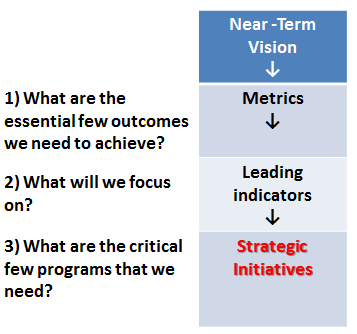
A complementary approach is illustrated in the nearby graphic. First, we ask for essential outcomes and then we narrow in on the vital few strategic initiatives. Organizations typically have many goals, and the process of suggesting gaps, evaluating them, and prioritizing them leads to the final selection. One good question is,

Which performance gaps cross boundaries and also provide leverage?

The Rut of Solutioneering

Solutioneering is a term that means a preoccupation with technology and solutions. This preoccupation is at the expense of problem definition. It is  a tendency to mis-frame symptoms as root causes. It is a bias towards the solution rather than users, needs, problems, and opportunities.

I have seen very smart, educated people fall into the solutioneering rut, so I don’t think the problem is one of intelligence. It is more of lack of discipline in problem definition, possibly due to the perception of limited available time and information.

Training As an Example of Solutioneering

Here is an example of solutioneering: A HR department decided to offer training to some target group of people at the Director level, offered by a prestigious northeastern university business professor. 

One of the participants was responsible for  running a $50 million business unit (that would likely grow ten-fold over the next few years). He told me (in confidence) that he was “strongly encouraged” to attend training.  He said, “I knew going in that my time was better spent growing my business, but this is part of playing the corporate game.” The implication: training added no value, and distracted from important business objectives.

His corporation had many business challenges, and the professor dispensed sound theory that was relevant to the business challenge. But it the training was a solution, not a problem. It wasn’t fitted to an integrated strategy of change and development. It was transactional. A solution. It had no apparent impact and was forgotten.

This example is not an isolated one.  Much training is wasted, because it isn’t directly linked to a business challenge. Unfortunately and too often, training yields little lasting result, because there is not a clear definition of expected outcomes or metrics to show those outcomes have been met. 

If including training in your strategic initiative, start with understanding the performance gap from a business perspective. Then link the benefits to specific and relevant  knowledge or skill development.  

Instead of “train and hope” to boost individual competencies, reframe the effort in terms of a story of addressing a business challenge and building a performance gap.

Tip # 1: Graph the Performance Gap

To help identify performance gaps, draw a trend line showing the current and expected trend of a key result area over time. Is your goal to increase, decrease, or stabilize the outcome (trend line)? It raises a natural question, Over time, what causes a change in the trend? This can help you find leading indicators and can help the organization select and prioritize the right strategic initiatives.

Tip #2: Know How Your Business Model Contributes to Performance

Enterprise performance involves changing the business model. You need to dig in and understand the model.

Earlier, I suggested that training may have limited benefit. Some basic knowledge of business models could make a significant improvement in strategic initiative definition and execution.

What other methods does your organization use to identify performance gaps? What are other barriers?

Posted in Success Principles for Strategic Initiatives | Tagged , | 6 Comments

The Job of the Program Manager is to…..

The leader of a strategic initiative must develop relationships with numerous stakeholders and numerous projects; thus, the strategic initiative leader functions as a program manager. There are several important competencies, and I refer the reader to this article, The #1 Success Factor: A Capable Program Manager. Those competencies are expressed through this job description,

The job of the program manager is to look outward and upward, conveying messages to stakeholders about the stakeholder receiving benefits. The program offers these benefits in exchange for the stakeholder’s commitment to the program. 

There several nuanced points to consider in this succinct job description.

The Program Manager is a Strategic Thinker

In looking up and out, the program manager is focusing on the needs of the executives in their organization (looking upwards) and external stakeholders (looking outwards). This strategic perspective helps to identify environmental variables (such as those identified by PESTLE) and increases the focus on outcomes and closing performance gaps.

The idea that Program Managers are strategic thinkers was a motivating idea for my book, How to Think Strategically. Sharpen Your Mind. Develop Your Competency. Contribute to Success. The book is available at all major booksellers.

The Program Manager Designs and Conveys Compelling Messages

Undoubtedly, communications is the single greatest driver and requirement of strategic initiative leadership. The program manager needs the ability to advocate for a strategy, and the ability to listen and understand stakeholder concerns.

Stories are powerful tool for communicating strategy; thus, I identified the program manager’s role of Chief Storyteller. The program manager is,

telling stories to stakeholders about stakeholders receiving benefits in exchange for their commitment.

The Program Manager Secures Stakeholder Commitment with Benefits

Getting alignment and “buy in” is high on anyone’s list of factors needed for execution of strategy. There is a simple transaction that is taking place: benefits (good experiences) are being exchanged for commitment (the willingness to invest in the face of uncertain outcomes). It takes considerable work to craft a good benefits statement, and I suggest reviewing my series of articles on benefits propositions for “how to’s” and examples.

The Program Manager Integrates to Deliver Value

Programs are collections of projects. Project managers have an important role; they create the deliverables — and that is some heavy lifting! The deliverables should be considered as “features” that the stakeholders experience as benefits.

The reason for a program is synergy: providing benefits greater than the sum of the individual projects. Program creates value by parsing and/or combining deliverables in such a way to create a stream of incremental benefits.

The program manager spends considerable time with the internal and external stakeholders and with project managers/teams to “architect” the projects into a coherent, integrated strategy for benefits delivery.

The Ultimate Program Manager

The folks at Project Manager dot com have developed a new resource, the Ultimate Guide to Program Management. The authors equate program management as multi-project management.  They write that program management is “process of managing several projects simultaneously” The goal is “to streamline organization and productivity” and “make all projects more efficient for long-term stability.”

The multi-project approach to program management is certainly a good way to introduce an organization to the topic.  With some scalable processes in place, you can then get to the essential practices of program management, which is benefits realization and strategic impact.

Do you agree with this description of the roles of a program manager?

Posted in Competencies of Strategic Initiative Leaders, Program & Portfolio Management | Tagged , , , , , , , , | 7 Comments

Use the Prospective Hindsight Technique to Improve Your Vision Statements and Story Telling

Have the team imagine the “disaster scenario.”

I have used the prospective hindsight technique many times with strategic initiative teams. The word prospective means to imagine a scenario and the word hindsight means to look back from the scenario to the cause of that scenario. For example, imagine a flat tire on your automobile; a plausible cause is that you ran over a nail.

Prospective hindsight – aka “project pre-mortem” – is quick and straightforward. It helps with both vision development and with risk identification.

How to Do It

I ask the group to vividly imagine the initiative at some point in the distant future: “Stare into a crystal ball.”

Further, I instruct them to imagine the strategic initiative has been an abject failure. It is very helpful to put one’s self into the picture. Linger on this visual. Then, the team imagines answers to this question: what happened to cause this disaster scenario? I ask them to write the reasons for the disaster on sticky notes, and we now have a good input for our risk identification.

The team can further analyze the sticky notes. One practical aspect of this technique is that people generate specific risk events for the scenario (a nail in the road caused the flat tire). That makes it much easier to develop risk responses to mitigate, avoid, transfer, or accept them via contingency plans. Too, often people come up with generalities such as “no buy in.”

To reinforce the value of the discipline of risk management, I remind the team that

CEOs attribute 21% of the reasons for success of a strategic initiative to “anticipating obstacles.”

An Eye-Opening Variant: The Delight Scenario

The steps for this are the same. Instead of the disaster scenario, I ask them to imagine a picture of glorious success. This delight scenario often causes people to look for opportunities and to reinforce the value of collaboration.

This question is fun and energizing for the team! Typical answers include looking in the white space, becoming a true team (and not a committee with a slogan), and looking for the customer’s unspoken needs.

The Chief Story Teller Role

In earlier articles, I explained that one of the four leadership roles is that of Chief Story Teller. Often when people hear of the story telling role, they think in terms of war stories: Stories about the past. These retrospective stories are useful because they teach and entertain, but they lack motivational force.

Strategic initiatives are concerned about the future. As I have pointed out in earlier articles on strategic thinking, strategy is ambiguous (and so is the future). People tend to avoid ambiguity. One answer to this situation is to stress the importance of becoming fluent in telling prospective stories. Prospective stories help people make sense of their imagined personal role in this new scenario.

A good story about strategy provides space in the narrative for the listener to use their imagination.

Enhancing the Vision Statement

You should now have considerable more – and relevant – detail to work with in improving the strategic initiative’s vision statements.

Have you ever used this?

Posted in How to Improve Your Story Telling Chops, Strategy Coaching and Facilitation, Useful Practices & Management Tools | Tagged , , , , | 2 Comments

The Purpose of a Strategic Initiative is Closing a Performance Gap

An illustration of a performance gap

Strategic initiatives are tools for closing performance gaps. As a leader, you need to help your organization “map the gap” and close the gap.

Performance Gaps Illustrated

The nearby graphic shows a simple depiction of a performance gap. The X axis is time and the Y axis is an organizational performance metric. The metrics could be for improving the revenue stream (in that case, we typically would look for an increase over baseline) or the cost structure (we would look for a declining trend) or something else.

Notice the two trend lines showing the forecast performance (what will happen if we do nothing) and the potential performance (what we desire). The performance gap involves a tension between the current state and a desired future state.

Hint:  Draw a generic diagram (similar to the above) and challenge your organization to label the lines.  It will stimulate some thoughtful discussion on strategy!

Clarifying the Performance Gaps

The performance gap can be quantified. My earlier article, Use the As-Is-&-To-Be Table to Clarify Strategic Initiative Vision, provides some useful advice.  In addition, here are two questions that I find useful:

  • What is the performance gap that is the most painful or visible?
  • What do you want to be different 3 years from now?

These questions help to reveal metrics. The lagging indicators will typically be the quantitative results that are of interest to the Board of Directors, investors, and bankers. As important is to leading indicators that can provide you early feedback on your benefits realization. You can find more detail in my article, How to Energize Strategic Initiatives with Outcomes.

Analytics and Strategic Initiatives

Many companies have now institutionalized use of “analytics” as part of their strategic scanning processes and assigning responsibility for analytics to strategic initiative groups.  The new jargon includes “big data” which intends to discover big issues (opportunities) that can be brought to the strategic formulation process and “core insights” which are undiscovered data relationships that provide competitive opportunities.

The point: The strategic initiative leader needs to have a drive to compete, complemented with some competency in analytics. The leader needs to an understanding of competitive advantage, data storage, and emerging analytics tools.

Knowledge of Performance Gaps Facilitates Strategic Alignment

Many organizations have a cluster of semi-related goals, projects, activities, and initiatives. They often lack a “big picture” and synergy. They benefit from a higher-order structuring, and this straightforward rule will lead to better strategic alignment:

Identify a single performance gap and charter a strategic initiative.

This rule causes management to think deeply about the core challenges and prioritization.

The next step is to invest the right resources and provide leadership. Program management is the “how” that provides structure to the strategic initiative team.

Have you ever seen a strategic initiative that did not know its performance gap?  What was the result?

Posted in Competencies of Strategic Initiative Leaders, Program & Portfolio Management, Success Principles for Strategic Initiatives | Tagged , , , , , , , | 18 Comments