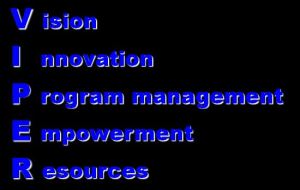
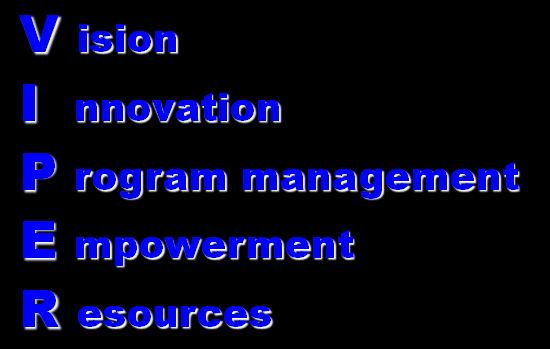
As a coach and seminar leader, I’ve found that case examples are powerful. Even though it is “older,” people still enjoy the story of the launch of the Dodge Viper muscle car in the early 1990s. The VIPER model – illustrated in the graphic – tumbled out in a discussion one day, and has been a wonderful tool for providing an integrated view of a strategic initiative.
Vision – The team had a clear understanding of the physical, functional, and emotive feel of their end result.
Innovation – The problem solving approach involved several changes to the team culture of the organization, and the use of outside suppliers.
Program Management – The team had discipline and focused on important program management ideas: stakeholder expectations management, value proposition, benefits delivery, coordinated schedules, and financial management
Empowerment – One simple but powerful idea was the use of “the viper bell.” When any team member discovered an issue that needed attention, they would ring the bell located in their work space (they were co-located) and the team would converge on the issue and resolve it. The team was moving so fast, that they could not afford extensive time in meetings and analysis paralysis.
Resources – The team had high quality staff, money, and leadership. Clearly, this was a strategic initiative and recognized as an important investment in the future of the company.
How have you seen these principles in your strategic projects? Which principle is most important?
Here is a good story that shows strategic initiatives can sustain their improvements and become institutionalized.
IBM continues to use a program it calls Speed Teams to identify opportunities for improvements. The first iteration of the strategic initiative was in November 1999, when IBM’s VP of business transformation and chief information officer (Steve Ward), pulled together a group of 21 high performers. He gave this first speed team a simple assignment: Get 100,000 people worldwide – the IT group — moving on the fast development of Web-oriented applications.
Said one of the co-leaders, Jane Harper,
“Our plan, when we started this, was to come together, look at what works, look at why projects get bogged down, create some great recommendations about how to achieve speed, get executive buy-in, and try to make those recommendations part of the fabric of the business.”
One of early realization was that identifying and removing speed bumps was essential to project speed. The article identified a few speed bumps for IBM, as listed in the exhibit below.
Causes of Slow(Speed Bumps)
Process steps that overvalue quality and undervalue timing
Process that is not tailored to the specifics of the project
Overly rigorous measurement
Information overload
Priorities not clear
Poor meetings with little emphasis on decisions
Causes of Speed(Accelerators)
Strong leaders
Talented people
Appropriate metrics
Rapid communications
Fast adjustments
Clear goals
An interesting quote from speed team member Karen Ughetta,
“A lot of people hear the word “speed” and think that we want them to keep doing the same thing, only faster, harder, and for longer hours, But we’re really about getting people to change the way they do things, about blowing up the process and discussing ways to avoid speed bumps.”
Leadership Lessons for Strategic Initiatives
Here are some of the lessons from IBM’s Speed Team Strategic Initiative:
You don’t need a comprehensive project plan, rather you need a simple and compelling vision. Steve Ward’s directive was simple, “get people moving faster.” You can quickly launch strategic initiatives. The scope of this strategic initiative was enormous and is still being felt to this day: 100,000 people working globally. How do you do this?
Get good people and trust them– When you have good people on the team, you don’t extensive rules. One characteristic of these good people is that they are able apply strategic thinking competencies to cope with ambiguity. (For another IBM example, in the 1990s IBM recognized that it needed to migrate its business model into services. It identified its top 10% of high performers/potential and asked them to work on the strategic initiative.)
Strategy can be bottom up and opportunistic. With good people who can practice strategic thinking, the organization finds many opportunities.
Process can get in the way of breakthrough performance. IBM does not instruct people to disregard process, but rather to pay attention to the spirit of the law, rather than absolute, rigorous compliance to the letter of the procedure.
Leverage temporary assignments for cultural change. When people came on, they knew that they would make an intense contribution to this goal, and move back into their home organizations. There were at least two benefits of this: 1) they could carry back new ideas and coach others in those ideas, and 2) they could work on the strategic initiative at an intense level.
Innovative approaches can become institutionalized. Strategic initiatives can morph into something different (For example, IBM now has a program called “Deep Blue” as part of its talent identification and development process)
In just a few years, it is likely that most people will read the news on an electronic reader, probably with a nice color screen. These electronic readers will pull news that is relevant to the consumer. And there will be advertising, too. Ads that are personalized with lots of color.
Is the news-by-newsprint model of the newspaper going away? If newspapers do not go extinct, and will look radically different. Let’s consider some of the pressures being faced by conventional newspapers:
There is a long-term trend in declining circulation. Even if there were not, People are reading newspapers less, regardless of the presence of the internet, a Google, or a Kindle.
Classified ads are going away (Craigslist, eBay, etc). Any business would struggle if it lost 30% of its revenue stream, but when combined with the other factors this is a killer.
Less is being spent on print ads.
Newspapers never made money on the “news.” Their best advertising sections are the home and garden section, automotive section, and so forth where advertisers can get their message in front of those readers who are interested in the topic.
In total, the newspaper industry is facing a serious disruption of its business model due to technological forces. The survivors are going to be forced to look in new directions. Undoubtedly, many of them will be launching a strategic initiative.
The good news is that Google has a strategic initiative in place that can be a partnering model for surviving this disruption. As James Fallows explains in his recent Atlantic cover story,
“If news organizations stop producing great journalism, the search engine will no longer have anything interesting to link to. Smart Google minds are working on this. They think they can make a difference.”… “Google is valuable because the information that people find through it is valuable.”
Leadership Lessons for Strategic Initiatives
Here are ten lessons for leaders of strategic initiatives:
Good people, given sufficient time – Early in the article, we learn that several very smart people are working on this strategic initiative and that they have time budgeted to understand the issues and craft good strategy and execution. In addition to smart people, there is a determination to succeed. Thus the leaders have this attitude,
Despite a difficult problem, people hold optimism that they will find a solution. Stories and storytelling are useful tools for the leader of a strategic initiative. The story being told is still unfolding: the story does not need to be accurate, it just needs to be plausible.
There is a clear rationale for “why” – There is a good rationale understood by all for the reason for the initiative: good news content gives people a reason to use Google.
The initiative is driven by data – As you might expect from a company that captures and generates data, Google has developed useful insights by mining its data.
Continuous experimentation:Permanent beta – and belief in the wisdom of customers and markets – This is a famous part of the Google culture, which is to keep trying many ideas, fail fast, and learn from it.
Incremental Benefits Delivery – Google is not going for one big solution, but a series of small wins. This is an important principle for creating commitment.
Boundary-busting approaches – Google is openly partnering with many other organizations using what is now popularly being called open innovation.
CEO involved – The CEO (at that time, Eric Schmidt) visibly supports the program, but delegated appropriately to experts.
The vision rests upon three strategic pillars – Those pillars are distribution (example: YouTube Direct), engagement (example: display ads), and monetization (example: each newspaper will determine whether they want to charge for content). On this last point on monetization, Fallows writes that Google says, “Of course people will end up paying for the news. They’ll have to leave it up to the market to decide.” See my posting on strategic pillars for an illustration.
“Buy-in” happens over time – In prior interviews (a year earlier) , people gave “dutiful” answer about the importance of the strategic initiative, but now “people sounded as if they meant it.” Skepticism gives way to optimism. Commitment and alignment require time, and the leadership challenge is to steadily increase the number of individuals and degree of passion.
You and watch some of the experiments in action. In particular, I encourage you to check out Google Alerts (I do one daily on strategic initiatives), Google News, and Fast Flip. All are accessible on the Google homepage.
This case study shows many of the principles of successful strategic initiatives. How can you apply these to your strategic initiative?
The leader helps the social network draw connections between vision and action
Vision is defined as a specific endstate or intent, typically tied to a moment in time. Stated simply, you can see a vision. Other people will refer to vision as the “to be” in contrast to the “as is.”
Few people will argue with the assertion that shared vision is one of the most important components of strategy. When people know the vision and believe in the vision, they can both align with the vision and commit themselves. They work independently on their parts of the initiative, and they can do so with the confidence that their efforts are good investments of their time and energy.
The concept of vision seems so easy. It ought to be straightforward to develop, right? In some cases, it is easy but in other cases, it becomes a laborious exercise that ends in futility. The problem is in socializing the vision so that it is shared by all important stakeholders and is a force for action. Most organizations find that as you get farther away from the “leadership circle” of an organization, people are less and less likely to be familiar with the vision. If they are not familiar with it, how can the leader assure that they understand it and act in alignment?
This framework* of five possible tactics to communicate or convey a vision is a useful managerial tool. The word socialization is perhaps the best word for the process. It is based on a simplification that there is an authority figure (“the boss”) and members who take action in support of the vision. The five ways are:
Telling: The boss knows what the vision should be, tells the vision to the organization, and members of the organization comply with that vision.
Selling: The boss knows what the vision should be, but needs the organization to “buy in.” The boss uses a carefully crafted message to persuade the audience of the benefits of the vision, and members decide whether to support the vision.
Testing: The boss has an idea of what the vision should be, but wants examine the reactions of the organization before proceeding. A sample vision is provided, and members provide feedback.
Consulting: The boss wants creative input from the organization before proceeding. Open-ended questions are asked of members of the organization.
Co-Creating: The boss and members develop a vision based upon their deeply-held fundamental values and aspirations. So first values and mission is captured and processed, vision emerges as individual members coalesce around those values that are most personally meaningful.
Note the pattern: the tactics at the top of this list consume little time, but often produce little commitment in the audience. The tactics at the bottom create commitment, but consume resources as the vision is both socialized, developed, and refined.
The leader of a strategic initiative needs to examine the tradeoffs. Vision development is hard work. Vision communication is time consuming. Vision alignment engenders conflict. People adopt visions at different rates.
For example, telling the vision is expeditious. The boss makes an announcement to the employees and they receive it. The downside is twofold: the vision’s success depends upon compliance by the organization, which means that some sort of enforcement effort is also necessary. The vision also may be misunderstood, and the organization may overlook possibilities that are distinctive and add value.
At the other extreme, co-creating will gain lots of support because people have participated in the creation of the vision, but it takes considerable time in discussion to identify and resolved differences, and build consensus.
As a coach/consultant, I’m most often asked to support on vision for the tactics of selling, testing, and consulting. Sometimes clients simply need an objective sounding board, and sometimes they need help to engage the audiences for their ideas and reactions.
* The source of this framework is the Fifth Discipline Fieldbook
How have you seen visions effectively conveyed to people?
The most important reason for a meeting is MAKING DECISIONS!
A recent article in Investors Business Daily stressed the importance of having good meetings when formulating and implementing strategies. It was a reminder of some good commonsense practices. I add the following:
Keep a clear focus on decision making. Too much time is spent in the typical strategy meeting on “educating each other.” Return (again and again) to the question: What decisions do we need to make now and in the future?
Make it safe to say, “I don’t know.” When we are dealing with strategies, we have numerous unknowns and those unknowns might be a cause of threat or opportunity. The rule is: it is more important to focus on what you don’t know than what you doknow.
The meetings that happen before the big event are just as important in identifying strategic issues. Use that as a time to get people thinking and talking about the future.
Strategic initiatives are often focused on internal improvements to organizations. This article develops a mapping analogy recognizing the landscape for improving performance.
All maps serve the same basic purpose: to orient the user to the surrounding “landscape” so that the user can identify routes and select the one that best meets their requirements for speed, safety, ease, and cost, among others. Good maps have a number of common features: they use consistent names of landmarks so that users can communicate effectively, and the scale of the map is clear. Maps can be simple schematics or more dynamic to allow the user to zoom into the details.
An improvement map depicts the terrain that the organization must navigate to get from “here” to “there.” A good improvement map will help the user see the big picture, but also show a suitable level of detail. A good improvement map will help the navigator recognize the numerous potential routes of improvement, and select the optimal one. Thus, it is an orientation tool, rather than a set of instructions. Finally, a good map will enable the management team to “zoom” into a selected element, and consider details about what decisions and actions are most appropriate. Continuing the analogy, your coach is your guide who holds and reads the compass for you, until you are ready to go solo.
Rather than seeing the improvement map as a tool, my experience shows that most people prefer to use it as a guiding metaphor to stay oriented to the critical work.
Here is a list of important improvement map elements:
Understandable assumptions
A vision of ‘the destination’
Sustained leadership
A supporting coalition of stakeholders
Identification of problem boundaries and root causes
Routes to a solution
Recognition of barriers and dynamics
Learning-as-we-go outlook
Relevant and timely metrics
In your experience, which of these are the most important? What are the benefits of an integrated approach to organizational change?
There are two simple concepts that drive the successful execution of a strategic initiative: alignment and commitment.
We say that people have integrity when their individual beliefs and actions are consistent. That is a precursor to organizational alignment.
When we collective the individuals into some venture, we need them to be aligned; that is, consistently focusing and acting on the intended outcomes of a strategic initiative: vision, benefits, and transformation.
Metrics are the best tool for fostering alignment; they make things simpler, more transparent, and logical. Individuals want to know who they “report to” – even if they might have more than one manager – and the expectations.
Program governance activities foster alignment, by logically connecting organizational structure to the espoused strategy.
Along with alignment, leaders must work to secure the commitment of individuals. Commitment is an individual’s willingness to invest resources – and stay invested – in the face of uncertain outcomes. Collective commitment is the aggregation of individuals so that they apply effort towards each strategic initiative.
What do you think? Have you seen initiatives where people are not aligned or committed?
This blog provides thought leadership on strategic initiatives. It is a resource for practitioners, executives, and academics.
It also provides additional information for participants in my popular seminar, Leading Strategic Initiatives (Program Management) [See top of page for a link].
Definition of a Strategic Initiative
A strategic initiative (SI) is an endeavor intended to achieve three interrelated outcomes:
A boundary-spanning vision or “strategic intent”
Realization of important benefits to “strategic” stakeholders and
Transformation of the organization
Alternatively, you could say that “a strategic initiative is the start of something important;” but, that statement does not have the same power as the three-part definition.
Closing Performance Gaps
A strategic initiative closes a performance gap. That gap could be the capture of an opportunity or the remedy of a problem. This simple axiom is a powerful screen for recognizing and chartering strategic initiatives.
How to Define a Strategic Initiative
I regularly use the three-part definition as management tool for defining an individual strategic initiative. I (with the team) write a short statement for each of the parts, and then combine them into a single statement. Here is an example,
UZH Healthcare System is launching this strategic to increase improve market share by 20% in the next three years, and change the culture of the delivery system. Doing so will increase its stature in the industry and create a new business model.
The Initiative Management Process
Organizations have many problems and opportunities that need attention. The better ones have a defined initiative management process for identifying strategic initiative candidates, prioritization, and selection. One useful tool is the Balanced Score Card, and the principles of that tool reinforce this point: It is better to have a few strategic initiatives, rather than many.
A useful rule of thumb is that an organization should only have about five active strategic initiatives at any given time.
Here are some common mistakes that organizations make when referring to strategic initiatives:
Strategic initiatives are NOT the same thing as strategic objectives or strategic goals. Strategic initiatives are the vehicle for achieving a strategic goal – “closing a performance gap,” as stated in the beginning of this article. Strategic initiatives are tools for turning vision into results, not hype.
Strategic initiatives are NOT studies oranalytics. Although it is useful to find patterns in the data, it only yields insight. That is NOT strategy, nor is does it meet the definition of a strategic initiative. This is a common mistake made in many job descriptions.
Strategic initiatives are (usually) NOT single-silo strategic projects. A strategic initiative is most-typically a corporate program that activates cross-functional competencies. In the opinion of CEOs, a strategic initiative is aimed at creating new markets, products, productivity improvements and the like. Of course, strategic projects in IT, HR, Operations might be referred to as initiatives; I would only designate them as a strategic initiative if – in some way – they supported corporate and business strategy. (You can get more valuable insight on corporate, business, and functional strategy in this article.)
Program Management
Successful strategic initiatives apply a disciplined approach for initiating, planning, executing, controlling, and closing. However, strategic initiatives are more complicated (and complex) than projects, thus there is a need for a nuanced approach. For readers who are familiar with the distinctions between program management and project management, strategic initiatives are an application of program management.
All strategic initiatives are programs, but not all programs are strategic initiatives!
I caution those who intend to apply a complex “methodology” that the skill of leadership is more important than the presence of rigorous forms and processes.
Need a strategic planning facilitator, implementation coach, neutral mediator, workshop, seminar, or hands-on program manager?
Greg Githens provides coaching, workshops, hands-on, and more.
Contact him at GregoryDGithens@cs.com or 419.424.1164









 Leading Strategic Initiatives