A Powerful Idea for Your Strategic Initiative: Program = Brand = Trust

20120131-142141.jpg
Brand management is a well-known discipline of marketing and a source of strategic advantage for many companies. As a discipline, it has a set of guiding ideas and professional practices.

The idea of “program as brand” is new to many strategic initiative leaders. The principles and tools of branding benefits the strategic initiative leader in several ways, including:

  • Helping the leader gain and maintain visibility with executives and other stakeholders. Branding helps to unify your requests, statuses, and issues. It helps you break through the clutter.
  • Helping the leader proactively manage the strategic initiative’s reputation. Branding is a form of risk management, helping you to decrease the impact of threats and leverage opportunities.

Program = Brand

Brand management shares with program management the principle of consistency;  consistency allows you to leverage your strengths and create efficiencies of scale. Both program and brand managers recognize that it is hard to undo certain kinds of policies, thus there is value in structured thinking about goals and measurements. Both program planning and brand planning are something that you do early, not as an afterthought.

Importantly, a strategic initiative is a bundle of promises about a new state of the organization, and a brand is a bundle of expressed and implied promises. Both deal with multiple audiences who develop dynamic sets of expectations.

Leaders both develop and leverage the use of their assets; we can regard “brand trust” as an asset. How might you do that?

Reputation ≠ Brand

Although a subtle point, reputation is different than branding in that reputation is what people remember about you or your company. Reputations can be good or bad, and can be influenced by the brand. Thus, proactive approaches towards branding increase the probability of earning and maintaining a good reputation.

Brand management is a form of risk management!

The Leadership Challenge: Stakeholders Minds are Cluttered with Many Message

The typical person is exposed to 5,000 messages every day, and few would argue against the assertion that our society is information overloaded. If you are providing message number 5001 to this information-overloaded stakeholder, it better be a good one!

The point? Each of these many messages is competing for stakeholder attention. It is easy for a stakeholder to ignore or forget a given message, especially if that message is complex, incoherent, or ambiguous. You must craft messages with care and with purpose.

The strategic initiative leader should constantly develop and convey “brand” messages about expectations. As the audience absorbs and reacts to the messages, the leader should expect change. Importantly, the leader needs to deliver on the expectations.

Brand = Trust

Amazon is the most-trusted brand in the United States. Based on my personal experience with them (as an occasional customer), it is fair to say that I trust Amazon. For me and millions of others, Amazon quickly comes to mind (brand positioning) when I am searching for a book, and the one vendor that I rely on when I need something reliably and quickly.

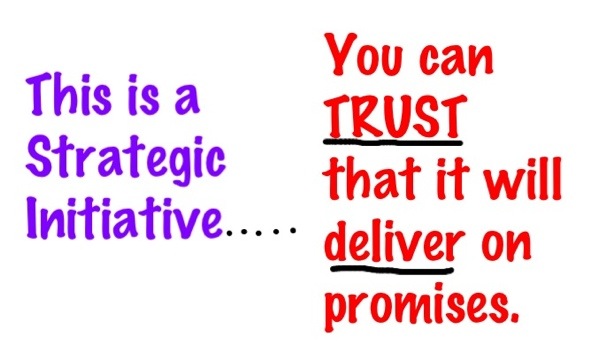
I’m sure you would like to have the same attributes for your strategic initiative: stakeholders think of you first, and know that you can be counted on to deliver on your promises.

Let’s take a closer look at trust? Regardless of whether we are considering people we trust, companies we trust, products we trust, leaders we trust, or program management, trust involves two things:

  1. Credibility. I know that I can reliably determine whether Amazon has an item in stock and the price of that item. This credibility comes out of efficacy, the ability to accomplish an intention. In programs, we gain credibility by showing that we have the right resources and a coherent plan. When we deliver the first increment of benefits, we prove our capabilities.
  2. A Choice to Risk Something of Value. When I deal with Amazon or any other party, I risk valuable resources: money, time, and attention. However, I enter this transaction by choice. Another way to think about this is to consider the words vulnerability and intimacy: I choose to be vulnerable and I choose to expose sensitive information. To trust is to move out of one’s comfort zone. Amazon makes it easy for me to reverse my decision and return a purchase. My probability of loss is low. The analogy is that leaders recognize this need for safety and provide assurances that the rewards will be worth the risk.

Program Governance

The prior definition of trust (trust is credibility and a choice to put oneself at risk) suggests questions that can help you guide the design of the strategic initiative’s program governance:

  • How might we build credibility with stakeholders?
  • How might we open up the conversation so that we can openly address risks, issues and other vulnerabilities? How might we build intimacy among stakeholders?

These questions will stimulate quality thinking by the individual leader, executive sponsors, the program team, and other stakeholders. Add in some discussion on scheduling and measuring benefits, and you have the some solid ideas for building program governance.

Clearly, we are talking about program communications. In a future post, I will describe how to substitute branding for more conventional, bureaucratic program management reporting.

How have you developed branding for your program? Would you like to be interviewed for an upcoming article?

Posted in Incremental Benefits Delivery, Useful Practices & Management Tools | Tagged , , , , , , | 4 Comments

Case Study: Strategic Initiative Kickoff in a Global Joint Venture

One challenge for strategic initiatives is getting people out of their comfort zone so that they work strategically. In this story about the kickoff of a major project platform at a joint venture, I describe seven take-always related to discovering unknowns and a learning on working with cross-cultural teams.

20120127-092416.jpg

A R&D Breakthrough Creates Opportunity

Two global companies (one French and one US) had created a joint partnership to patent and commercialize medical products. The JV’s first product was in use by the early adopters in its market. However, sluggish product performance was keeping the product platform from “crossing the chasm” and becoming a major revenue generator. A R&D breakthrough found a solution to this performance problem. Top management wanted to exploit the opportunity with a global new product launch (and on an aggressive schedule).

One of the JV partners had a rigorous new product introduction process. The team’s short-term challenge was to validate the feasibilities to manage risks.

Boundary Spanning: Cultures and Global Product Launches

The client assembled a team (mostly R&D people) and scheduled a 1-day kickoff meeting, asking me to facilitate it. The job of the facilitator is to provide structure to the meeting, with the goal of enhancing dialogue, deliberation, and decisions.

It is worth mentioning, too, that French was the first language of many of the participants, including the strategic initiative Program Manager. At this stage, the team was only French and US, but eventually the team added people from other countries. Often strategic initiatives take place in cross-cultural setting, so an important skill is facilitating effective conversations.

Of course, corporate cultures are also an issue. In this case, there were three distinct organizational cultures in play.

Setting The Scope

People (technical, particularly) tend to avoid ambiguity and stay in their comfort zone. I recognized that this audience might waste time in “interesting technical discussions” and not make progress towards the most strategic of the objectives.

I started the meeting by asking each person to complete this sentence, “I want to accomplish this _______ in this meeting.” (A similar idea on defining completion criteria and success criteria is found in this article.)  Most of their expectations were tactical, and I recognized that this group would need my help to leave their comfort zone.

To help the team gain a strategic perspective, I wrote these three statements on a flip chart page:

  • What do we know?
  • What don’t we know?
  • How do we find out?

For the first question, the senior marketing person presented top management’s wishes for schedule and volumes. This clarified much of the ambiguity about vision. Next, one of the engineers presented the results of one of the preliminary feasibility studies.

What Don’t We Know & How Do We Find Out?

After the presentations by the company insiders, the team listed the major risks and unknowns. The program manager started a parallel list that assigned responsibilities for investigating the issues and making decisions. The format resulted in something similar to the issues management approach described in earlier articles. When all participants agreed that their expectations had been met, we ended the meeting (ahead of schedule).

A Major Success!

The product is now a internationally-recognized product with significant revenues.

Lessons for Leaders of Strategic Initiatives

Here are seven learnings that come from asking the group to identify what they know and don’t know:

1. It is important to focus a group on what they don’t know. Too often, conversations focus on knowns and knowables. The faster you can get answers to what you don’t know, the more progress you will make.

2. You need to get people out of their comfort zone and into the learning zone. Strategic thinking makes people uncomfortable and their anxiety can brush them close to the “panic zone.”

3. Strategy is inherently ambiguous, so recognize and accept ambiguity as a fundamental leadership responsibility.

4. Let people who hold strategic information share what they know. assure that everyone is getting the same information at the same time.

5. You will tend to find more issues than risks (early in planning); thus, be prepared with a issues-management strategy.

6. The “focus on what you don’t know” principle is an expression of the Chief Learning Officer role: be curious and encourage others to be curious. Also, assume the Chief Integration Officer role, which seeks to recognize patterns and understand relationships of the various elements. Together, these two leadership roles help promote  sense making, which is essential for gaining stakeholder commitment.

7. Recognize and avoid the time-wasting trap of “interesting technical conversations.”

Recommendations for Strategic Initiatives in Multi-Lingual and Cross Cultural Teams

This example involved a French-US team. Strategic initiatives increasing must span geographic, language, and cultural boundaries. The obvious recommendations apply: don’t assume that others process and value the same things, take extra time to define words and acronyms, leverage the abilities of bi-lingual people, and write things down for all to interpret.

What tips do you have for kickoff meetings in strategic situations? What are your experiences with cross-cultural teams?

Posted in Examples of Strategic Initiatives, Strategy Coaching and Facilitation | Tagged , , , , , , | 4 Comments

Five Rules for Managing Complex Strategic Initiatives

Complexity 3

Complex strategic initiatives involved numerous actors making decisions for different reasons, delays between actions and outcomes, and ambiguity. The most apt descriptor comes from complexity theorists, “unordered environments.” Here, the leader’s goal is to create the conditions for good things to emerge (rather than predictable outcomes).

Three examples of complex strategic initiatives are Google’s initiatives in the news business, IBM’s speed team, and Wal-Mart’s greening in China. (For contrast, Domino’s Pizza Turnaround and the Heathcare IT cases operated in relatively more-ordered environments. Complexity theory would describe them as “complicated” in that they are working toward a pre-determined result by applying plan-your-work-and-work-your-plan methods.)

In complex strategic initiatives, you avoid forcing a solution. You create an array of agile market/technology solutions and position yourself to capture emerging opportunities .

Rule #1 – Manage Starting (Initial) Conditions

Small changes in initial conditions can have great subsequent effect (in complexity theory, this is known as the Butterfly Effect). For me, this principle becomes a simple rule,

Get off to a good start! You’ll have little opportunity to recapture the moment.

Advice:  apply the four driving questions, a “secret” for success. The questions are,

  1. Why are we doing this?
  2. Who needs to be involved?
  3. What exactly are we going to do?
  4. When are we going to do it?

The team asks and answers the four driving questions in order. The approach assures that there is a compelling reason, top-notch people are involved, etc. When good people understand the reason for strategy, they can more artfully construct a coherent program of value delivery.

Rule #2 – Broaden the Involvement of Stakeholders

The presence of numerous stakeholders is one attribute of an unordered environment. Not only are there many stakeholders, their interests are nuanced and difficult to discern.

An important task is outreach. As I identify individuals and groups, I create dialogue around questions such as:

  • Do they agree on the nature and patterns of the problem or opportunity?
  • Do they agree on the solution design?
  • Are they willing to make sacrifices and promises?
  • What benefits does the stakeholder seek?
  • What kinds of metrics are in use, and should be in use?

Rule #3 – Dissent Strengthens the Strategy

Strategy operates in organizations where different stakeholders hold various points of view. Often, these views are grounded in differing set of facts.

Here is where leadership behaviors become essential.  The leader needs to engage (e.g., hold conversations) with stakeholders to make strategy more transparent. As new facts come to light, new insights emerge. Often you will find that you can “flip” opponents into supporters by accommodating their criticisms and point of view into the program. This “generative” approach to strategy incorporates each perspective and increases the probability that the organization will actually implement something (rather than defer action for a future date).

I call it constructive dissent.

Rule #4- Increase Learning with Rapid Experimentation
This rule reflects the Chief Learning Officer role (follow this link for an introduction to the role), applying the dictum, “fast to learn is fast to deliver.”

You improve speed and probability of success by launching multiple probes. Here are four types of probes. If you detect a response, you have learned something useful.

  • People
  • Ideas
  • Resources
  • Location

Finally, pay attention to weak (as well as strong) signals.

Rule #5 – Monitor for Emergence

Complex programs operate in unordered environments. We watch for the presence of “strange attractors” that arise and create new market and industry structures.

An example: Apple’s capture of digital music opportunity through its iPod and iTunes business ecosystem. Steve Jobs answered the what-is-your-strategy question in a 1998 interview, with these words,

“I am going to wait for the next big thing.”

Jobs did not know what “the next big thing” was, but he knew that the industry was constantly introducing new technologies. Jobs knew he needed to be patient and alert for the short term. When the time was right, he showed that he could be agile and aggressive with opportunities.

The learning: keep your “heads up” with the expectation that opportunity will emerge.  My article on Path Finding and Way Finding might be helpful for you.

Conclusion

Complex business environments have complex patterns of behavior; maybe bordering on chaotic. Traditional command-and-control approaches have limited utility. Instead, you need to embrace leadership tools and ideas that recognize the non-linear elements of complexity.

How do you manage complexity?

Posted in Ambiguity and Strong-Minded Thinking, Strategic Planning Issues for Strategic Initiatives, Strategy, Success Principles for Strategic Initiatives | Tagged , , , , , , | 10 Comments

Advice for Strategic Initiative Charters

InitiativeA secret of strategic initiative success is to establish effective starting conditions. One of the first documents created in a program is the charter. A strategic initiative charter serves at least two foundational functions:

  • The information in the charter provides inputs for discussion and reference. You can describe the quality of this information as “initial,” or “preliminary,” or “tentative.” As the team learns its way into the program, it updates and supplements the information in the planning documents.
  • A signature on the charter indicates that the strategic initiative is legitimate (e.g. management is prepared to invest resources into it). Strategic initiatives are boundary spanning and transformative; thus, this legitimacy helps to identify the stakeholders who will support with visibility and resources.

The strategic initiative charter serves as a symbol of the launch of the strategic initiative. It is of far less importance to document intentions for planning or controlling the work.

In prior articles, I explained that strategic initiatives are programs and not projects. If you have a template designed for projects, be careful as the typical template is designed for ordered, understood deployment projects and not complex strategic endeavors (a related article on Five Rules for Complex Strategic Initiatives is found at the bottom).

Strategic initiatives often work in an environment where you want good things to emerge, rather than obtain a predetermined result.

Enforce Conciseness with the Two-Page Rule

I and other practitioners compared our experiences with strategic initiative charters. We noticed the “two page” rule: cull the information into the essential elements and keep the entire document to two pages. This practice encourages you to think about your audiences and your purposes in communicating to them.

I once worked with an executive whose mantra was, “Conciseness is next to godliness.”

You don’t want to make the mistake of putting too much information into a strategic initiative charter.

I have created one-page strategic initiative charters. The response was that this one page is insufficient. Experience says that two pages is optimal.

Essential Elements of a Strategic Initiative charter

When I write a document to charter a strategic initiative, I include the following elements. I write and edit to keep the document to two pages.

  1. Strategic Initiative Name
  2. Background/Rationale – This is a brief statement explaining the significance of the strategic initiative, including the impetus, who is affected and how.
  3. Statement of Problem or Opportunity – This takes the prior section and goes into more detail, and is typically where tentative vision and metrics are described.
  4. Lead Entity (ies), Other Partners – Often the initiative involves other organizations. It is useful to clarify other partnering organizations that are likely to be involved, and their roles, if known. Who is the lead partner?
  5. Program Manager Name
  6. Key Resources – If known, state the people, funding, equipment/facilities dedicated to this initiative.
  7. Strategies/Actions to Advance This Initiative – This describes the problem-solving approach. I often find it useful to explicitly address deviation from standard project methodologies. This helps you avoid misunderstandings with project offices, which often enforce compliance to project standards that are inappropriate for programs and strategic initiatives.
  8. Out of Scope – I describe the known excluded items, particularly other strategic initiatives.
  9. Anticipated Timeline – Here I focus on incremental benefits delivery. I avoid due dates for deliverables, which is much better addressed in program and project planning documents.
  10. Program Sponsor and Other Key Stakeholders
  11. References – Strategy takes place in an environment where there is a plethora of information; literally, hundreds of pages of presentation slides, spreadsheets, analysis, proposals, and the like. In this section of the charter, I reference strategic planning documents.
  12. Approval – (Signature)

There are many things than can be included in a program charter and anyone with experience with project or program charters should be able to provide many suggestions. These elements can include authorities, decision rights, strategic assumptions, and budget.

What is your experience with strategic initiative charters?

Posted in Interpreting Strategy Documents, Strategic Planning Issues for Strategic Initiatives | Tagged , , , , , , , , , | 13 Comments

How to Improve Strategic-Operational Collaboration

Strategy execution often flounders unless the organization manages this fundamental question: how much energy and attention should managers devote to operations (planning and acting for today) compared to strategy (planning and acting for the future)?

This query from a strategic initiative leader illustrates the challenge,

My organization is filled with managers who are very good at operations, but not good at creating or supporting strategy. Our managers, directors and VPs need to think and operate at a more strategic and less tactical level. How do I get people to move from a hands-on, day-to-day mindset to a more strategic one?

Operations people are important stakeholders for several reasons. First, they are performers of the key activities of the current business model, and will also perform activities if the organization migrates to a new business model. Second, they are providers and controllers of resources that are used in the strategic initiative. Third, when  operations people change their behaviors to adopt strategy, they create benefits.

Unfortunately, many people who are strong in operations are less comfortable with the ambiguity of strategy. People avoid ambiguity, so they avoid strategy-setting discussions.

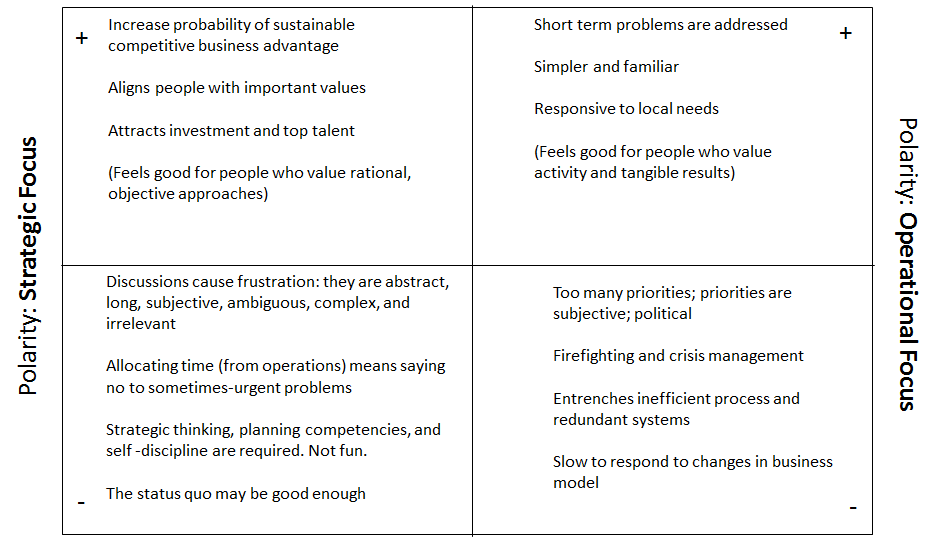
A Polarity Map illustrates Organizational Tensions and Polarization

This article provides a polarity map for operations and strategy. Understanding it will help you develop a better working relationship with operational managers, thereby increasing their buy in for the strategic initiative.

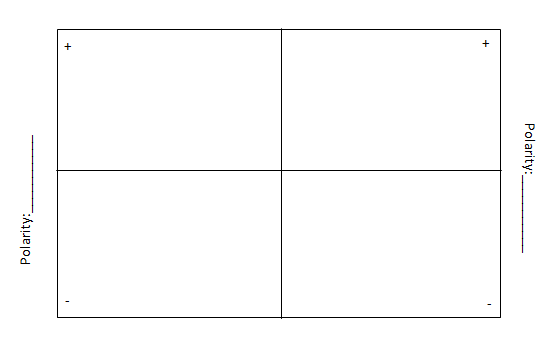
A template for a polarity map is shown in the following graphic. The strategic-operational tension is shown on the left and right. Note the symbols in the corners. The “+” sign is a place for capturing the advantages of that pole, and the “-” sign is for the disadvantages. Thus,

  • The upper left is advantages of strategic focus; the lower left is disadvantages of strategic focus.
  • The upper right is advantages of operational focus; the lower right is disadvantages of operational focus.

Here is a completed polarity map for the strategy-operational tension. Examine the perceived advantages and disadvantages of each perspective. Notice the presence of items in each of the four quadrants: it illustrates a somewhat complete picture of operations and strategy. Notice the upsides and downsides of each perspective; neither is perfect.

When People are Polarized

People are “polarized” when they only see the upsides their position [on the polarity map] and the downsides of the opposite.

The following graphic shows two related polarity maps. The top graphic shows the polarized view of the operational perspective. Operational managers take pride in accomplishing their duties, and things that distract are not welcome. The lower graphic illustrates the polarized view of the strategist. They want to increase the success for the future, and regard the operational view as risky (over the long term).

The polarization increases when a polarized party avoid contact with the other party or view them as an antagonists.

One important benefit of a polarity map is,

A polarity map helps people to see the big picture.

How to Gain Support for Strategic Focus

Here are the steps:

  1. The strategist has to acknowledge the value of holding an operational focus (the upper right quadrant).  This is absolutely vital for change agents to understand! Operations people may not see the big picture, but they know they run their piece of the business model.
  2. The strategist has to acknowledge the disadvantages of a strategic focus (the lower left quadrant). You have to assure the operations person acknowledges your understanding of their perspective. Steps one and two should relax the tension. You are ready to gently introduce the reasons for more strategic ways of thinking.
  3. Now, as Steven Covey advises, we “seek first to understand and then be understood.” Now, introduce the upsides of the strategic focus perspective and test for agreement:

“The focus of strategy is to create and sustain competitive advantage.
Do you agree with this statement and its importance to our organization?”

Often, people only see the pieces in isolation. As a change agent, you have to help each position recognize the value proposition for the organization both at present and in the future.

You are now in a better position to explore common values and aims.

Tensions to Manage

The organizational goal is to stay in the upper half of the polarity map. Recognize that there will be tension between the two poles. Sometimes there will be more emphasis on operations and sometimes more on strategy. Be prepared to cycle back and forth.

Recognize, too, that the downsides are natural and unavoidable. When the downsides of the polarity become noticeable, it is time to shift energy to the opposite pole. For example, when you start to experience complaints about strategy, it is time to revisit operations. When you start to see the dysfunctions of the operational focus (too many projects and conflicting priorities), it is time to invest more energy in discussions about strategic alignment.

The key, of course, is balance.

Strategy is not the solution to the problem of operations, and operations is not the solution to the problem of strategy. Remember, there are few problems to solve. Rather, there are tensions to manage.

How do you get people to see the big picture?

Posted in Strategic Planning Issues for Strategic Initiatives, Strategy Coaching and Facilitation, Strategy, Ambiguity, and Strong-Minded Thinking, Transforming the Organization | Tagged , , , , , , , , , , , , | 6 Comments

Strategy-as-Story: The ABCDE Model

Many people find the ABCDE Model* to be a very useful model for understanding the flow of strategy from the beginning to the end of a cycle of strategic planning/execution activities. The model is illustrated in the nearby graphic and described below:

AAssessment of current situation. This element involves scanning the external environment, competitive scanning, assessing the current situation; and clarifying perceptions of problems, needs, and opportunities. I provided two useful ideas for this sensing environmental context in this earlier article.

BBaseline the gap. This element involves identifying performance gaps, and evaluating trends.

CComponents of strategy. Example components of strategy include common concepts like core competencies, values, mission, vision, metrics, goals and objectives, portfolios, and processes. Vision is the most important of the components (in formulating and executing a strategic initiative). This describes the point where managers would select and fund strategic initiatives as a ‘C’ component.

DDelivery of component. This is the delivery of the strategic initiative, as well as other programs, projects, and operational work. As part of this, executives will formulate action plans; benefits capture plans, targets, standards, and metrics.

EEvaluation of progress. This includes review of progress, reporting, tweaking of goals, corrective actions, and learning.

You could think of ABC as the process of strategy formulation and the DE as the strategy execution piece. (For the record, I think it is unhelpful to separate strategy formulation and execution; both require strategic thinking.)

Chartering Strategic Initiatives: Steps C & D

한국어: 장승업의 전(傳)-인물도(人物圖), 자본담채, 국립중앙박물관 소장 Engl...

Image via Wikipedia

The process of identifying and chartering a strategic initiative falls somewhere in the C or D area, depending on the organization. The process is this: the executive team considers the gap between the current state and future state and develops answers to this question, “What are the few critical programs that allow us to close our most important performance gaps? The answer is to charter one or more strategic initiatives focused on achieving each critical outcome.

The strategy team then selects and funds the strategic initiatives.

The “Story Arc” and Story Telling

Through the ABCDE model, you can position four important questions in the organization’s narrative arc:

  1. Where is the organization at? As I wrote in tip #2 on backstory (see top of page for link), you have to know the background of the strategic initiative.
  2. Where does it want to be? The vision statement is a crucial tool that needs to be understood and agreed by others.  Consult this article on socializing vision statements for some useful advice.
  3. How will the strategic initiative team close the performance gap? The short answer is, “We will close the performance gap by applying resources and provide program leadership.”
  4. How will the strategic initiative team measure and report its benefits? The short answer is, “We will identify the vital metrics of most importance to strategic stakeholders and communicate them per our program governance strategy.”

Storytelling is a valuable strategic leadership tool. Stories – in their simplest form – involve a beginning, a set of activities, and a conclusion.

When organizations “set strategy,” they start (the beginning of the story) with strategic inputs, perform some activities, and conclude with some sort of learning.

An Example

Here is an example script for telling the strategic initiative story. You should be able to find all elements of the ABCDE model in it:

My organization found its financial performance slipping versus expectations, due to changes in the external environment that affect the entire industry. The organization developed a strategic intent that went beyond survival, to thriving. The changes involve creating a more coherent value proposition that will cause redesign of the elements of the business model. Accordingly, executives chartered and resourced this strategic initiative to close the performance gap. Our strategic initiative will incrementally provide benefits that support the balanced score card metrics. We plan to complete delivery of targeted benefits in 24 months, and close the program.

Notice how this script does not belabor projects or deliverables, and instead focuses on strategic context and delivery of benefits to stakeholders. Does this suggest an idea you can use?

* Thanks to Matt Evans for sharing the ABCDE model.

Posted in How to Improve Your Story Telling Chops, Strategic Planning Issues for Strategic Initiatives | Tagged , , , , , , , , , , | 2 Comments

A Master List of Questions for Strategic Initiatives

I believe that an essential leadership skills is the practice of asking more and better questions, and asking them in a professionally-skilled manner.  It is important because:

Leaders lead by asking questions.

Many of my clients and students have asked for a single list of good questions.  So here are over 80 questions, organized into three categories.

I grouped those questions that are part of a more sophisticated probe into a string.  In most cases, the questions are contextual; I selectively inserted “Read More” links to lead you to articles that would help you understand the why and how for the question.

A Do and Don’t recommendation:

  • Do use this list to improve your skills at inquiry and strategic thinking. The best questions are “informed questions” that are asked in a specific context.
  • Don’t use this list as a checklist.

Greg’s Master List – Questions for Setting Strategic Path Finding

If we are successful, how do we appear to our investors/owners? To achieve our vision, how must we appear to customers? To satisfy our customers, at which processes must we excel? To achieve our vision, how must our organization learn and improve?  Read more.
Why are we doing this? Who needs to be involved? What exactly are we going to do? When are we going to do it? Read more.
What is the impact you want to have? Considering the competition, what change in direction is needed to realize the impact? How will we need to change the thinking in our organization?
What are you deeply passionate about? What can you be best at? What drives your economic engine?
What is portfolio management?
What category of innovation is this (superficial, feature enhancement, solution enhancement, breakthrough, or disruptive)?
What are the strategic pillars that support the vision? Read more.
What are your leading and lagging performance indicators?
Are the statements in the strategy document coupled to either a problem or an opportunity?
Where does the money come from? What are the revenue streams? Where does the money go? What is the cost structure? Read more.

Greg’s Master List – Questions for Betterment of Risks, Issues, and Decisions

What type of decision is this? Read more.
What is the crux of the matter?
What do I want to achieve, preserve, and avoid?
If this is the strategy, what does it imply for implementation?  What are the opportunities for synergy?
What are the strategic assumptions?
What are you concerned about?
Are we facing ambiguity or uncertainty? What kind of ambiguity is present (outcomes, priorities, metrics, and methods)? Read more.
What happened to cause this {disaster or delight} scenario?
How important is it to get the decision right? If wrong, what are the consequences? Are we considering the long-term and systematic consequences? Are we considering our stakeholders? Is the decision reversible?
Is this a problem or an opportunity? Of what is this a part of? Where does it sit on the ladder of abstraction? What are the boundaries between these and other related concepts?
What are the likely consequences of this decision? How likely is the given consequence of a risk event? Can I manage the adverse consequences [for risk events that I have chosen to accept]?
Why didn’t I know? Why didn’t my team know? Why wasn’t I told? Why didn’t I ask?
What are the mistakes I must not make? What are the mistakes that others must not make? What resources do I have to deal with the unexpected? Read more.
Are we asking the right questions?

Greg’s Master List – Questions for Elaborating Requirements, Solution Designs, and Value Propositions

Who are the stakeholders?
What is your pain? Who else has the pain?
What are the seven most important things to know about your job?
What is the future state? Is it to maintain a function, add a function, or increase performance of a function?
What is the customer experience? What is a bad experience? What do we do that annoys important stakeholders? What is a good experience? What do we do – or could we do – to delight people?
What is being bought and what is being offered?
What is distinctive about the offering?
What does the user need to be able to do? How well do they need to be able to do it? How will you verify it?
Are we measuring the right things?” What are the right things to focus on? What are the right actions to focus on?
Where have others found similar problems, opportunities and solutions?
What barrier, if removed, would allow us to make amazing progress?
Which of your many duties is most essential to your organization’s performance? How do you know if you are doing a good job? Compared to today, what do you need to be able to do better tomorrow? What do you want to be different a year from now? Read more.
How does the stakeholder interact with elements of the business model that drive revenue streams or the cost structure?  Where do they spend most of their time?
What are the actions that inhibit vision development and problem solving?
Is there any question that I should have asked you that I haven’t asked?  Read more.

Greg’s Master List – Strategy-as-Story Questions

What is the Strategic Initiative Backstory?
Can you walk me through the background and your thought process?” Read more.
Given this set of activities, what is the most likely outcome?
What’s Scary, Weird, Stupid, or Hard? Read more.
What do we know? What don’t we know? How do we find out?
How do you feel about ______?
What happened? What am I feeling? Who am I?

~~~

Disclaimer: I am not the author of many (perhaps most) of these questions. I often hear good things from others and make a mental note, so my apologies to those who are not cited as references.

What are some other good questions for leading strategic initiatives?

Posted in Competencies of Strategic Initiative Leaders, Useful Practices & Management Tools | Tagged , , , , , , , | 3 Comments

HSBC’s Powerful Idea: Separate “Change the Business” from “Run the Business”

A simple, powerful idea for portfolio management

Observers of strategy have long recognized the tension between operations and transformation: How to balance the present and the future? Finding a balance between the two polarities is a core challenge of strategic management.

The dilemma for managers is this: On one hand, there are endless operational challenges.  A common jargon is the “lights on” project, which is a project intended to accomplish just that: keep the lights on so the business can keep running.  On the other hand, companies need to experiment and innovate with business models. Failing to do so puts the future of the enterprise at risk.

How HSBC Balances Operations and Strategy

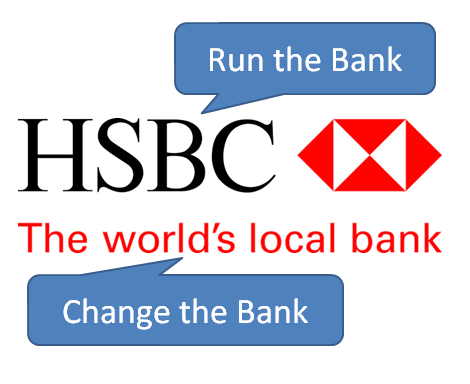
HSBC is one of the largest banks in the world. HSBC categorizes projects as either 1) run the bank (I often substitute the word business), or 2) change the bank (business).  How sensible!

The guiding philosophy of HSBC’s portfolio management strategy is this:

  • Most projects fall into the Run the Bank (Business) category. These are projects that are meant to support the function of the bank as it stands today, often with the acronym BAU for Business as Usual. Current HSBC examples are supporting the bank’s goal of “ever greening” and another is compliance with new regulations.
  • A few, focused projects fall into the Change the Bank (Business) category. These business transformation projects are changing the way HSBC performs a process – or adding a new functionality. Compared to the “run the” projects, these projects require more sophisticated project management.

Interestingly, the “ever greening” that is now a run-the-business concept is the operationalization of a strategic initiative: to become the first major bank in the world to commit to going carbon neutral (announced in December 2004).

Funding the Project Portfolio

HSBC has used this “run the” and “change the” to align its $5 billion annual spend in IT with its business drivers. Examine the nearby graphic for one example. Notice that the “run the” proportion of Information Technology funding from 2005 to 2008 was approximately 70%.

About 70% of the portfolio is “Run the”

HSBC’s use of the “run the” and “change the” continues and is recognized at the highest levels of the organization. For example, its May 2011 presentation to investors reported performance improvement opportunities in both Change the Bank and Run the Bank categories.

Aligning with Strategy for Growth

Smart companies prioritize for strategic alignment for growth in targeted sectors. A HSBC manager explained to me,

“The Bank gives priority to Change-the-Bank projects because the Bank wishes to be able to grow in new market sectors. The classification allows our organization to start projects that will provide the greatest benefit to the Bank.”

Managerial and Leadership Lessons

Consider these three points:

  • The HSBC model provides a simple first cut for identifying the role of strategic initiatives: Strategic initiatives are a change-the-business tool. They compete with   run-the-business imperatives for resources. Thus,….
  • Budgeting for operations must be balanced with budgeting for strategic change. From the data in the prior graphic,  I infer that HSBC invests about 30% of its budget in transformation. Budgeting and accounting decisions and conventions have consequence! A strategic initiative is likely to be found somewhere in the 30%, and it is in competition for funding with operational imperatives. If the strategic initiative leader understands the follow-the-money story (see the link below), they can better create a compelling benefits proposition for operational leaders.
  • All organizations face and must answer the question: What is strategic alignment? Is it operating within the current business model? Or is changing the model?  This is a big challenge for strategic management within organizations.

  Do you agree that there is a tension between “run the business” and “change the business?”  How else can this tension be managed?

Posted in Program & Portfolio Management, Success Principles for Strategic Initiatives | Tagged , , , , , , , , | 7 Comments

How to Be Strong Minded (3 Capabilities and 5 Tips for Strategic Thinking)

| Read Part 1 | Read Part 2 | Read Part 3 | Read Part 4 | Read Part 5 |

Strong minds and muscles function in practical ways

It is useful to define strong mindedness through this analogy: A strong body has muscle fibers that function by contracting; the better they perform the function of contracting, the stronger the muscle. Similarly, the mind functions to perceive information, structure it for recall, and combine it to produce new concepts. The better the performance of these functions, the stronger the mind. This analogy offers a straightforward characterization of a strong mind,

Strong minds produce strong ideas.

There is a secondary characteristic of a strong mind found in the synonym of robustness. In systems engineering, robustness is the characteristic of being able to continue to function despite failure of some part of the system. As an example, aircraft have redundant and parallel technologies for critical systems. Since strategic initiatives are characterized by complexity and ambiguous information, we should include this characterization of strong mindedness,

Strong minds do not fail.

Through observation and study of strong-minded strategists, I can offer three competencies:

1.       Strong-Minded Leaders are Good at Probing and Sensing

Strong minded leaders work to gain a holistic and integrated view of their situation. They are comfortable with asking conceptual questions that help to identify the different dimensions and relationships:

  • Is this a problem or an opportunity?
  • Of what is this a part of?
  • Where does it sit on the ladder of abstraction?
  • What are the boundaries between these and other related concepts?

In many struggling strategic initiatives, I find that people have a difficult time gaining perspective and categorizing. Thus, one of my favorite questions for strategic thinking is,

What is the crux of the matter?

The answer to the what-is-the-crux question can be found in one of four categories:

  • Self – I might be distracted or lazy or apathetic.
  • Others – Others might also be distracted, lazy, or apathetic. Or they may have their own agenda for defining the problem and solution.
  • Events – External changes in the markets might cause people to reprioritize their work, affective my ability to plan and execute the strategic initiative.
  • Context – The organizational culture filters out data that does not agree with preconceptions.

Actually, all four areas may contribute to the difficulty of finding the crux, but typically there is one dominant area. I have found that once you can find and (get others to agree on) “the crux,” you can get unstuck.

As I have pointed out in earlier articles, strategic thinkers have a skill in tolerating and managing ambiguity.  For example, in Part 4, I explained the importance of sensing the difference between uncertainty and ambiguity (and I provided some example questions that will help you do this).

2.       Strong-Minded Leaders Imagine the Logical Future Consequences

Strategic thinking is not the same as critical thinking.  Critical thinking is the application of analysis and logic; seen as step by step or cause-and-effect relationships.

Strategic thinking adds to critical thinking the ability to imagine possibilities; it is future oriented.  Strong minded thinkers are comfortable with asking questions that force informed speculation. Here are three examples:

  • What are the likely consequences of this decision?
  • How likely is the given consequence of a risk event?
  • Can I manage the adverse consequences [for risk events that I have chosen to accept]?

A four star general pointed out that one of the essential leadership competencies is to be a good anticipator. Through a strong intellectual understanding of the situation, you gain the judgment that helps you distinguish the important from the unimportant. This presents to you the opportunity to shape issues (rather than having the issues shape you).

3.       Strong-Minded Leaders Look for Opportunities to Apply Ingenuity

Ingenuity is the pragmatic application of imagination to solve a problem or exploit an opportunity. It comes from accumulating relevant knowledge, merging into that accumulated new knowledge and then conducting a determined search for possibilities.

Here are two good questions for fostering ingenuity:

  • Where have others found similar problems, opportunities and solutions?
  • What barrier, if removed, would allow us to make amazing progress?

Five Tips for Mental Robustness

Earlier I wrote that a strong mind does not fail. These tips will help you avoid common failure modes for thinking:

  • Strong-minded people avoid making mistakes. For more, read my article on The Compact Approach to Strategy. This approach suggests that you identify possible mistakes that you and others could make. Some weak-minded mistakes would be simply to fail to ask some of the questions listed above.
  • Strong-minded people have emotional resiliency. Resiliency is the quality of maintaining an emotional perspective that keeps your mind functioning. I have seen many people get overwhelmed by things: information, grief, hurt feelings, and change. Strong minded people do not let anger or fears destroy progress.  A key skill for resiliency: detachment.
  • Strong-minded people have a capacity for self-reflection. When they criticize themselves, it is in the spirit of growth cultivated by the desire for performance.
  • Strong-minded people have the ability to generate alternative solution pathways, as I described in the article on the Six Traits of Strategic Initiative Leaders and How Google Will Save the News. They try numerous different strategies, knowing that some will work and some will fail.
  • Strong-minded people have an ability to balance action with contemplation.  As I frequently say to audiences,

Action without reflection is impulsiveness.
Reflection without action is procrastination.

Good strategic initiative leaders are strong minded, strategic thinkers.

Do you agree with my two characterizations of strong mindedness (strong ideas and resistance to failure)? Have you applied any of them?  Did I miss anything?

Gregs new book available now

Posted in Strategy, Ambiguity, and Strong-Minded Thinking | Tagged , , , , , , , , , , , | 7 Comments

Why Your Organization Will Perform Better With Fewer Strategic Initiatives: Six Bits Evidence

The Russians have a saying, “If you chase two rabbits, you won’t catch either.”

The lesson of focus and choice is certainly a driver of success with strategic initiatives. Effective leaders have the discipline to focus, choose the best target, and pursue: it is the #1 characteristic of outstanding performers.

Fewer Initiatives Means Better Organizational Performance?

I am often asked, “Is there a correlation between the number of strategic initiatives and good organizational performance?”

The answer is a “qualified yes.” In this article, I will present six bits of evidence that support the commonsense notion that executives need to “pick the rabbit” for the organization to chase.

However, the academics have yet to establish irrefutable proof that fewer projects lead to better profitability. Read on and decide for yourself!

1. Few Initiatives = Top Tier in Industry; Many = Bottom Tier

Booz & Company collected data from 1813 C-Level respondents from firms worldwide. Booz’s data reveals:

  • Firms that select a fewer priority initiatives are 16% more likely to be in the top tier of their industry than those who have no priorities or many priorities for initiatives. The data suggest that the number of strategic initiatives is optimal in the range of three to six programs.
  • Firms that have many “priorities” (or no list of priorities at all) are 10% more likely to find themselves near the bottom of their industry.

Booz states this conclusion:

As an executive team’s priority list grows, the company’s revenue growth declines relative to its peers.

2. “Far Too Many Projects” → “Best Projects Starved”

Dr. Robert Cooper and his colleagues at McMaster University conducted numerous studies of the methods and results of new product portfolios over the past two decades. They conclude,

“Most firms confessed to having far too many projects for the available resources. The result is that resources are spread very thinly across new product projects, so that even the best projects are starved for people, time, and money. The end result is that projects take too long to reach the market. The bottom line is that there is a lack of focus, which creates a plethora of other problems.”

3. A Case Study from Harvard

Harvard University’s Steven Wheelwright and Kim Clark have written a seminal book, Revolutionizing Product Development: Quantum Leaps in Speed, Efficiency, and Quality. In one chapter, they examine the project portfolio of a company they call PreQuip. They note the problems of too many projects and no prioritization:

“By piling on project after project, failing to identify critical projects, and succumbing to short-term pressures, they [top management of PreQuip] had systematically underinvested in the most important projects for the company.”

They continue,

“The problems at PreQuip are not unique. Most organizations fail to realize the strategic potential in new technology or markets and the next-generation projects because there are too many projects, and because they pay too little attention to the strategic mission of the development effort and too much attention to short-term pressures.”

Wheelwright and Clark conclude,

“In PreQuip’s case (and in the case of every other company we have studied), the difficulty and significant of those choices have made strong leadership from strategic management imperative. Without that leadership, organizations that have habitually overcommitted themselves will have great difficulty killing and postponing projects, or resisting the short-term pressures that drive the organization to spend the bulk of its resources ‘fighting fires.’”

4. “The Most Frequent Trap is Initiative Overload”

Alan Brache and Sam Bodley Scott’s book, Implementation: How to Transform Strategic Initiatives into Blockbuster Results, is one of the first books to address the management of strategic initiatives. They provide more reinforcement for how initiative overload undermines strategy and creates waste,

“The most frequent trap into which organizations fall is initiative overload. A business, regardless of its nature, size, complexity, and infrastructure, has a finite project capacity. Money is limited, person-hours are limited, mind share is limited, and the change-absorption bandwidth is limited. Unaware of their organization’s limitations, executives frequently launch more initiatives than can be effectively and efficiently implemented. The typical outcome? Twelve initiatives are adequately implemented and three end up as road kill. A better result? The five most pivotal initiatives are spectacularly implemented.

5. Here is The Death Spiral

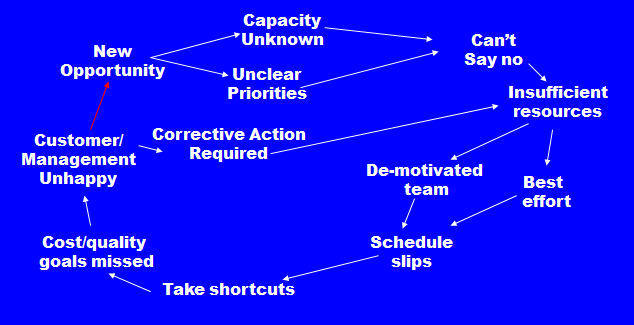
The following diagram was prepared by a manager at a Texas Instruments to help his executives understand what was happening.

Start in the upper left with “new opportunity” and follow the arrows to see a system story of how piling on projects on insufficient resources causes shortcuts that affect quality that creates the need for more projects.

This causal loop diagram shows a common organizational problem: too many projects for the resource pool. This diagram illustrates decision making as a system, where accepting too many projects creates a “death spiral.”

6. Nodding Heads

Finally, I will share a personal experience that shows that overloading the project pipeline is a real significant pain.

I am frequently in front of audiences. I will say,

“Executives tell me that they believe that people will speak up when they are getting overloaded with work. However, most project managers are afraid to speak up because they fear that expressing their limitations will be perceived as a sign of weakness. Thus, the piling on continues.”

As I look at the audience, I often get nods of approval. The message that project participants most want executives to hear is that too many projects and unclear priorities cause frustration. People will come up to me and say, “I know exactly what you are talking about because I’m living it. Then they ask, “How can a junior person speak “truth to power?”

My first answer is this, “Here is what is happening:

Executives and practitioners are operating out of different mental models and not telling the truth to each other!”

How? We need to arm ourselves with facts, and have the courage to share those facts with people who have the power to set organizational priorities.

Conclusion: High Performers Focus on The Vital Few Rather than the Trivial Many

World class organizations focus on the vital few projects, instead of the trivial many. If you want to improve your revenue and profitability performance, you will get better performance by limiting your portfolio to a few key strategic initiatives. And it’s worth abiding by the definition: not everything is a strategic initiative. As it becomes clear which are the strategic initiatives, it becomes easier to give them sufficient resources and the best of leadership.

If you are chasing more than one rabbit, you are going to end up exhausted and hungry!

Do you have any additional evidence about the relationship between number of initiatives and performance to share?

Posted in Program & Portfolio Management, Strategic Planning Issues for Strategic Initiatives, Success Principles for Strategic Initiatives | Tagged , , , , , , , | 6 Comments