Resolving Ambiguity and Uncertainty (Strategic Thinking – Part 4)

Uncertainty + Ambiguity & Strategic Thinking

| Read Part 1 | Read Part 2 | Read Part 3 | Read Part 4 | Read Part 5 |

Ambiguity and uncertainty are different concepts that affect the execution of a strategic initiative. As I explained in earlier articles (A Fight With Ambiguity, Framing Decisions, and Two Tools for Strategic Context), ambiguity has to do with multiple meanings and is an essential quality of strategy formulation.

Examine the graphic at the top. The picture on the right is titled, “My Wife and My Mother-in-Law,” (W.E. Hill, 1915). It is an example of a style called “pictographic ambiguity,” because it cleverly incorporates two images. If you can’t see the two portraits, notice that the chin of the young lady is the nose of the old woman.

Uncertainty has to do with a lack of precision in estimates, and it is the focal point of classic risk management because it has to do with an event, a probability and an impact.

For an example, examine the left side of the graphic. It is a hurricane forecast for 2005’s devastating Hurricane Katrina. This graphic is the output of a computer model of the
storm’s path, showing probable position at different points in time in the future, based on meteorologic data, physics, and sophisticated computerized forecasting models.  The graphic illustrates a “cone of uncertainty.”

The Questions Leaders and Managers Ask

Leaders lead by asking questions and those questions reveal priorities and mental models.  Given the distinctions, here are two kinds of questions that you might ask:

  • You ask explicit questions. In this instance, you seek answers that reduce uncertainty.
  • You inquire to find new perspectives. You wonder if you are asking the right questions.  Here, you seek to reduce ambiguity.

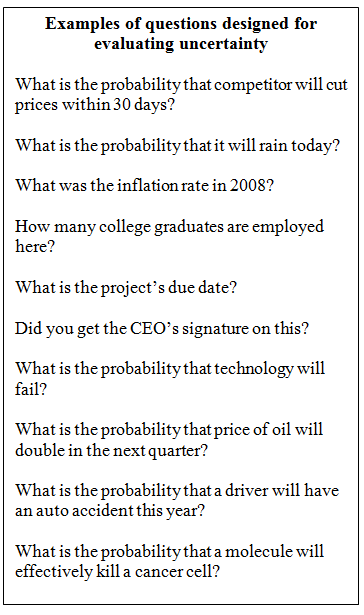
The two text boxes provide examples of questions that reduce ambiguity or uncertainty.

Ask these questions to get a handle on ambiguity

Both kinds of questions are important and useful. However, from my experience, the questions that address ambiguity are those which make or break strategic initiatives.

Ambiguity, Schm-ambiguity!  The Paradox of Ambiguity Avoidance

People in organizations are  well practiced at recognizing and working with uncertainty.  In their managerial role, they make budgets,  establish prices, forecast results, and make decisions based on limited  information.

Many people are practiced at  ambiguity avoidance and work in well-defined processes (that allow uncertainty,  but not ambiguity). Because they are not exposed to ambiguity they lack the knowledge and skill to recognize it. What a paradox!

You will find people who will  be dismissive of the semantic. It is true that defining distinctions between  words can get tedious. However, communications are an essential competency; we must pay attention to language.

Tips for Managing Uncertainty

I have previously discussed  how to recognize and work through ambiguity. Fundamentally, you manage ambiguity  through sense-making dialogue and deliberation.
Fundamentally, the core of uncertainty management is to understanding the models you’ve selected.

A hurricane forecast involves  real-world data and experts. Leaders adopt an experimental mindset to cope with uncertainty and bias.  When you are making sense out of uncertainty you should:

  • Be data driven – Uncertainty  is reduced by gathering more data
  • Recognize that  models are weighted differently. This weighting reflects the developer’s  judgment as to the importance of different parameters.  All models have a bias, and the bias can be  mathematically understood.  That is why increasingly, you see hurricane forecasts that show the predictions of each of several models.

Often, there is wasted energy  in slicing and dicing the data. Watch for analysis-paralysis.  I faced this with a bunch of electrical  engineers at Motorola: I wrote a sign: the purpose of analysis is insight for improvement. The key here is that the insights need to help a decision  maker know where to focus their scare resources. Thus, the analysis needs to  generate insights, and those insights need to be valuable.

You now have an appreciation for the  distinctions of ambiguity and uncertainty. Do you see how both leadership and management apply to strategic initiatives?

Posted in Competencies of Strategic Initiative Leaders, Strategic Planning Issues for Strategic Initiatives, Success Principles for Strategic Initiatives | Tagged , , , , , , , , , , , , | 9 Comments

Fast and Effective Decisions Drive the Strategic Initiative

English: A manually drawn decision tree diagra...

English: A manually drawn decision tree diagram drawn on a flip chart (Photo credit: Wikipedia)

Fast and effective decisions lead to fast delivery of benefits

The fastest decision is an impulsive decision, but impulsive decisions are often of poor quality. Because strategic initiatives are complex, an impulsive decision is not desirable.  We need to balance the need for decision speed with need for decision quality….

The decision needs to be an effective decision as well as a fast decision.

What is an effective decision?  People commonly answer that a good decision is one that yields a good result. The problem with this criterion is delay: we have to wait for the result to know if the decision was good. As leaders, we need to consider decision making in light of unclear consequences that are experienced in the future: good decisions consider risk! Risk is defined as an uncertain event that will impact the endeavor in positive ways (e.g. opportunities) or negative ways (e.g. threats).

A strategic mindset is essential. Specifically, I am always thinking about my decisions and the consequences of the decisions in terms of the definition of success and failure. I use this criterion to guide my decisions:

A good decision is one that increases the probability of success and decreases the probability of failure.

Another answer to the question, “What is an effective decision?” is that an effective decision is based on good information. Detail, data, and perspective can improve decision making. Those take time, so we need to ask ourselves:

  • How important is it to get the decision right?  If wrong, what are the consequences?
  • Are we considering the long-term and systematic consequences?
  • Are we considering our stakeholders?
  • Is the decision reversible?

Two Ideas for Making Better Decisions

One very useful idea for the strategic initiative leader is to but this list at the top of their meeting agenda: “Decisions to Be Made in This Meeting.” That is because (in my opinion) the most important purpose of a meeting is decision making.  Too much time is
wasted in information sharing, and a focus on decisions helps to create energy and progress on the key issues of the strategic initiative.

The second useful idea is to use decision trees to graphically present the choices available to the group. You draw a decision tree by drawing a box on the left side of the paper, and showing a series of branches diverging from this box where each branch is labeled as one of the decision alternatives.

An example: I was facilitating a strategy session for a new product introduction. People were confused by all of the issues and choices facing them, including questions such as these:  Do we make the key component or purchase it? Do we find an alternative component? I quickly drew and labeled a decision tree that labeled the many alternatives faced by the team. This graphic became a focal point for discussions, and as we discussed each one we started to estimate probabilities and consequences of different risks.  Through this discussion, we identified an optimal strategy for the launch.

How do you balance the tension between decision speed and decision quality? What tools do you use to drive decision making?

Posted in Strategy Coaching and Facilitation, Success Principles for Strategic Initiatives, Useful Practices & Management Tools | Tagged , , , , , , , , , , , , | 5 Comments

Interpreting Vague Strategy: The Compact Approach

Texting on a keyboard phone
Image via Wikipedia

This article describes three straightforward questions for people who find themselves in a situation where they are directed to take action, but the directive is vague and ambiguous.  This article will help strategic initiative leaders gain a useful perspective and avoid predictable problems.

In the ideal world, managers formulate strategic initiatives through a thoughtful strategic planning process, but sometimes they originate from a text message or a brief encounter with executives. In my experience,

brilliant strategic initiatives sometimes originate  from a top manager’s stroke of inspiration. This inspiration needs to be matched with someone who can run with the idea.

Executive inspiration provides opportunities and energies, but sometimes are  “half-baked ideas:” a top reason for project failure according to one industry observer.

Three Questions Compose the Compact Approach

I call this management tool the Compact Approach for Strategy Implementation. You ask these three questions:

  1. What are the mistakes that I must not make?
  2. What are the mistakes that others must not make?
  3. What resources do I have to deal with the unexpected?

The first two questions recognize that people make mistakes, and it is the response to mistakes that causes trouble. Individuals will sometimes take the wrong actions, sometimes act when they shouldn’t, and sometimes lack a good sense of timing. The questions encourage the individual to look inward, reflecting on his or her experiences, strengths, and weaknesses.

This important insight of articulating what not to do is a useful practice for implementing strategic initiatives.  Too often, strategists only plan for success and they make assumptions that everything will work perfectly. Of course, people are human and they make mistakes.

Too, an individual may respond perfectly to a situation, but find that mistakes by others can undermine the whole endeavor. Action or lack of action by others has profound effects on our success. We work in systems with lots of “coupling;” these interdependencies can cause minor mistakes to cascade into catastrophe.

Two Generic Mistakes

Here are two generic answers for the first two questions about mistakes that you might make or others might make:

  • One mistake is to over-react and do more than is necessary to fulfill the request.
  • Another mistake is to under-react and do less than is necessary to fulfill the request.

The Third Question is about Contingency: Always keep some “Mad Money”

The Compact Approach’s third question encourages us to acknowledge that we cannot anticipate all mistakes and all risks. Despite the best of planning, things will not go as expected. The commonsense here is,

Always have some resources set aside for emergencies and know who you will contact should you need help.

The Source of Mistakes: When you Ass-u-me, you Make an ….

One common mistake is assuming that we know and understand the words and acronyms in use.  If you get a written directive, look closely at each word for the semantics. If you get a verbal directive, confirm it in writing.  Pay attention to semantics.

Too, don’t hesitate to validate your assumptions.  Ask questions!

Good strategic thinkers are mindfully aware of verifiable facts as well as gut reactions.

Are you “heads up” and mindful of the possibility of the unexpected?

Posted in Useful Practices & Management Tools | Tagged , , , , , , , , , , , | 6 Comments

Balanced Score Cards and Strategic Initiatives

Balanced Scorecard Dark

Image by Jinho.Jung via Flickr

A leader of a strategic initiatives needs to have a working knowledge of balanced score cards (BSC). Academic research suggests that about half of all organizations are using BSC in some form, so it is now mainstream in strategic management.

Balancing Financial Metrics With Leading Indicators

Historically, bottom line financial measures have been the metrics of choice for organizations, large and small. Although these measures are important, they can contribute to shortsighted managerial decisions. For example, a company could cut its R&D budget to boost profitability, but that may deny its new product development pipeline innovative new ideas that will be the source of future profits.

The BSC concept is that while organizations should have finance measures, they need to balance them with non-financial benefits.

Financial measures are lagging indicators. We have to ask, what causes good financial outcomes?

Besides financial measures, the most-common BSC areas of interest are:

  • Customer value-add measures
  • Process improvement measures
  • Learning and innovation measures

In addition to the balance of finance and non finance, the score card enhances the balance of internal and external perspectives and the balance of past performance with the future.

The Right Questions for a Strategic Perspective

The balance of financial and non-financial concerns encourages consideration of four interrelated strategic performance questions:

  • If we are successful, how do we appear to our investors/owners?
  • To achieve our vision, how must we appear to customers?
  • To satisfy our customers, at which processes must we excel?
  • To achieve our vision, how must our organization learn and improve?

Notice that investors, owners, and customers are stakeholders – one of the important concerns of competent program management. Too, notice that vision and success criteria are also essential. Thus, make sure that you can answer these questions for your strategic initiative.

Where do Strategic Initiatives Fit?

There are several general approaches:

  • Take each BSC perspective and develop strategic initiatives that help achieve the vision
  • Use the vision and BSC to validate the selection of a strategic initiative and otherwise validate/develop the portfolio
  • Use the BSC to edit the scope of a strategic initiative
Posted in Strategic Planning Issues for Strategic Initiatives | Tagged , , , , , , , , , , , | 4 Comments

Pillars of Strategic Initiative Success

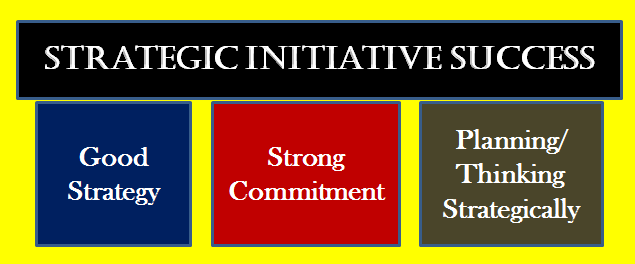
Strategic Initiatives Pillars of SuccessWhat are the pillars of success for strategic initiatives? C-Level executives answer that question with the following four items: good strategy, commitment of stakeholders, anticipating obstacles, and good program planning. I view them as three pillars that I call good strategy, strong commitment, and planning/thinking strategically. (Some people refer to strategic pillars as strategic planks.)

The findings in this article originate a study of 163 C-Level executives conducted by Financial Dynamics (a consultancy) in cooperation with Forbes Insights (part of Forbes Media). The investigators asked the C-Level executives this question,

“What was the primary reason why the strategic initiative met or exceeded expectations in terms of effort required and delivery of expected benefits?”

Pillar #1: Good Strategy

Having the “correct strategy,” was the top-ranked reason for strategic initiative success, cited by 33 % of C-Level executives.

A correct strategy for a strategic initiative is one that matches a problem or opportunity with the organization’s internal capabilities. Although strategic initiatives stretch the organization (see other postings on this site for examples), they should are achievable (thus, the strategy must consider the needs for funding, talent, focus, and other resources). As a rule of thumb, a strategic initiative is a one-to-three year endeavor.

So, what is a good strategy? First, strategy is characterized by the four attributes, listed below. Note that a good strategy performs on that attribute better than does a bad strategy:

  • Strategies bridge the past and future. Good strategies are future focused, with a set of coherent ideas and results that move towards that future state.
  • Strategies are both planned and opportunistic. Good strategies are have a budget, scope, and schedule but they are also open to opportunities that could not be anticipated by a methodology.
  • Strategies guide investment. Good strategies help managers make choices on where to place their scarce resources. If organizations had unlimited resources, they would not need a strategy.
  • Strategies involve coordinated actions by many people. A good strategy will have thoughtful linkages about the timing and scope of these actions.Richard Rumelt’s excellent book, Good Strategy/Bad Strategy explains that the three elements of a good strategy are: a diagnosis that defines the challenge, a guiding policy that describes the overall approach, and action that is coherent. Each stakeholder needs to commit to making the recommended action, and do so with awareness of others.

Pillar #2: Securing & Maintaining Stakeholder Commitment

Commitment is essential to success and is nearly equal to strategy as a success factor in the opinion of C-Level executives. Executives report that they have to spend considerable time working with middle-level managers to clarify direction and secure the needed changes in structure and behaviors.

I have written several other articles on commitment (commitment is the willingness to invest in the face of uncertainty), buy in, and leadership.

Pillar #3: Planning and Thinking Strategically

For this pillar, I combined two factors from the FD/Forbes study, “Anticipating Obstacles” and “Upfront Program Planning.” There are many obstacles, but the two that seem to catch the attention of C-Level executives are continuing instability in the economy and shifts in government policy. The upfront planning activity is the obvious need to integrate and schedule factors such as investment, leadership, teams, resources, and communications.

Do you agree with these factors?

Posted in Strategic Planning Issues for Strategic Initiatives, Success Principles for Strategic Initiatives | Tagged , , , , , , , , , , , , , , , , , | 3 Comments

Eight Distinctions between Portfolio Management & Program Management

A leader of a strategic initiative needs to have an expert understanding of program management and be knowledgeable in the principles and application of portfolio management. He or she needs to be able to intelligently discuss this question:
“What are the differences between portfolio management and program management?”

The following table shows differences along eight use dimensions. In the attempt to write in a concise manner, I acknowledge that I have simplified numerous complex concepts of theory and practice. My goal is to provide useful insights to strategic initiative practitioners.

Why Lump Together Project Portfolio Management and Program Management?

I mentioned that this is a complex topic. One complexity is that some practitioners use the term Portfolio Management to refer to both “Project Portfolio Management,” as well as what I call “classic Portfolio Management.”

It appears to me that Program Management and Project Portfolio Management have more similarities than differences; thus, I grouped them together and contrasted them with classical Portfolio Management.  Do you agree?

Within the project portfolio or program, managers make goal-oriented decisions that are consistent with an intended strategic outcome.  Each treats risk as uncertain events that affect the outcome and are subject to managerial control. The governance processes of Program Management and Project Portfolio Management are similar; for one example, both apply roll-up reporting of the individual components for the purposes of monitoring, control, and decision making.

I encourage you to place the term portfolio management into the search function of an online bookstore; you will get an excellent peek into the rich literature of portfolio management.

What About the Distinctions with Project Management?

The reader should also review A Concise Guide to the Difference Between Projects and Programs for more detail.

Implications for Leaders of Strategic Initiatives

The leader of a strategic initiative is accountable for delivering turning vision into results, and is navigating through considerable ambiguity with strategic thinking skills:

  • A core problem is that “strategic alignment” is only useful in the context of the kind of strategy under consideration. For example, managers of functional strategies tend to be pre-occupied with resource availability and getting work done with assigned resources; thus, strategic alignment and functional mission are nearly identical. Business-level strategies place a higher emphasis on strategic alignment as a selection criterion. I recommend that you follow the below link for definitions of the three types of strategies (functional, business, and corporate).
  • The most successful organizations have fewer strategic programs, and these programs are staffed with the best resources. These successful organizations are skilled at portfolio management; that is, they understand how to invest and disinvest in programs and projects.
  • Strategic initiatives are transformative and involve stakeholders that do not have training in program and project management concepts. All strategic initiatives are programs, but not all programs are strategic initiatives.
  • Experienced professionals don’t always agree on the terms and distinctions.  Standards in project portfolio management and program management are still maturing.

Do these distinctions make sense to you? How can this knowledge help you lead a strategic initiative?

Please bookmark this article with your social media. It is noticed and appreciated!

Posted in Program & Portfolio Management, Strategic Planning Issues for Strategic Initiatives | Tagged , , , , , , , , , , , , , , , , , , | 12 Comments

Use the Columbo Question to Get Strategic Information

columbo

Image by whatleydude via Flickr

The recent passing of Peter Falk (age 83) reminded me of one of my most productive techniques for gaining strategic information.

The question is best used in a situation involving interviews with other people, so bear with me as I establish the analogy.

Skillful Questioning

Falk’s Lt. Columbo is a Los Angeles detective investigating to a crime scene (typically a homicide). He doesn’t fit the cliché of the authoritarian lead detective, or the intellectual clue gatherer, or the smarmy and charming gadfly.  He attire and demeanor is famously rumpled; the word bumbling is often used to describe his style.

Every episode of the television program has a scene where Lt. Columbo is inspecting a crime scene and interviewing people associated with the victim. Lt. Columbo is well-practiced in the technique of the false exit: he begins to leave the scene, and is nearly out the door when he stops and turns around to ask a question. The question is prefaced by his now-famous tag,

Just one more thing,…….”

Lt. Columbo makes an observation about some inconsistency. The seemingly trivial, it turns out to be the detail will tie together the entire investigation and establish the culpability.

Strategic Information is Revealed

Now, here is the insight that you can capitalize upon: people will often reveal their important information at the end of a conversation.

Great insights appear when people
think that the interaction is over.

Therapists, salespeople, and consumer researchers repeatedly notice this when interviewing people in home visits and focus groups.  Don’t relax at the end of a session, be more alert.

You ask the Columbo question to take advantage of the principle that the best information might come at the end of a conversation. The Columbo Question is the last question you ask:

Is there anything that I haven’t asked you that I should have asked you?

It Works!

Try out the Columbo Question the next time you are searching for information. Here are some examples of useful information that I and others have discovered with the Columbo Question:

  • There are unrecognized stakeholders who are affected by a decision
  • There are unrecognized project elements that need to be included in the scope
  • People have serious doubts about a strategy, but don’t feel that they have permission to reveal those doubts
  • People have expectations for follow-up from the conversation that might include roadmap that lays out the next steps

Peter Falk’s portrayal of Lt. Columbo made this unassuming-but-determined character a genius at putting people at ease and exploiting the strengths of his own personal style. He brought a sense of curiosity and was sensitive to inconsistencies and incongruities.  He wasn’t intimidated by wealthy, powerful, or brilliant people.

How can you use Columbo Question to improve your leadership skills?

This post orginally appeared in the Linked2Leadership blogazine.

Posted in Competencies of Strategic Initiative Leaders, Useful Practices & Management Tools | Tagged , , , , , , , , , , , | 2 Comments

A Guide to the Three Types of Strategy and Business Model Scope

Strategic Initiatives Occur in All Three Types of Strategy

This article continues a series on interpreting strategy documents. It will give you a framework for determining if the scope of a strategic initiative is correct by identifying three types of strategy (see the graphic), and indicating how the definition of the business model can affect the scope of the strategic initiative.  You need to understand business models:

  • When you are leading a strategic initiative for executing a corporate-level strategy, you are creating a new business model
  • When you are leading a strategic initiative for executing a business-level strategy, you are improving several or all of the nine elements of a business model
  • When you are leading a strategic initiative for executing a functional level strategy, you are optimizing one or more of the nine elements of a business model.

The word strategy is ambiguous in many ways, not the least which is the distinction of corporate-level strategy, contrasted to business-level strategy, and functional strategy.

Corporate-Level Strategy

This kind of strategy is concerned with market definition: what businesses and markets do we want to be in?  A strategic initiative might be launched to answer that question, or more likely to realize the strategic intent of a new chosen business or market.

The Red-Ocean-Blue-Ocean metaphor has been popular over the last few years.  A red ocean is a market where competitors bloody each other up fighting for market share.  A blue ocean is an emerging, growing business arena; potential competitors have not yet identified it and the opportunity for success is large.

An example of corporate-level strategy:  The February 2011 announcement an alliance between Microsoft and Nokia Corp. The alliance involve Nokia will produce phones running Windows Phone 7, a recognition that Nokia’s investment in its own operating system has failed.  The alliance gives Microsoft access to the world’s largest phone maker and its huge mindshare—in many developing nations a mobile phone is known as a Nokia. The deal with Microsoft gives both Nokia and Microsoft a route to the future in the smart-phone market.

Business-Level Strategy

This kind of strategy is concerned with succeeding in chosen markets.

An example of a business-level strategy was Domino’s Pizza Turnaround which required all areas of the organization to pull together to achieve a simple understandable business goal: have a clear win against competitor in a taste test.

Functional-Level Strategy

This kind of strategy is concerned with making improvements to business functions that support business and corporate strategy.

Functional strategy include IT strategy, marketing strategy, IT strategy, human resources strategy, and operations.  Typically, documents portraying functional strategy will list estimates and plans for operating expenses, headcount, and continuous improvement.

As implied by the graphic, functional-level strategy is the foundation that supports both corporate-level strategy and business strategy. Many strategic initiatives are simply the implementation of functional strategies, but often a strategic initiative straddles numerous functions and businesses.

An example of functional-level strategy: In 2008, Swiss Life Group, a Zurich-based insurance company (ranked #373 on the Fortune Global 500 list) announced a change in its Information Technology functional strategy priorities. The implications of this was a decision to considerably scale back the number of IT projects in order to reduce costs through re-prioritization.  This was successful as shown in this November 2010 announcement,

“Swiss Life increased its net profit in the first half of 2010 over the prior-year period from CHF 139 million to CHF 269 million. This improvement is mainly attributable to the significant operational progress made.”

What is a Business Model?

The nine elements are identified in the boldface font below.

A business model is a strategic management tool that managers use to describe the creation, capture, and delivery of economic value, commonly called the value proposition. You can understand the value proposition as the answers to (and optimization of) these two questions:

  • Where does the money come from? What are the revenue streams?
  • Where does the money go?  What is the cost structure?

For more on this, see Osterwalder’s Business Model Canvas (you can find numerous illustrations with on images in your favorite search engine). The canvas includes the two above questions on cost and revenue and adds seven others elements (key partnerships, key activities, key resources, customer relationships, customer segments, channels).

One Reason Why Strategy Execution Flounders!

I don’t think that you’ll get too much argument that the priorities for selecting strategic initiatives should be in this order:

  1. Strategic Alignment
  2. Business Value
  3. Resource Availability

The problem occurs when managers miss the nuance about the three types of strategy and make too many assumptions about strategic alignment and the scope of change that is needed to (or within) the business model.  Too often, project portfolios are driven by less-strategic priorities such as ROI (a business value metric) or resource availability.

Two examples of poor understanding of strategic alignment. Google could have captured the social networking space before Facebook came along, but missed that opportunity.  Sony could have easily beat Apple to the digital music distribution market; but the strategic initiative leader reported, “I just didn’t understand the significance of the opportunity.” Clayton Christiansen has earned a reputation for his work on explaining disruptive innovation where companies continued to operate with old and entrenched business models instead of recognizing the appropriate use of “strategy innovation.”

An example of prioritizing resource availability over strategy.  I saw a strategic initiative where the program manager’s top priority was keeping programming staff utilized, rather than meeting the value proposition.  The initiative was cancelled after burning through several million dollars and delivering no value to the organization.

Business Model Innovation

When we are considering strategic initiatives, we are more concerned with what Fortune Magazine (June 13, 2011, page 27) wrote,

“In the good old days, a strong business model lasted for decades. No more. CEOs in almost every industry will have to innovate at their business’s deepest level.

~~

This isn’t just theory and semantics!  You need to have a working knowledge of concepts if you are going to accomplish a vision.  Do you agree?               

More good ideas:

Posted in Examples of Strategic Initiatives, Interpreting Strategy Documents, Strategic Planning Issues for Strategic Initiatives, Success Principles for Strategic Initiatives | Tagged , , , , , , , , , , , , , , , , , , , , , | 18 Comments

A Practical Tool for Gaining Program Management Insights

I call the nearby graphic the SIMple model (SIM = Strategy, Inquiry, and Metrics).  It shows three interrelated factors that can foster insights into a program.

Here are the definitions of each of the three elements:

  • Strategy – A useful definition of strategy is, “A set of actions based on a set of beliefs.”  The goodness of strategy can be evaluated through this statement, “The right actions on the right things.”  The “right thing” is a choice of focus on objectives, vision, or outcome. The “right actions” are the purposeful activities that move toward the strategic intent (vision). If you want more thinking on correct strategy, review this link.
  • Inquiry – This is the practice of asking more and better questions. The inquiry mode is useful for problem identification and resolution. Leaders lead by asking good questions.
  • Metrics – I define metrics as “measures that signal important information, which will foster appropriate action by individuals.”  They are the vital few indicators that focus attention. A metric is not the same thing as a measure. The practice of identifying a critical few leading and lagging indicators increases focus and attention.

There are obvious interactions between the three elements of inquiry, metrics, and strategy as suggested by the two-headed arrows in the graphic. They include,

  • Asking about the definition of strategic success naturally causes the topic of metrics to arise.
  • Asking questions about metrics helps to reveal the priorities. For example, metrics can help us evaluate the appropriateness of the selected strategy.  If metrics are few in number, then it sparks the question, “Are we measuring the right things?” We can develop leading indicators for performance and work on those.
  • The definitions of strategy and metrics naturally suggest questions. For example, What do people believe to be true? What are the right things to focus on? What are the right actions that logically flow out of beliefs and into results?  Are we measuring the right leading and lagging indicators?

Where to Start?

I’ve used the SIMple Model as a tool in many situations.  I find it best to start with metrics or with inquiry. If the team has been assigned specific performance objectives, we can identify the specific metrics that can allow us to develop a strategic initiative program.  See these two posting on outcomes and benefits for more detail.

The team can start developing a list of questions that will help it define its knowledge gaps, exercising the Chief Learning Officer role played by the program manager. The what about technique will provide some structure for this activity.

How can you use the SIMple model for your strategic initiative program?

Please bookmark this article with your social media.  It is noted and appreciated!

Posted in Program & Portfolio Management, Success Principles for Strategic Initiatives, Useful Practices & Management Tools | Tagged , , , , , , , , , , , , , | Leave a comment

Does Your Strategic Initiative Need a Fresh Perspective?

If you are facing headwinds in your strategic initiative, examine the situation from four leadership perspectives: storytelling, learning, integration, and decisions. (You can find an explanation of the four LIDS roles in this article). As an example, let’s look at the struggles of Angie, a program manager at an internet security firm. She wrote in an email, “I have a number of issues and problems with my strategic initiative.” She proceeded to describe her difficulties with her executive sponsors, priorities, reporting and the timing.

In complex situations that are typical of strategic initiatives, it is important to gain perspective and that is the benefit of the SLID roles. I asked Angie to spend 30 minutes on an exercise.  I asked her to use this template,

When I placed myself in the role of _____, I realized  ____.

The first blank is the role and the second blank is for elaborate the issues and possible solutions.

Read the following paragraphs for Angie’s realizations as she assumed each of the SLID roles.  Maybe you’ll find some useful ideas for the headwinds in your strategic initiatives.

Chief Storyteller Role

“When I placed myself in the role of Chief Storyteller, I realized my initiative was competing for ‘share of mind’ for many important stakeholders (and didn’t have much top-of-mind awareness). One reason was that it didn’t seem connected to the larger/longer narrative for the organization. I needed to get in front of people and have an effective conversation (listen and talk) with them about the strategic initiative.  I developed and delivered an elevator speech. The result was that individuals found that the story helped them make sense of the vision and their role in making it happen. Consequently, they individually and collectively showed more interest and enthusiasm for the initiative.”

Chief Learning Officer Role

“When I placed myself in the role of Chief Learning Officer, I realized that team learning was weak. We were struggling with ambiguities due to different perceptions of the nature of the problem, the opportunity, and the possible solution. I encouraged the delivery team to develop curiosity, ask questions, and learn the answers. As we probed into the nature of the unknowns, we found that several assumptions were invalid and that we needed to be more proactive about identifying and evaluating risks.”

Chief Integration Officer Role

“When I placed myself in the role of Chief Integration Officer, I found that my team needed a greater appreciation of the ‘big picture.’ I realized, too, that we needed a more systematic approach for identifying and characterizing the problem and solution elements.  We needed a better understanding of the relationship of each element to each other. We came to recognize that we had a number of failure points at system interfaces.

Chief Decision Architect Role

“When I placed myself in the role of Chief Decision Architect, I realized that we were stalled waiting for decisions or providing analysis. I needed to understand and establish the appropriate ‘decision rights’ to determine if I should make the decision (as program manager) or the project manager or an executive. I worked to involve the appropriate people and give them the pertinent information they needed for the decisions.”

~~~

Each of these four LIDS roles provides excellent insights and perspectives for the strategic initiative. Actually, the best order is not L -> I -> D -> S, it is rather L-> S-> I -> D (but the acronym is not as memorable) because ambiguity is better resolved with a mindset that values learning and storytelling. The integration role is about partitioning problems and solutions; it becomes more important as the organization starts to develop and evaluate options.  The earlier roles tend to provide facts, risk information, and intuition that are helpful for decisions.

What was Angie’s Feedback?

“The hardest thing was to quiet my mind and let my imagination and visualization work.  Regardless, it was an invaluable exercise and that helped me prioritize my action plans. I gained a renewed sense of determination to lead this strategic initiative and make it successful.”

 Let me know about your experience with this exercise!

Please bookmark with social media, your votes are noticed and appreciated:

Posted in Competencies of Strategic Initiative Leaders, Examples of Strategic Initiatives, Strategy Coaching and Facilitation, Useful Practices & Management Tools | Tagged , , , , , , , , , , , , , , , , , , , , , | 1 Comment