

Imagine that another person has started a crossword puzzle and handed it to you to finish. You take over with the hope that the existing answers are correct, but you can’t sure of the accuracy of the words.
It is an opportunity for you to show what you can do.
Horizontal Connections: Don’t Focus on the Solution, Focus on the Stakeholder
Horizontal connections are those that occur between common elements of other functions or with suppliers and alliance partners. As you review for horizontal connections, be aware of a typical flaw in found in many strategic plans:
The flaw is that the typical strategy document describes solutions and activities, not stakeholders and needs.
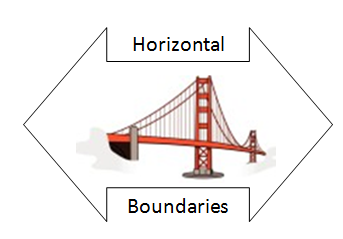
Success at a strategic initiative involves bridging horizontal boundaries
Some might argue that this is not a flaw; that the purpose of a “plan” is to list solutions and activities. The problem with describing solutions and activities is the ambiguity avoidance. People implement things “to the letter;” they then miss – or lose sight of – the underlying rationale for the strategy.
Leaders recognize ambiguity and probe for the contextual factors
behind decisions and strategic intent.
I’ve seen it happen repeatedly: Ambitious goals are lowered to the point that it is no longer a strategic initiative, just a technology-deployment project. Don’t de-scope or ignore boundaries.
Try this instead:
Focus on audiences and outcomes. Clarify the “need” as either a problem solved, or an opportunity seized. Build bridges and search for synergy.
For example, the VP of HR for a large company in the Travel/Hospitality industry presented his strategic plan, which contained several activities that would support the company’s growth strategies. The plan was approved and handed off to a project manager in the HR department. As time went by, little progress was made on strategic objectives. The turnaround came when this project was rolled into a strategic initiative program, and program management concepts were applied:
- The program manager led the reexamination of stakeholders and outcomes (in this case, the board of directors was holding executives accountable for generating new revenues for invested dollars).
- There was more emphasis placed on finding the best ideas from anywhere, not simply within the company. The project manager of the HR portion was forced to look at cross-functional concerns from the marketing and operations groups. Creative ideas were found by looking outside of the company’s existing product line.
The result of program management and improved leadership: The strategic initiative was able to establish a credible program for generating the business revenue growth.
Leaders Make Connections
By definition, a strategic initiative is boundary spanning. Here are some additional ways that you can make connections that might suggest opportunities to find strategic synergy:
- Person-person – Who are the people who have information, resources, and personal connections?
- Cause-effect – Given that you want a certain outcome, what are the drivers of that outcome?
- Supplier-customer – What interesting is going on with your suppliers and with your customers?
Synergy involves the accumulation and fusion of knowledge. Where can you find boundary spanning opportunities in your current endeavor?


 Leading Strategic Initiatives
Pingback: Strategic Initiatives Case Study: Hospital and Health Care – Part 2 | Leading Strategic Initiatives
Pingback: Validation: How to Get Strategy Right | Leading Strategic Initiatives
Pingback: Strategic Thinking (Part 2): Framing Decisions with the Four Types of Ambiguity to | Leading Strategic Initiatives
Pingback: Strategic Thinking (Part 2): Framing Decisions with the Four Types of Ambiguity to | objetoa.net
Pingback: Strategic Thinking (Part 1): A Fight with Ambiguity | Leading Strategic Initiatives
Pingback: Vice President, Director, Manager of Strategic Initiatives: Position Description Best Practices | Leading Strategic Initiatives